
Amazon Simple Email Service (SES) is widely known as a reliable, scalable, and affordable option for sending high volumes of transactional and promotional emails. Its pay-as-you-go pricing and dependable infrastructure mean it checks plenty of boxes, just not all of them.
If you are looking for more than a powerful sending engine, Amazon SES can feel a little sparse. Its interface is more functional than user-friendly, and features such as advanced analytics, marketing automation, and hands-on support are limited.
Postmark is one of the best Amazon SES alternative for businesses focused mainly on transactional email. However, the right choice depends on what Amazon SES is missing for your team.
Here is the quick breakdown:
- Postmark: Best for reliable transactional email
- Mailgun: Best for developers and flexible email APIs
- SendGrid: Best for combining transactional and marketing email
- Brevo: Best for small businesses and multichannel marketing
- SMTP2GO: Best for straightforward setup, support, and reporting
What Makes a Great Email Service?
An email delivery service is only as good as its ability to get your messages where they’re meant to be. That’s why email deliverability is such an important topic in email marketing. A reliable email delivery platform constantly works behind the scenes—keeping a good IP reputation, avoiding spam traps, and keeping sender trust rock solid. Without this foundation, even the best email campaigns might as well not exist.
But deliverability isn’t the whole story. Features matter, too, and what makes or breaks a service depends on your needs. For some, it’s powerful APIs and seamless integrations that streamline workflows. For others, marketing tools, audience segmentation, A/B testing, or analytics give campaigns their edge. The sweet spot lies in how well a platform balances features to feel truly well-rounded.
Then there’s the ease of use, a detail that can save you countless headaches. A simple setup and a dashboard can make all the difference. This is especially true for businesses without tech geniuses on staff, where a user-friendly platform becomes the real hero.
When all these elements come together, you’ve found a platform truly worth your trust and investment.
Top 5 Amazon SES Alternatives for 2026
Email platforms come in all shapes and sizes, each designed to meet specific needs. Whether you’re focused on transactional emails, full-scale marketing campaigns, or a mix of both, the “best” choice depends on what matters most to you. Is it rock-solid deliverability to keep emails out of spam? Or maybe advanced features like audience segmentation and detailed analytics?
Below, we’ll talk about five Amazon SAS alternatives that stand out in 2025. Let’s talk about what makes them the frontrunners and how they can help take your email strategy to the next level.
1. Postmark: The Developer’s Dream

Postmark is a go-to choice for businesses needing fast, reliable delivery of transactional emails. It’s built for businesses that often send password resets, order confirmations, and notifications and it focuses on fast, dependable delivery.
One of its best features is Message Streams, which separates marketing and transactional emails to keep deliverability high. With 45 days of detailed activity data, Postmark also offers great visibility and control.
It’s simple, volume-based pricing is a relief—no hidden fees, just clear rates. Developers love how easy it is to set up, and its responsive customer support gets consistent praise. While it doesn’t include marketing tools, this focus on transactional emails allows Postmark to truly shine in its area of expertise.
Pros:
- Exceptional deliverability for transactional emails.
- Transparent, volume-based pricing.
- Message Streams for better email organization.
- 45 days of message history for tracking deliveries, bounces, opens, and clicks.
- Friendly and responsive customer support.
Cons:
- No built-in marketing automation or campaign management tools.
- Limited analytics and no A/B testing.
What Makes Postmark a Great Amazon SES Alternative?
Postmark is easier to set up and manage than Amazon SES, with a more user-friendly interface, clearer message-level reporting, and responsive customer support. It is especially well suited to businesses that prioritize reliable transactional email and want strong visibility without managing a more technical AWS setup.
2. Mailgun: A Flexible Solution

Mailgun is a popular developer-friendly platform thanks to its powerful APIs and impressive scalability. It handles all kinds of email volumes, from small to enterprise-level. Mailgun offers an email validation service, which identifies invalid addresses and keeps your sender list clean. For businesses with large databases, this translates to lower bounce rates and better deliverability.
Mailgun offers tiered monthly plans with included sending volumes and overage pricing, allowing businesses to scale as their needs grow. Its detailed documentation and integration options make it a developer favorite. That said, shared IPs can sometimes lead to hiccups in deliverability, and the quality of support depends on your chosen plan.
Pros:
- Feature-rich APIs for sending, tracking, and validating emails.
- Scalable pricing that adapts to businesses of all sizes.
- Email validation that helps reduce invalid addresses and bounce rates.
- Extensive, developer-friendly documentation.
- Reliable for large-scale email operations.
Cons:
- Shared IPs may lead to occasional deliverability issues.
- Support options vary by plan tier.
What Makes Mailgun a Great Amazon SES Alternative?
Mailgun is a strong alternative for developers who want powerful APIs, detailed documentation, built-in email validation, and more accessible management tools than Amazon SES. It is especially well suited to businesses that need flexible, scalable email infrastructure without relying as heavily on the broader AWS ecosystem.
3. SendGrid: Marketing And Transactional
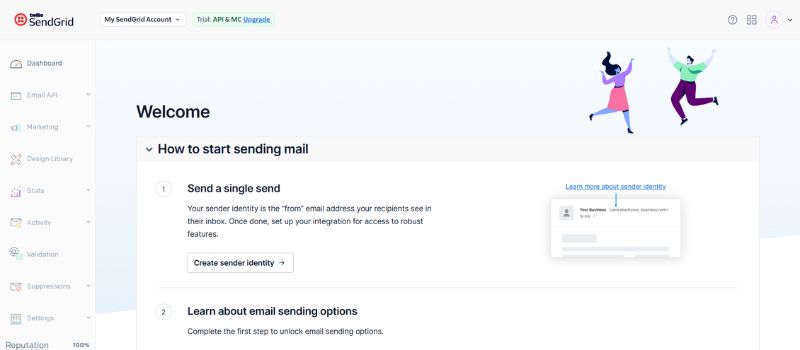
SendGrid by Twilio is a versatile platform that brings transactional email services and marketing automation under one roof.
It includes advanced analytics for tracking engagement and deliverability, alongside marketing must-haves like responsive templates and A/B testing. SendGrid integrates well into existing workflows with an easy-to-set-up email API that lets businesses handle their email in various ways.
SendGrid’s scalability is another plus, accommodating everyone from scrappy startups to sprawling enterprises. That said, customer support can be hit or miss—premium support is an option, but it comes at a cost that doesn’t sit well with everyone. Shared IPs can sometimes have deliverability issues, but still, these hiccups don’t take away from the platform’s impressive range of features.
Pros:
- Tools for both transactional and marketing emails in one platform.
- Advanced analytics for engagement and deliverability insights.
- Pre-designed email templates and A/B testing for simpler campaign optimization.
- Scalability that meets the needs of businesses at any stage.
- Good API integration.
Cons:
- Premium support comes at an extra cost.
- Shared IPs can cause deliverability issues.
SendGrid is a great SES solution that bridges the gap between marketing and transactional functionality with a platform that’s as scalable as it is feature-rich.
What Makes SendGrid a Great Amazon SES Alternative?
SendGrid is a strong alternative for businesses that want transactional email and marketing tools in one platform. Compared with Amazon SES, it offers a more accessible interface, built-in templates, campaign features, A/B testing, and engagement reporting, while still providing scalable email APIs for developers.
4. Brevo (formerly Sendinblue): The All-in-One Solution
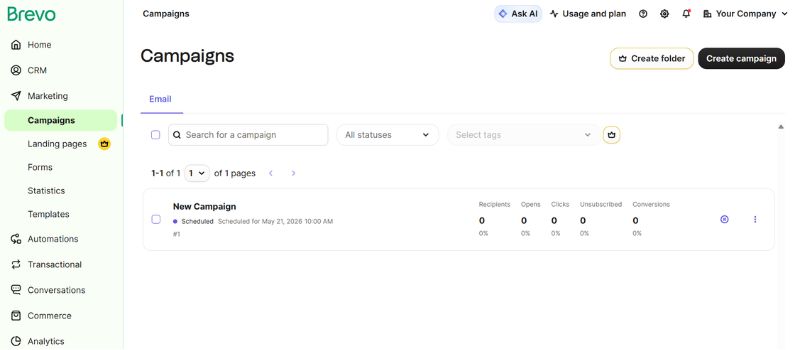
Brevo, formerly Sendinblue, combines email, SMS, and CRM tools into one multi-channel marketing platform. Perfect for businesses looking to streamline their communications, it even offers a free tier that allows up to 300 emails per day—a nice addition for small businesses or startups who want to test its capabilities. With great automation features and pre-built workflows for things like drip campaigns and welcome sequences, Brevo takes a lot of the heavy lifting off your plate.
Segmentation tools make Brevo particularly powerful, letting businesses focus on specific audiences with precision. The intuitive drag-and-drop editor makes email creation easy, even for beginners. That said, Brevo isn’t without its quirks—its email template library is limited compared to competitors, and the support on lower-tier plans might leave you wanting more.
Pros:
- Free tier with up to 300 daily emails—great for small businesses testing the waters.
- Combines email, SMS, and CRM tools in one platform.
- Automation workflows for drip campaigns and other tasks.
- Segmentation tools for precise audience targeting.
- User-friendly drag-and-drop email editor.
Cons:
- Template options may feel limited compared with some competitors.
- Priority email and phone support are reserved for higher-tier plans.
Brevo delivers a lot where it counts, so if versatility and affordability are what you’re after, it’s a solution worth looking into.
What Makes Brevo a Great Amazon SES Alternative?
Brevo is a strong alternative for businesses that want more than email infrastructure alone. Compared with Amazon SES, it offers a more user-friendly interface, built-in marketing automation, CRM tools, audience segmentation, templates, and multichannel features such as SMS, making it a better fit for teams that want to manage campaigns without relying on several separate platforms.
5. SMTP2GO: Simple and Reliable Email Delivery
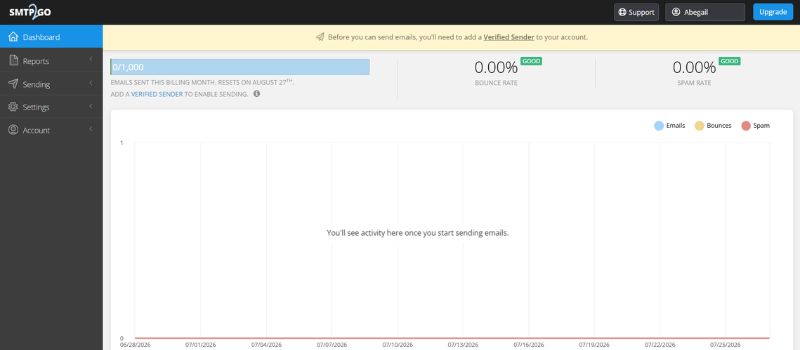
SMTP2GO is a user-friendly email delivery service built for businesses that want to send transactional and bulk emails without managing complicated infrastructure. It supports both SMTP relay and an email API, making it suitable for websites, applications, CRMs, business software, and connected devices.
The platform includes real-time reporting for deliveries, bounces, opens, clicks, and spam complaints, helping users monitor performance and troubleshoot sending problems. It also provides authentication tools, global data centres, and automatic routing designed to support reliable email delivery across different regions.
SMTP2GO offers a free plan for up to 1,000 emails per month, while paid plans use monthly sending allowances and start at $15 per month. Setup guides are available for a wide range of applications and programming languages, and paid customers can access ticket, live chat, and phone support.
Pros:
- Straightforward SMTP relay and email API setup.
- Real-time reporting for deliveries, bounces, opens, clicks, and complaints.
- Free plan for up to 1,000 emails per month.
- Global infrastructure and regional data-centre options.
- Phone, live chat, and ticket support on paid plans.
Cons:
- Fewer marketing automation features than all-in-one platforms.
- The free plan only includes five days of email reporting.
- Advanced features such as subaccounts and extended activity storage require a paid plan.
What Makes SMTP2GO a Great Amazon SES Alternative?
SMTP2GO is a strong alternative for businesses that want a simpler setup, accessible reporting, and direct customer support. Compared with Amazon SES, it requires less reliance on a broader cloud ecosystem while still offering scalable SMTP and API-based email sending.
What About the Cost?
Pricing for email services is rarely cut and dried. Free plans are usually best for testing or very low volumes. Brevo allows up to 300 emails per day, Mailgun 100 per day, Postmark 100 per month, and SMTP2GO up to 1,000 per month.
Paid plans vary widely. Postmark, Mailgun, and SMTP2GO use monthly allowances with overage charges, while SendGrid and Brevo price different sending, marketing, and automation features separately.
Amazon SES will often be the cheapest option based on volume alone. However, alternatives may include templates, validation, automation, detailed reporting, customer support, and easier management.
Compare the total cost at your expected volume, including overages, dedicated IPs, data retention, validation, and support. The best value is the platform that provides the features your team will actually use.
Final Thoughts
Choosing a reliable email service starts with knowing what your business needs most. Whether it’s reliable transactional email delivery, next-level marketing automation, or easy scalability, there’s a platform that fits the bill. Each of these services offers tools to simplify workflows and boost your email strategy.
If deliverability is a priority (and it absolutely should be), make sure to check out InboxAlly. Its tools improve inbox placement and boost sender reputation which makes sure your emails actually get seen—not buried in spam.
Whatever platform you choose, focusing on features that match your goals while leaving room to grow will set your email strategy on the path to success.