
Mailtrap is widely used for building, testing, and sending emails throughout the software development lifecycle. Its Email Sandbox allows developers to capture emails in a safe testing environment and debug transactional email workflows before it reaches real users.
However, Mailtrap was never designed to solve every email challenge. Some organizations need more specialized capabilities. To help you choose a Mailtrap alternative closely aligned with your business objectives, we evaluated six options. Some are direct replacements, while others solve different (but equally important) parts of the email lifecycle.
Quick Overview
Not every Mailtrap alternative performs the same function. If you’re looking for another testing platform with developers and marketers in mind, Mailgun, Mailosaur, Postmark and Mailpit are functional alternatives. For an all-in-one email marketing platform, Litmus is a good choice. For excellent email deliverability and improving sender reputation, use InboxAlly.
Snapshot: Mailtrap alternatives
| Product | G2 Rating | Free Plan | Paid Plans Starting Price |
|---|---|---|---|
| InboxAlly | 4.6 out of 5.0 | 10-day free trial | $149 per month |
| Mailgun | 4.2 out of 5.0 | Limited to 100 emails per day | $15 per month |
| Litmus | 4.6 out of 5.0 | No | Contact sales |
| Mailosaur | 4.7 out of 5.0 | 14-day free trial | $50 per month |
| Mailpit | Open source, no rating | Yes | No |
| Postmark | 4.6 out of 5.0 | Limited to 100 emails per month | $15 per month |
6 Mailtrap alternatives
Rather than simply comparing feature lists, we evaluated what problem each platform is designed to solve, who it is built for, its core capabilities, pricing and who benefits most from using it.
1. InboxAlly

Why choose InboxAlly? Mailtrap helps developers test and debug application emails before they’re sent to users. InboxAlly helps businesses improve inbox placement by strengthening sender reputation and engagement signals. It is best for agencies and marketing firms sending high volumes of email monthly.
Instead of acting as another testing platform, InboxAlly works alongside your email service by sending messages to a network of seed inboxes. These email inboxes interact with your emails through opens, replies, clicks, scrolling and moving messages out of spam folders. This tried-and-tested process mimics human engagement, dramatically increasing open rates.
If your emails are technically correct and you’re struggling with declining open rates, a high spam score, or a poor sender reputation, InboxAlly addresses the problem Mailtrap wasn’t designed to solve.
Key Features
- Universal compatibility. Works with any email sending service.
- Repair and increase deliverability on any IP/domain on any platform.
- Can be used with large list sizes.
- Create multiple sender profiles to accommodate all of your domains/IPs.
- Use proprietary, use-case-specific engagement profiles, or create your own.
- Use real email content during email warmups.
- Data-driven insights into your email performance with powerful reporting tools.
Pricing
Starting at $149 for 100 seed emails per day, up to $1,190 per month for high-volume senders. Enterprise pricing available with unlimited emails, sender profiles and phone support.
Best for
Business focused on improving inbox placement and excellent email deliverability rather than developer testing. InboxAlly complements email sending services.
Teach inbox providers that your domain is important and your emails are valued by recipients. Try InboxAlly for free.
2. Mailgun

Why choose Mailgun? Mailtrap helps developers test application emails before deployment. Mailgun helps developers and teams to preview, validate, and quality-check marketing emails.
Mailgun Inspect is the closest direct alternative to Mailtrap’s Email Sandbox. Building on the Email on Acid technology, it provides a complete pre-send quality assurance platform. Teams that need to test email rendering across devices, fix broken links, validate HTML, and test accessibility before launching campaigns use Mailgun Inspect.
When a business needs to shift from basic developer-focused email debugging to enterprise-level quality assurance and strict compliance monitoring, it would choose Mailgun over Mailtrap.
Key Features
- Email previews across major email clients and devices.
- HTML and CSS validation.
- Suppression management.
- Automated IP warm-up.
- Spam content analysis.
- Comprehensive pre-send email quality assurance.
- Use Mailgun Inspect as a standalone product or combine with Mailgun products.
Pricing
Offers a free tier. Paid pricing ranges from $15/month for 10,000 emails to $90/month for 100,000 emails. A paid add-on of 1,000 emails is available on every tier.
Best for
Developer teams and digital marketers looking for the closest functional replacement for Mailtrap’s email testing workflow.
3. Litmus

Why choose Litmus? Mailtrap helps developers verify that transactional emails function correctly before deployment. Litmus helps marketing teams manage every aspect of their campaigns and move through review and approval workflows efficiently.
Litmus goes beyond email testing by providing a complete workflow for creating, reviewing and optimizing marketing emails. Teams can preview campaigns across multiple email clients and automate the QA checks. Proofing and approval tools enable teams to collaborate before campaigns go live.
Unlike Mailtrap, Litmus offers post-send analytics that help marketers understand the customer experience. Growing businesses transition to Litmus as their quality assurance needs escalate.
Key Features
- View the exact rendering of emails across more than 100+ email clients and devices.
- Pre-validate campaigns against major spam filters.
- Eliminate back-and-forth communication with real-time proofing and structured sign-off systems.
- Analytics that help you understand how a reader interacts with your email.
- Drag-and-drop builders, branded templates and real-time content elements.
Pricing
Enterprise plan pricing details are available from the vendor. Six upgrades are available for the enterprise plan.
Best for
Teams that need broader quality assurance and email testing capabilities, as well as better collaboration for email approvals.
4. Mailosaur
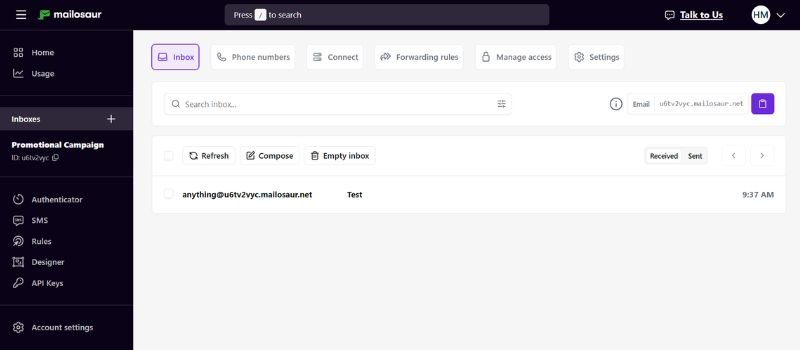
Why choose Mailosaur? Mailtrap allows developers to manually inspect emails during development. Mailosaur is designed for automated email testing within software development pipelines.
Mailosaur has been gradually expanding the platform’s capabilities. Their objective is to help developers automate email testing within their continuous integration and deployment workflows. Rather than using a sandbox (like Mailtrap’s Email Sandbox), developers can write automated tests that verify email content, links, one-time passwords, verification codes and password reset emails.
APIs and SDKs for multiple programming languages make it easy to integrate email validation directly into automated test suites. Mailosaur also supports SMS testing, making it useful for businesses building multi-factor authentication.
Key Features
- Create automated email rules that simulate every type of scenario.
- Unlimited recognizable email address for your brand.
- Disposable testing inboxes.
- Quickly test emails and SMSes for broken links and codes.
- CI/CD integrations.
Pricing
QA testing plans range from $20 to $50 per month. Enterprise pricing is available directly from the vendor.
Best for
Mailosaur is best for developers, QA professionals, and product managers who need to automate end-to-end testing of email and SMS workflows.
5. Mailpit
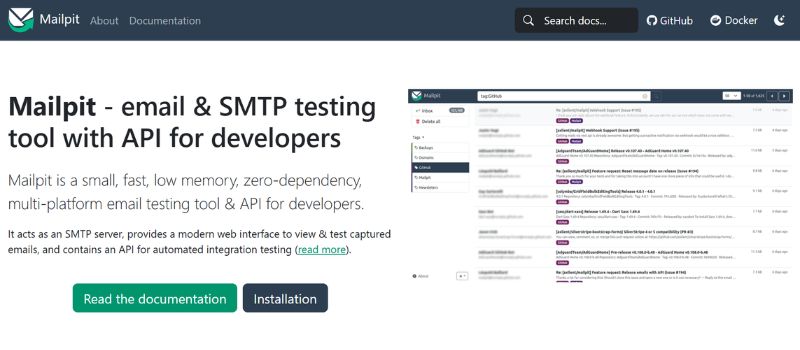
Why choose Mailpit? Mailpit is an open-source email testing server designed for local staging environments. Instead of routing emails through a hosted service, developers run Mailpit on their own machines or inside Docker containers.
Captured emails can be viewed through a clean web interface, making it easy to inspect HTML, plain text, attachments, headers, and SMTP transactions without contacting external servers. Because the platform is run locally, it is fast, lightweight and completely free.
Key Features
- It is a completely free and open-source platform.
- Use a local SMTP server.
- HTML and plain-text email previews.
- Inspect attachments.
- Docker and GitHub support.
- Contains an API for automated integration testing.
Pricing
Free, open-source platform.
Best for
For solo developers, startups, and engineering teams looking for a free Mailtrap alternative.
6. Postmark
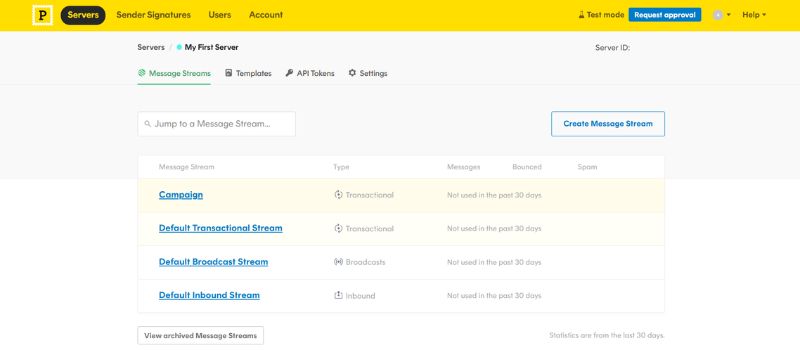
Why choose Postmark? Mailtrap helps developers test emails safely before they reach users. Postmark is a transactional email service built to send and track production emails such as password resets, order confirmations and account notifications.
Postmark provides a robust email API and SMTP service that focuses on speed, reliability and excellent deliverability. It separates transactional and broadcast email streams to help protect the sender’s reputation. By default, Postmark keeps 45 days of full content history to help developers get to the bottom of every issue.
The platform has a sandbox mode for testing email workflows, webhooks and bounce rates. But its focus is on supporting production email delivery, rather than directly replacing a platform like Mailtrap.
Key Features
- Custom sending domains.
- High-quality, vetted IPs.
- Automatic suppression.
- Sandbox mode and dynamic API documentation.
- Event webhooks.
- 45-day default activity retention.
Pricing
Postmark offers a free plan with 100 emails per month, but paid plans range between $15 and $18 per month, depending on the features you need.
The following add-ons are available on all paid plans:
- Dedicated IPs – $50 per month
- Custom activity retention – $5 per month
- DMARC monitoring – $14
Best for
Agencies, bootstrapped startups, enterprise, side projects. If your business has moved beyond development and needs a reliable platform for sending emails at scale, Postmark is a good choice.
Which Mailtrap alternative should you choose?
The right Mailtrap alternative depends entirely on how closely it aligns with your business goals. MailGun Inspect is the closest functional alternative to Mailtrap’s Email Sandbox, while Mailosaur is better suited for automating testing in CI/CD pipelines.
Mailpit is an excellent free option for developers who want to work locally, and Postmark is ideal once you’re ready to send reliable transactional emails in production. For marketing teams managing approvals, rendering and campaign quality assurance, Litmus is the best option.
If your emails are technically correct, but they’re landing in spam folders, or your sender reputation has deteriorated, switching platforms won’t solve the problem. For this your need InboxAlly to help email providers trust your domain and get legitimate emails into inboxes more consistently. For businesses that rely on email to generate leads and drive revenue, it’s the strongest choice.
Book a demo and discover how InboxAlly can integrate with any one of these alternatives to improve close rates, generate more leads and increase revenue.
FAQs: Mailtrap alternatives
Darren Blumenfeld is the CEO and Founder of InboxAlly, an email deliverability platform trusted by growth-focused marketers. He’s previously founded HonestMail, worked at NASA, and holds degrees from Tufts and Columbia. His passion for tech, education, and creativity continues to inspire innovation in email outreach.