About the Author: Jeanne Jennings is a veteran email marketing consultant and strategist with over 20 years of experience. Through her boutique firm Email Optimization Shop, she partners with medium‑to‑enterprise teams in fractional and project roles to audit program performance, design optimization roadmaps, and embed best practices.
In November 2025 I led a panel on AI and Email Deliverability at the Email Sender and Provider Coalition’s Fall Meeting. Professionals from Constant Contact, Oracle, and Rasa.io joined me on stage. Just before our session, a group of professionals from the mailbox provider world spoke on a similar topic. This article is a mix of what I learned there and my own experience in the industry.
If you’ve ever felt like your email deliverability is being judged by a secret tribunal, you’re not wrong. And increasingly, one of the voices at that table is AI.
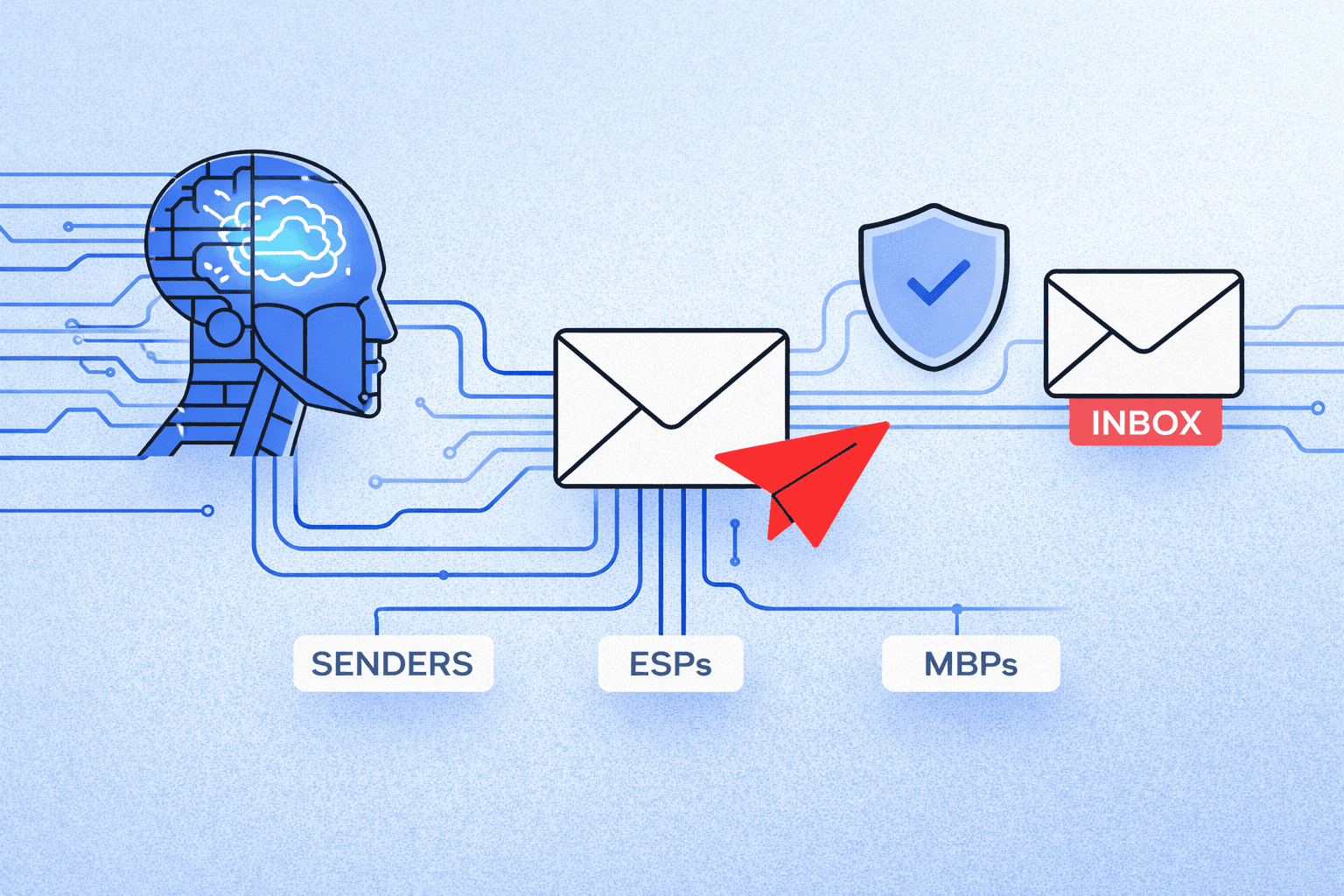
Artificial intelligence is reshaping the email ecosystem from top to bottom. But what “AI in email” looks like depends heavily on where you sit. If you’re a sender, you’re probably using it to write copy, optimize send times, or power segmentation. If you’re with an email service provider (ESP), you’re likely using AI for abuse prevention and early deliverability diagnostics. And if you’re a mailbox provider (MBP)… well, you’re the final judge, jury, and spam-folder executor, using AI to decide whether a message ever sees the light of day (aka the inbox).
Here’s how each player is using AI today, and what it means for your deliverability strategy.
Free Email Spam Checker from InboxAlly Get instant insights to keep your emails out of the spam folder, just send us your email.. |
|---|
1. Senders: AI as Content Generator, Time-Saver… and Occasional Liability
Let’s start where most marketers start: using AI to create and optimize email campaigns.
We’ve all seen the big use cases:
- Generate subject lines
- Create body copy
- Determine optimal send time (which still relies on following best practices for staying out of the send folder)
- Build behavioral segments
These are table stakes now. What’s more interesting, at least to me, is how my clients and I are going beyond that.
Here are a few under-the-radar ways my clients and I, as senders, are using AI right now:
- Prompting for a consistent voice by pasting in copy from successful campaigns and asking the AI to “write like this.”
- Crafting newsletter blurbs that drive clicks. We’re using AI to write short, punchy intros for blog posts, focused less on summarizing and more on teasing value to encourage click-throughs.
- Testing for tone and clarity by asking AI, “What does this message sound like to a first-time reader?” to uncover confusing language or overly salesy phrasing.
- Roleplaying the recipient. We’re even asking AI to embody target audience personas and provide feedback on our copy before we send it. It’s a great gut check before sending.
Now, here’s the caveat: AI-generated content doesn’t always play well with inbox filters. Especially when it’s vague, overly polished, or, well… dull. Many call this “AI slop;” content that sounds generic, over-sanitized, and lacking the specificity that resonates with real people (and, increasingly, AI-powered filters).
If your copy reads like it was written by a committee of over-caffeinated interns and ChatGPT, you might be unintentionally training the spam filter to ignore you.
The fix? Use AI for drafts, not decisions. Prompt creatively. Always rewrite. And please, please never publish the first output.
Free Email Content Tester from InboxAlly Enhance your email’s performance by identifying trigger words and optimizing your subject line. |
|---|
2. ESPs: AI as Guardian, Gatekeeper, and Quiet Deliverability Coach
We don’t always think of email service providers as deliverability actors in their own right, but they are. Especially now, as AI becomes a tool for proactive abuse prevention.
ESPs are responsible not just for helping you send email, but for maintaining the integrity of their platform. That means they need to spot risky behavior before it affects their sender reputation. And increasingly, they’re using AI to do just that.
A few things ESPs are doing with AI right now:
- Scanning outbound messages pre-send to look for known spam triggers (e.g., sketchy phrasing, brand impersonation, suspicious formatting).
- Scoring campaigns based on historical complaint risk and content patterns. Some platforms have internal reputation scores, and if you dip too low, you may be throttled or reviewed manually.
- Pattern-matching to catch impersonators or phishers. AI can compare your copy and style to past sends and flag anomalies that might indicate an account has been compromised.
- Protecting shared IP reputation by identifying senders with unusually high bounce or complaint rates before they take down the rest of the neighborhood.
These aren’t theoretical tools. Some ESPs are actively warning senders about risky content before deployment. Others are using AI-generated recommendations to suggest tone adjustments or even subject line changes. (“This subject line resembles others that have generated high spam complaints; try something more direct.”)
What’s wild, and actually pretty wonderful, is that we’re seeing ESPs proactively start to act like inbox allies again. Not just vendors, but guides. AI is helping them spot trouble before it hits your metrics, if you’re willing to listen.
Free Trial of InboxAlly No credit card required. Try the ultimate deliverability tool for 10 days at no charge. |
|---|
3. MBPs: AI as Final Gatekeeper and Behavior Analyst
Mailbox providers like Gmail and Yahoo have always played the final card in deliverability. But their spam filters aren’t just blocklists anymore. They’re massive machine-learning systems trained on real user behavior.
And that means AI is deeply embedded in the inbox decision-making process.
MBPs are now using AI to evaluate:
- Engagement patterns beyond opens. Think: dwell time, scroll behavior, deletion speed, or “mark as unread” rates, which are part of the engagement signals mailbox providers look at.
- Sender reputation trends. AI spots changes in volume, domain setup, or spike activity far faster than traditional filters.
- Language and content modeling. MBPs aren’t flagging “AI content” per se. They’re flagging predictable, low-value content that doesn’t spark action.
- Inconsistencies in tone or targeting. If your email sounds nothing like your past sends, or like thousands of others recently flagged, it raises a red flag.
AI is essentially asking:
“Does this message feel like something this sender typically sends, to people like this, with results like that?”
If the answer is no? Spam folder. Or worse, silent filtering.
What surprised me (in a good way) while I was speaking to industry friends about this? MBPs aren’t just punishing bad behavior. They’re rewarding consistent, high-quality behavior. That means good list hygiene, well-tuned engagement, and yes, intentional messaging structure are more valuable than ever.
Free Warmup Planner from InboxAlly Establish your sender reputation. Improve your deliverability. Get more opens. |
|---|
So What Does This All Mean?
It means AI is now everywhere in email; upstream, downstream, and in your own production workflow.
And that’s not a bad thing. Used wisely, AI can help you write faster, test smarter, and fix problems before they become disasters, especially when you’re focused on improving deliverability proactively. But you’ve got to stay hands-on.
Here’s the punch list:
- AI is your assistant, not your boss. It’s great for ideation, less great at judgment.
- Don’t be sloppy. Lazy AI-generated copy is a deliverability liability.
- Ask your ESP what tools they have. You might be ignoring powerful diagnostics.
- Understand that MBPs care about reader behavior, not just your content. Think through the full journey.
- If your gut says “this feels off,” trust it. AI can mimic tone, but it can’t replicate instinct.
Free Demo of InboxAlly InboxAlly is the most powerful email deliverability platform and warmup service, trusted by leading senders since 2020. |
|---|
Final Thought:
If AI is the new middleman in deliverability, then your job as a marketer is to speak fluently to humans and algorithms. You’re writing for readers, but you’re also performing for models.
Know the game. Learn the rules. And for the love of inbox placement, don’t let the robots do all the talking.
Jeanne Jennings is a veteran email marketing consultant and strategist with over 20 years of experience. Through her boutique firm Email Optimization Shop, she partners with medium‑to‑enterprise teams in fractional and project roles to audit program performance, design optimization roadmaps, and embed best practices.
She also leads hands-on training workshops, both public and private, to upskill internal teams in email strategy, campaign execution, and use of AI. When she’s not helping clients refine their email programs, you’ll find her programming the Email Innovations Summit, managing the Only Influencers community of email industry professionals, teaching digital marketing at Georgetown University (Hoya Saxa!), or watching hockey (Let’s Go Caps!).
About InboxAlly InboxAlly is a deliverability software platform built to help your emails land in the inbox, not the spam folder. Our tools include real‑time warm-up, engagement signals, seed testing, deliverability diagnostics, and domain/IP reputation repair. All without needing to hand over direct access to your sending infrastructure. Whether you’re launching a new IP/domain, recovering from deliverability issues, or scaling a multi‑sender program, InboxAlly gives you the infrastructure and insights to send with confidence and see measurable improvements in open rates, placement, and sender credibility. View our Plans and Pricing, including our free 10-day trial (no credit card required) |
|---|