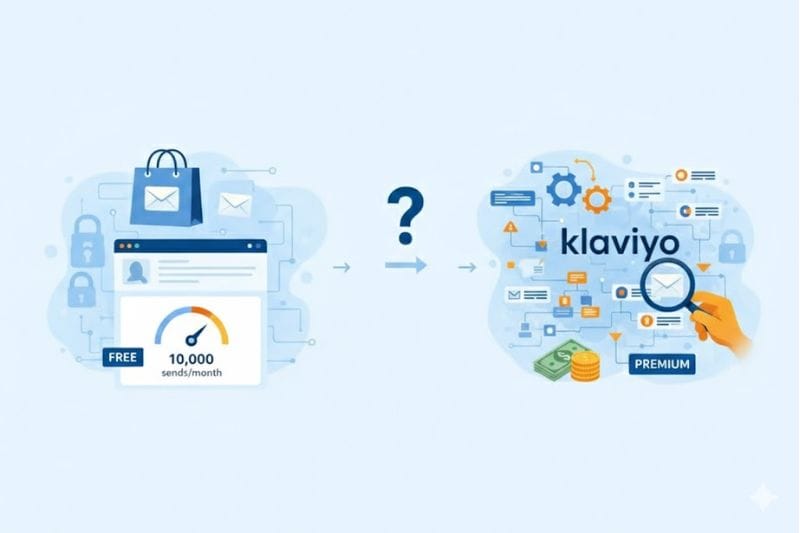
If you run a Shopify store, you’ve probably been staring at this question for quite a while: Should I stick with Shopify’s built-in email marketing tool or bite the bullet and pay for Klaviyo?
That decision can get complicated: Shopify Email is free for your first 10,000 sends each month, and it’s right there in your dashboard. Klaviyo costs real money (sometimes hundreds per month), but everyone keeps saying it “delivers better results through advanced automation.”
The truth is a bit more nuanced than “free vs premium.” Your answer depends entirely on where your store is right now and what you’re trying to accomplish when you click “send.”
Let’s figure it out.
Key takeaways
- The native Shopify option works when you’re sending under 10,000 emails monthly and need basic automation. Setup takes minutes, and it handles newsletters and simple flows without requiring a new platform to learn.
- Klaviyo delivers measurably better results, but only when you actually use all the features to justify the cost.
What’s different about these platforms
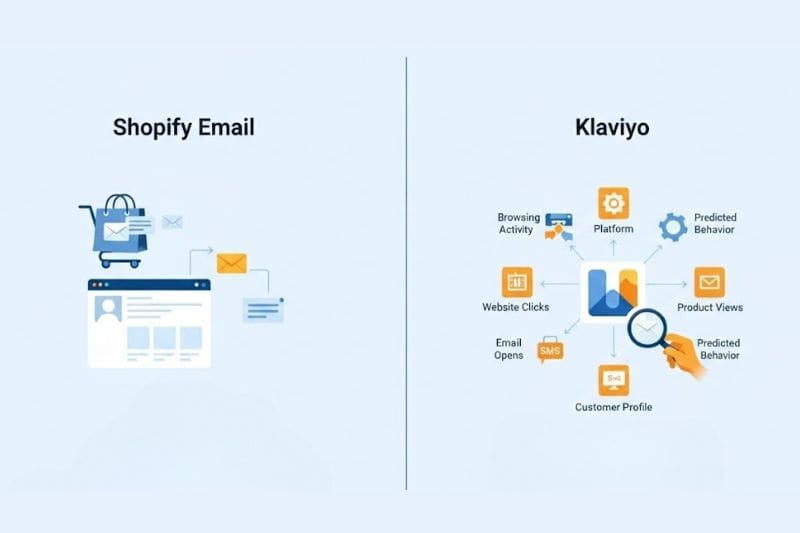
Shopify Email is a marketing tool that sends emails. Klaviyo is a customer data platform that happens to include email.
This is more important than it sounds.
Here’s what we mean: Shopify Email gets its data from your store (who bought what, who abandoned their cart) and lets you send marketing campaigns based on it. For the most part, it’s built for ecommerce store owners who want to announce sales, send newsletters, and recover some abandoned carts.
Klaviyo tracks what visitors do on your site before they ever give you their email. Whether they clicked on a product, added something to cart but didn’t check out, or browsed for 10 minutes then left, Klaviyo knows. It builds a profile for each person that combines things like browsing, purchases, email opens, predicted customer behavior, and uses that to trigger personalized email and SMS campaigns.
In 2022, Shopify put $100 million into Klaviyo and made it the recommended solution for Shopify Plus. The company that built Shopify is literally betting on Klaviyo as the future. That tells you something.
Email builder and templates
Both give you drag-and-drop builders. The difference is in how they make you work.
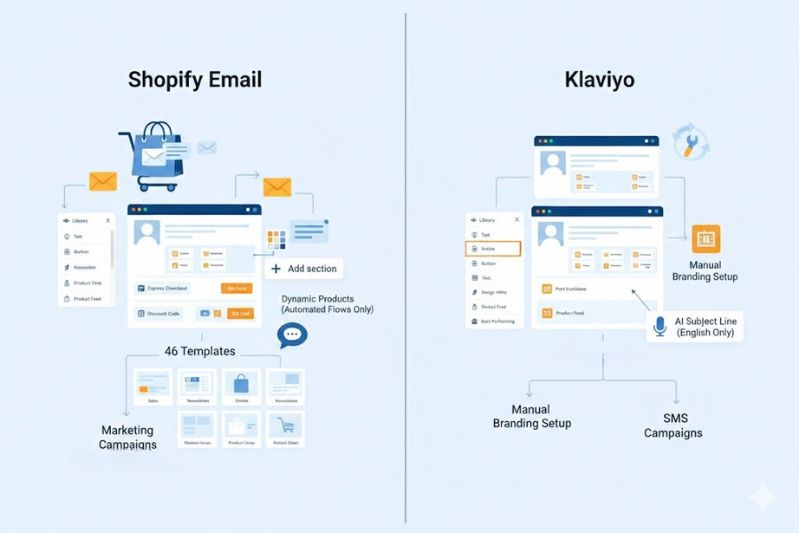
Shopify Email automatically pulls your entire branding with the logo, colors, and fonts into every template. You get 46 email templates covering the basics like product drops, sales, and newsletters. The builder is clean, but not very streamlined, since every time you want a new block, you need to click “+ Add section,” which breaks your flow.
It also has ecommerce blocks like express checkout buttons, discount codes, and gift card options, which make it easy to build shoppable emails. It all works well, but with a caveat: dynamic products (where different customers see different products based on their behavior) only work in automated flows, not regular campaigns.
Klaviyo shows all your block options in a sidebar that stays open, so you don’t have to click around. The template library is bigger and, for that matter, better designed with actual layouts with animation, instead of simple text blocks. You can also add dynamic product feeds to campaigns, so different people see different products based on whatever conditions you set. Browse history, past purchases, cart value, predicted interest, it’s all in there.
The tradeoff, however, is that you have to manually add your branding to Klaviyo, which means more setup work.
Both have AI tools for subject lines and email copy. Klaviyo’s Subject Line Assistant shows you which subject lines performed best in the last 90 days, which helps you learn what your audience responds to. But Klaviyo’s AI only works in English. Shopify Email supports eight languages.
Automation: where the biggest difference lies
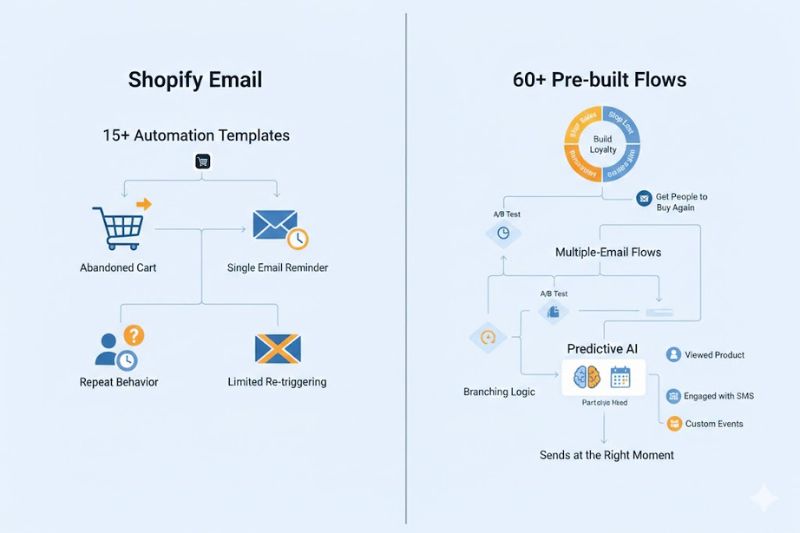
With Shopify Email, you get 15+ automation templates like welcome emails, abandoned cart, post-purchase, and win-back. You need the free Shopify Flow app to use them. The builder is flowchart-style and easy to understand, even if you’ve never built an automation before.
The problem is, most of these are single emails. When someone abandons their cart, they get one reminder. If they abandon again next week, they might not get another follow-up simply because Shopify’s re-triggering doesn’t handle repeat behaviors well.
Klaviyo has 60+ pre-built flows organized by what you’re trying to accomplish: stop lost sales, turn subscribers into customers, build loyalty, get people to buy again, etc.. Each flow can be multiple emails with branching logic, delays, and A/B tests built in. You can trigger based on dozens of behaviors: viewed a product, added to cart, made a purchase, clicked an email, engaged with SMS, literally any custom event you want to track.
But Klaviyo gets the most interesting with predictive AI, where it looks at each customer’s purchase pattern and predicts when they’re likely to reorder, then it sends the reminder at the right moment for that specific person.
Shopify is working on AI features, but right now, it’s behind.
Segmentation and who you can target
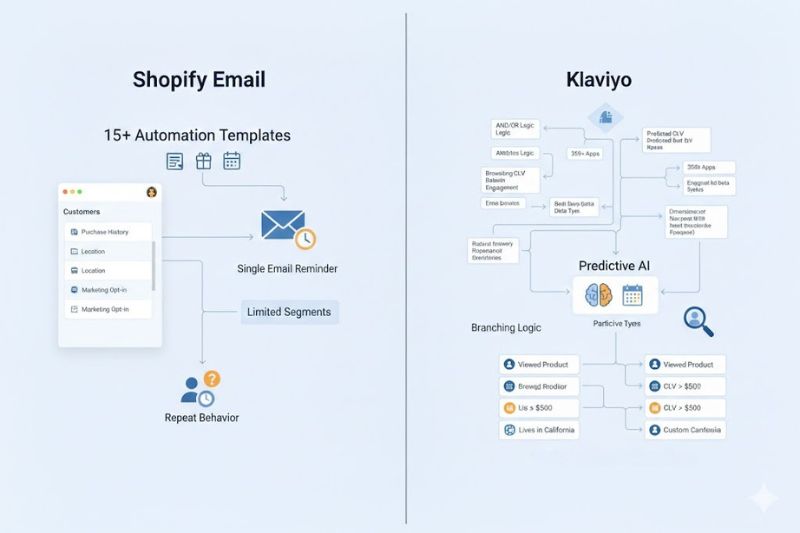
Shopify Email uses your store’s customer data, like purchase history, location, and marketing opt-in status, to build segments. You create segments in the “Customers” section, then go back to Shopify Email whenever you want to send a campaign out. A bit clunky, but the pre-built templates sort of speed up the whole process.
Klaviyo’s segmentation is powerful, but it can get quite technical. There are no pre-built templates, but instead you build everything manually using conditions, AND/OR logic, and filters that pull from browsing behavior, email engagement, predicted lifetime value, and data from 350+ apps.
Klaviyo doesn’t cap how many conditions you can use. You could target customers who viewed a specific product, didn’t add it to cart, opened your last three emails, have a predicted CLV over $500, and live in California. Shopify Email simply can’t do that.
Klaviyo uses terms like “dimensions” and “Boolean data types,” which hint at the fact that the learning curve is real. If you’re not comfortable with that language, it can feel quite intimidating.
For most small stores, Shopify Email’s segments work fine. For growing stores trying to squeeze more revenue from the same list, Klaviyo’s precision pays off many times over.
Analytics and what you can see
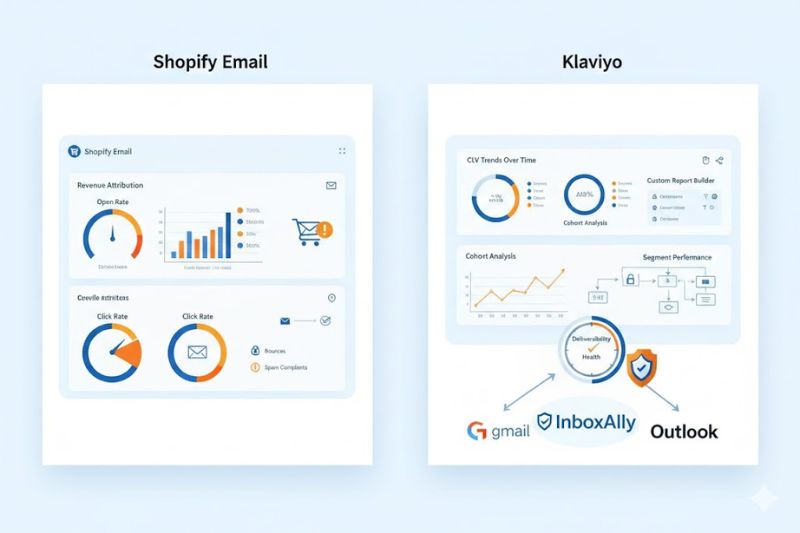
If you like the basics you’re already used to, Shopify Email has got you covered: open rate, click-through-rate, delivery rate, bounces, spam complaints, and revenue attribution using last-click. Everything syncs with your Shopify dashboard, which makes it easy to see how email affects overall sales.
Klaviyo offers custom reports, cohort analysis, revenue per recipient, multi-touch attribution, competitive benchmarking, and predictive metrics. You can also build custom dashboards, track CLV trends over time, and see how different segments perform in different campaigns and flows.
Klaviyo also shows deliverability health and offers dedicated sending options to protect inbox placement. Shopify Email doesn’t show deliverability details and sometimes shuts off automations when it detects problems (often without telling you what went wrong)
But built-in deliverability tools only go so far. If your emails land in spam, none of these analytics matter. InboxAlly trains Gmail, Yahoo, and Outlook to trust your domain from day one, so your metrics set realistic expectations based on inbox performance. Book a free demo and stop guessing where your emails end up.
Pricing and when it matters
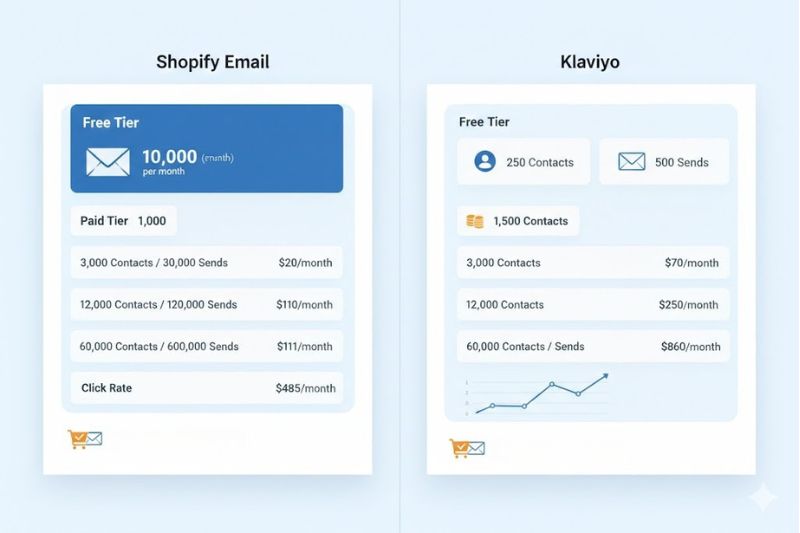
Shopify Email is free for 10,000 emails per month. After that, it costs $1 per 1,000 emails. Transactional emails like order confirmations and shipping updates, fortunately, don’t count toward your limit.
Klaviyo charges based on active profiles (contacts) instead of sends. Free plan covers 250 profiles and 500 sends per month. Paid plans start at $45/month for 1,500 profiles.
In practice, it looks something like this:
3,000 contacts / 30,000 sends monthly:
- Shopify Email: $20/month
- Klaviyo (email): $70/month
12,000 contacts / 120,000 sends monthly:
- Shopify Email: $110/month
- Klaviyo (email): $250/month
60,000 contacts / 600,000 sends monthly:
- Shopify Email: $485/month
- Klaviyo (email): $860/month
The price difference gets smaller as you grow. For a small store with a few thousand subscribers, Shopify Email is hard to argue against. Klaviyo’s cost makes sense for a growing store when you use the features that generate revenue to cover it.
One thing to watch out for: Unlike Shopify, Klaviyo does count transactional emails toward your limit. If you’re doing high volume, those order confirmations can quickly push you into the next pricing tier.
Integration and how it fits your email marketing strategy
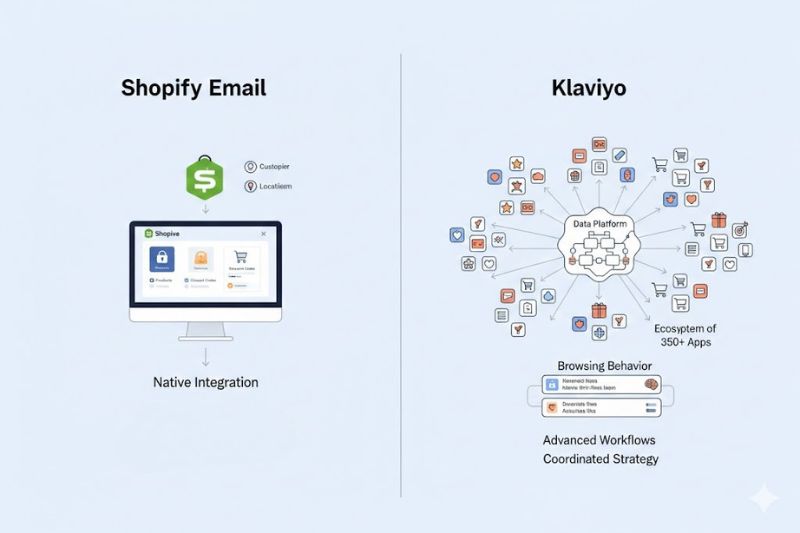
One of the most appealing things about Shopify Email is that it’s a native solution. It doesn’t require any kind of setup, API keys, or separate login. Your products, customers, and discount codes are all there right from the start.
Klaviyo integrates through Shopify’s certified partnership and sees the same data Shopify Email does. This tight connection is why many consider it the go-to klaviyo shopify email marketing app for scaling stores. The difference is that Klaviyo also connects with 350+ other tools, a lot of which are review platforms, loyalty programs, ad platforms, etc.. Those integrations let you build workflows that Shopify Email can’t.
If everything you do runs through Shopify, the native option is simpler. If you need email to coordinate with other tools in your stack, Klaviyo’s ecosystem is unmatched in that space.
When Shopify Email makes sense
Use Shopify Email if you’re:
- Launching your first email campaigns
- Sending under 10,000 emails monthly
- Running a small store on a budget
- Focused on basic campaigns and simple automation
- Looking for something you can set up today
Shopify Email is cost-effective, predictable, and works great for anyone looking for a simple way to send professional campaigns.
When Klaviyo is worth paying for
Use Klaviyo if you:
- Need complex segmentation based on behavior and predictions
- Want multi-channel campaigns (email + SMS marketing)
- Rely on automation workflows for revenue
- Use data and analytics to optimize everything
- Have outgrown basic tools
Shopify stores get up to $85 revenue for every $1 spent on Klaviyo. When you use it right, it pays for itself.
What this leaves you with
At the end of the day, this comparison isn’t about crowning a winner. Both Shopify Email and Klaviyo have clear advantages depending on where you are in your ecommerce business.
What works best for you depends on how much you’re willing to invest in email, and whether you need behavior-driven automation or just the good ol’ basics.
We hope this comparison has given you a clear picture of both worlds.
And remember: no platform can outpace a poor sender reputation. Whether you’re sending 1,000 or 100,000 emails, deliverability sets the ceiling. Book a free demo with InboxAlly to make sure your emails reach their rightful destination every time.