
Email marketing continues to deliver one of the highest returns of any digital channel, and the latest data proves it.
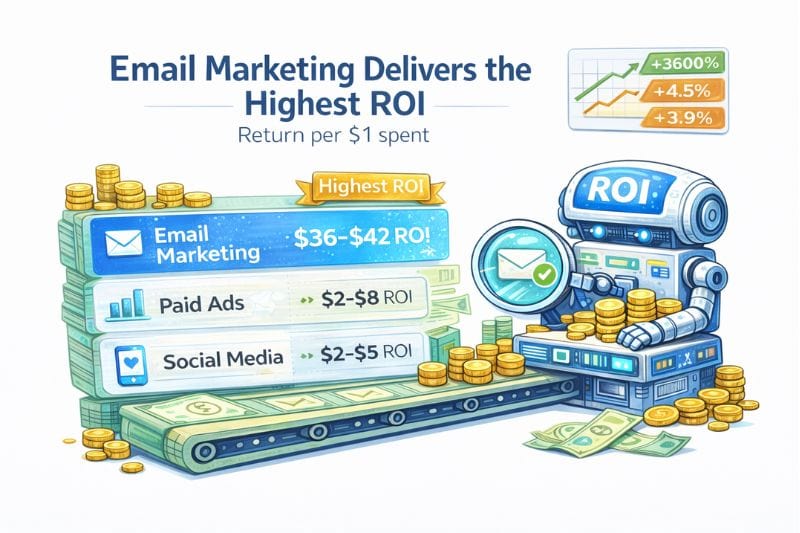
Studies show that email marketing generates between $36–$42 per $1 spent, making it one of the most cost-effective ways to drive revenue in 2026.
Here are the latest email marketing ROI statistics and the key trends shaping performance in 2026.
Email Marketing ROI: Quick Takeaways
- Email marketing generates roughly $36–$42 per $1 spent
- It remains the highest ROI digital marketing channel for most businesses
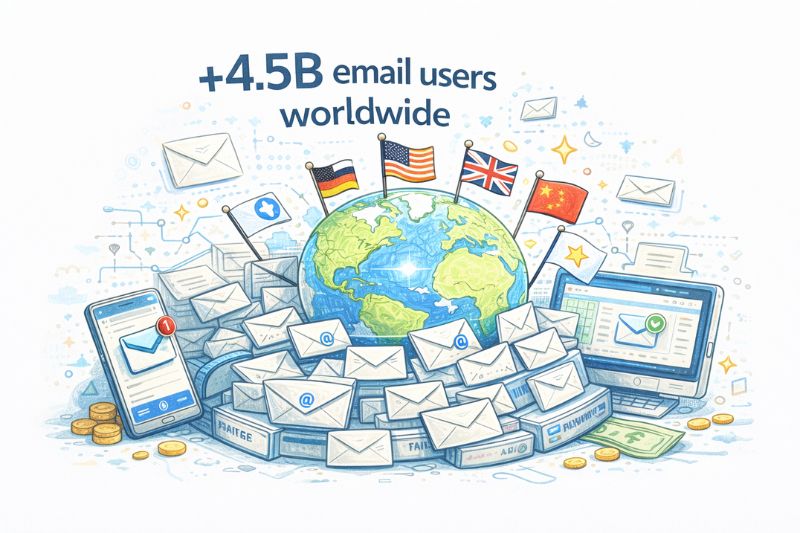
- There are now over 4.5 billion email users worldwide
- Personalization significantly increases conversions and revenue
- Automated emails consistently outperform standard campaigns
- Segmentation can drive substantial revenue growth—up to 760% in some cases
Email Marketing ROI Statistics (2026)
- Email marketing delivers an average ROI of $36–$42 per $1 spent, according to Campaign Monitor.
- Email consistently ranks as the highest ROI marketing channel, outperforming paid search, social media, and display advertising
- Social media marketing typically generates around $2–$5 for every $1 spent, significantly lower than email
- Paid advertising often delivers an ROI of $2–$8 per $1 spent, depending on the platform and targeting, according to WebFX.
- Email marketing’s ROI is driven by its low cost, high scalability, and direct access to owned audiences
- Businesses with mature email strategies (segmentation, automation, personalization) tend to see significantly higher ROI than average
- Email marketing remains one of the most cost-efficient channels for customer retention, which directly impacts long-term ROI
- According to Campaign Monitor, Welcome emails and lifecycle campaigns often generate higher revenue per email than standard promotional campaigns
- Triggered emails (such as abandoned cart or onboarding sequences) contribute greatly to overall email revenue
What These ROI Statistics Mean
Email marketing’s high ROI comes down to a simple advantage: you own the channel.
Unlike paid ads or social platforms, email gives you direct access to your audience without ongoing media costs. When combined with segmentation, automation, and personalization, this creates a system that can scale revenue efficiently over time.
This is why, even as new marketing channels emerge, email continues to deliver some of the most reliable and predictable returns in digital marketing.
Not seeing the ROI benchmarks? Your emails might not be reaching the inbox. InboxAlly helps improve deliverability so your campaigns actually perform.
Email Marketing Performance Statistics
- There are over 4.5 billion email users worldwide, and this number continues to grow each year
- Data from Statistica shows that more than 300 billion emails are sent and received daily, making email one of the most widely used communication channels
- Email remains one of the most frequently used digital touchpoints between brands and consumers
- According to Insider One, average email open rates typically range between 20% and 40%, depending on industry and audience quality
- Click-through rates (CTR) for email campaigns generally fall between 2% and 5%
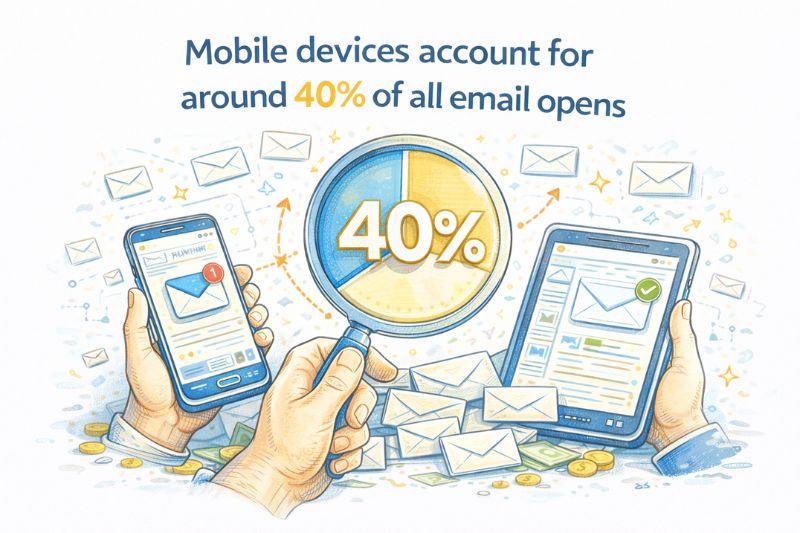
- Mobile devices account for around 40% of all email opens, highlighting the importance of mobile optimization (Hubspot)
- A significant portion of users check email multiple times per day, increasing opportunities for engagement
- Email newsletters are among the most widely used content distribution formats for both B2B and B2C marketers
- Email continues to outperform many social channels in terms of direct engagement and conversion potential
- Marketers consistently rank email as one of the most reliable channels for reaching their audience
What These Statistics Tell Us
Email marketing isn’t just high ROI; it’s built on scale and consistency.
With billions of users and daily interactions, email provides a level of reach and reliability that few other channels can match. Combined with strong engagement metrics, this makes it a dependable foundation for both customer acquisition and retention.
Email Marketing Trends (2026)
- AI is increasingly used to optimize subject lines, send times, and content personalization
- Privacy changes (such as email tracking limitations) are reducing the reliability of open rate data (Microsoft)
- Marketers are placing greater emphasis on first-party data as third-party tracking declines
- Deliverability and inbox placement have become more critical due to stricter spam filters and algorithms
- Interactive emails (such as embedded forms, surveys, and dynamic content) are gaining adoption
- Mobile-first design is now essential, with a majority of users accessing email on mobile devices
- Personalization is evolving beyond basic fields to include behavioral and predictive targeting
- Email is increasingly integrated with other channels (SMS, CRM, automation platforms) for omnichannel marketing
- Brands are focusing more on engagement quality rather than list size alone
- Data privacy and compliance (such as GDPR and similar regulations) continue to shape email marketing strategies (Research Gate, 2025)
What These Trends Mean for ROI
Email marketing is evolving, but its core advantage remains the same: direct access to your audience.
However, achieving high ROI in 2026 requires adapting to these changes. Marketers who invest in better data, smarter targeting, and stronger deliverability practices are more likely to maintain, and even increase, their returns.
In other words, email still delivers exceptional ROI, but only when it is executed with a modern, data-driven approach.
Great strategy, weak results? Even the best emails won’t convert if they’re not seen. InboxAlly helps ensure your emails land in the inbox.
Personalization & Segmentation Statistics
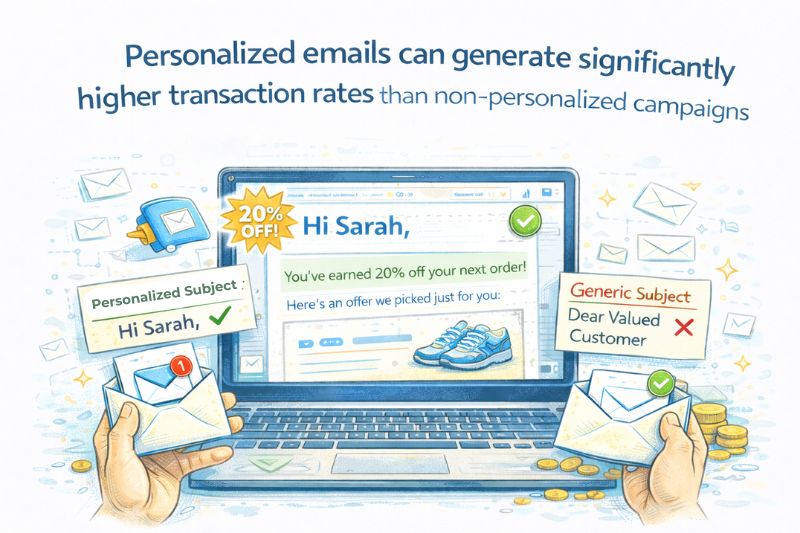
- Personalized emails can generate significantly higher transaction rates than non-personalized campaigns
- According to MailForge, emails with personalized subject lines tend to achieve higher open rates than generic messages
- Personalized calls-to-action (CTAs) can perform substantially better than standard CTAs
- Product recommendations and dynamic content can drive a meaningful share of email-driven revenue
- Segmented email campaigns consistently outperform non-segmented campaigns in both open rates and click-through rates
- Segmentation can increase email revenue by up to 760% in some cases (Campaign Monitor)
- Targeted email campaigns contribute a large portion of total email marketing revenue
- Behavioral targeting (based on user actions) leads to higher engagement and conversions
- Sending relevant content based on user preferences significantly improves customer retention and lifetime value
- Marketers who use advanced segmentation and personalization strategies typically see stronger ROI overall
Why Personalization and Segmentation Matter
Email marketing performs best when messages are relevant.
Instead of sending the same message to your entire list, segmentation and personalization allow you to tailor content based on user behavior, preferences, and intent. This leads to higher engagement, more conversions, and ultimately, a stronger return on investment.
In practice, this means delivering the right message to the right person at the right time, something email marketing is uniquely positioned to do well.
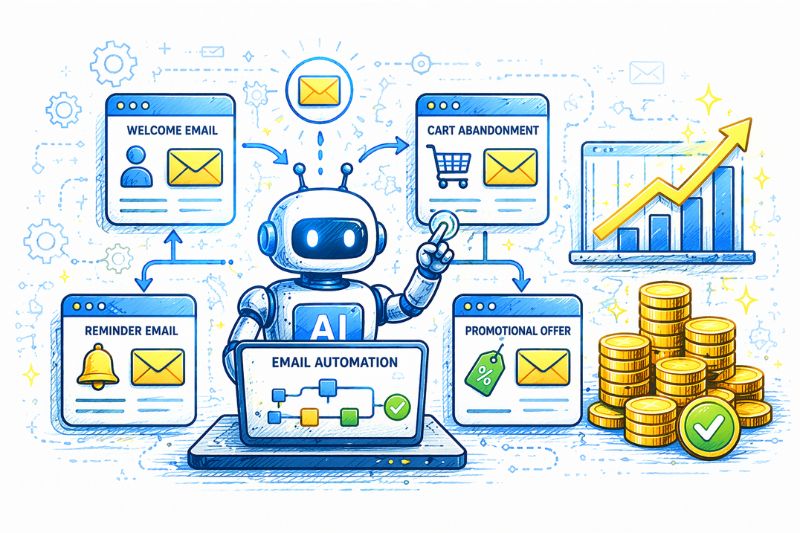
Email Automation Statistics
- A majority of marketers use automation to send triggered and lifecycle-based emails
- Automated emails typically generate higher open rates than standard bulk campaigns
- Click-through rates for automated emails are often significantly higher than regular newsletters
- According to Demand Sage, 75% of the email revenue is obtained from triggered personalized emails (such as welcome, onboarding, and abandoned cart emails)
- Welcome emails consistently deliver some of the highest engagement rates across all email types
- Automated email sequences can generate substantially more revenue than one-time campaigns
- Behavioral triggers (such as purchases, sign-ups, or inactivity) lead to more timely and relevant communication
- Automated campaigns improve customer retention by maintaining consistent engagement
- Businesses that invest in automation often see stronger overall email marketing ROI
Why Automation Drives ROI
Automation turns email marketing into a scalable system.
Instead of manually sending campaigns, automated workflows allow you to deliver timely, relevant messages based on user behavior. This increases engagement while reducing effort, two factors that directly improve ROI.
When combined with segmentation and personalization, automation enables you to build high-performing email sequences that run continuously and generate revenue over time.
Here Are the Reasons Why Email Marketing Has an Impressive ROI
Email marketing consistently delivers strong ROI because it combines low costs, high reach, and precise targeting.
1. You Own the Audience
Unlike social media or paid ads, your email list is an owned asset. You’re not relying on algorithms or paying for every interaction, which keeps costs low and returns high over time.
2. Personalization at Scale
Email allows you to deliver highly relevant content based on user behavior, preferences, and past interactions. This level of personalization increases engagement and drives more conversions.
3. Automation Increases Efficiency
With automated workflows, you can send timely, behavior-based emails without manual effort. This improves performance while reducing costs—two key drivers of ROI.
4. Strong Customer Retention
Email is one of the most effective channels for retaining customers and driving repeat purchases. Since retention is typically more cost-effective than acquisition, this has a direct impact on overall ROI.
5. Scalable and Cost-Effective
Once your email system is in place, it can scale with minimal additional cost. Whether you’re sending to hundreds or thousands of subscribers, the incremental cost remains low.
6. Data-Driven Optimization
Email marketing provides clear performance metrics, allowing you to continuously test and improve campaigns. Over time, this leads to more efficient strategies and higher returns.

How to Improve Your Email Marketing ROI
The data makes one thing clear: email marketing works, but results vary widely depending on how it’s executed.
If you want to move beyond average returns, focus on the areas that have the biggest impact on performance.
Start with your audience. The more precisely you segment your list, the easier it becomes to send relevant content. Broad, one-size-fits-all campaigns tend to underperform, while targeted emails consistently drive better engagement and revenue, especially when segmentation is applied effectively.
From there, invest in personalization. This goes far beyond adding a first name to a subject line. The most effective campaigns are built around user behavior, what people browse, click, and buy and use that data to shape the message.
Automation is where these gains start to scale. Instead of relying on one-off campaigns, set up flows that trigger based on actions such as welcome sequences, abandoned cart emails, and re-engagement campaigns. These tend to outperform standard emails because they reach users at the right moment.
It’s also worth paying close attention to deliverability. Even strong campaigns won’t generate ROI if they don’t reach the inbox. Keeping your list clean, monitoring engagement, and avoiding spam signals can make a measurable difference.
Finally, treat email as a system that improves over time. Small changes like testing subject lines, refining timing, or adjusting your calls to action can compound into meaningful gains in performance.
Conclusion
Email marketing continues to deliver one of the highest ROIs in digital marketing, but those results aren’t guaranteed.
The gap between average and top-performing campaigns is driven by execution. Brands that treat email as a system, combining segmentation, personalization, automation, and deliverability, consistently outperform those relying on one-off campaigns.
In 2026, email isn’t just a channel. It’s an owned growth engine.
If your emails aren’t consistently reaching the inbox, you’re not seeing the full ROI email marketing can deliver. InboxAlly helps improve your sender reputation and ensures your emails land where they matter most, so your campaigns can actually perform.
Start improving your email deliverability with InboxAlly.
Sources
Litmus – Email Marketing ROI Benchmarks
Campaign Monitor – Email Marketing Guide
WebFX – Digital Marketing ROI Statistics
EmailMonday – The Ultimate Marketing Automation statistics overview
HubSpot – 2026 Marketing Statistics