
If you are searching for a Warmy alternative, you have already formed a view about whether it is working for you. Worth being precise about what is not: most people at this point are not shopping for a different warm-up tool, they are looking for the things warm-up on its own does not settle. Whether inbox placement is actually being measured. What happens when a domain has already gone against you. What the bill looks like once you add mailboxes.
That last one is where Warmy.io tends to get expensive. It prices per inbox from $49 a month and scales to $429, so cost climbs with every mailbox you warm. Its inbox placement testing runs on five seed inboxes per provider, which is a thin sample to make sending decisions on. Warmy advertises warm-up in 30+ languages, though that is a property of template-based warm-up rather than an advantage over engaging real mail.
InboxAlly does the same warm-up job and then keeps going. Warming a new domain or inbox is a core use case, not an adjacent one — the difference is how, and what comes with it. Engagement happens as GUI-level actions on your real campaign mail, up to eight per seed, rather than AI-generated messages passed around a network. Placement is tested against a comprehensive seed list rather than five inboxes. Damaged reputation gets actively repaired rather than waited out. Pricing is $149 a month flat, whatever number of mailboxes you are warming.
Below are the four tools worth comparing, what each one is actually for, and where it stops.
Key Takeaways
- InboxAlly is the stronger pick for serious deliverability work: GUI-level engagement on your real campaign content, comprehensive inbox placement testing, and active reputation repair, at $149 a month flat.
- Warmy.io prices per inbox from $49 a month and scales to $429, so the cost grows with every mailbox you add.
- Warmy.io‘s inbox placement tests use five seed inboxes per provider, which is a thin sample to act on.
- InboxAlly engages your real campaign content, so warm-up is language-agnostic by design — there is no per-language template set to maintain.
- MailReach, Smartlead and TrulyInbox each solve a narrower problem — see the comparison table for where each one fits.
Warmy Alternatives: Quick Comparison
Choosing a Warmy alternative depends on what problem you’re trying to solve. Some tools are designed to ensure a strong sender reputation, while others focus on scaling outbound sales or simplifying inbox warm-up at scale.
| InboxAlly | MailReach | Smartlead | TrulyInbox | |
|---|---|---|---|---|
| Primary objective | Sender reputation and inbox placement for high-volume senders and agencies, including warm-up | Network warm-up with placement diagnostics | Outbound campaign automation, warm-up included | Warm-up volume across many mailboxes |
| Engagement method | GUI-based engagement on real campaign emails | Automated network | Automated warm-up for cold outreach at scale | AI-generated warm-up emails |
| Real content warmup | Yes | Partial | Partial | Partial |
| Inbox placement testing | Comprehensive seed list, per provider | Included | Included | Included |
| Reputation management | Active repair | Monitoring | Monitoring | Monitoring |
| Pricing model | $149/pm flat, any number of mailboxes | $32/pm | $25 per mailbox/pm | $22/pm |
1. InboxAlly
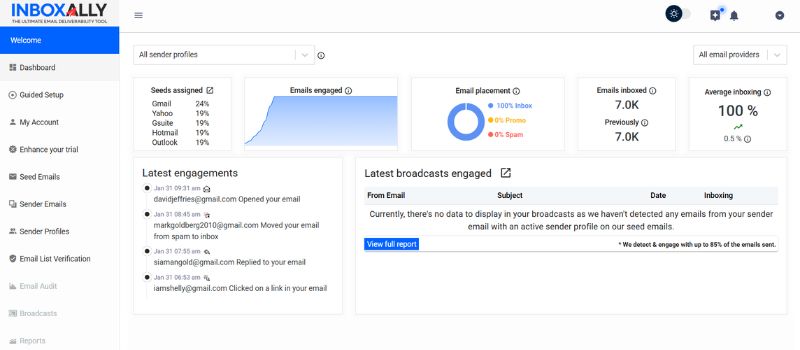
Why choose InboxAlly over Warmy? InboxAlly’s value becomes immediately apparent when you understand that GUI-based engagement is the future and produces stronger results for reputation management. Warmy’s automated email warm-up is functional, and if you’re building a new domain, it may work for you. But if you’re concerned about reputation damage, persistent spam placement or the future of your campaigns, InboxAlly offers a robust alternative to Warmy.
Reputation is about more than a good warm-up schedule. Most warm-up tools focus on the mechanics of warming up an inbox rather than on long-term sender reputation. This assumes that reputation is primarily built through a warm-up schedule and by avoiding spam filters. In reality, email providers are looking for actual user interaction with your content after your campaign starts.
The wider the seed network, the better the data. InboxAlly’s placement testing uses a larger seed network than Warmy. During the warm-up process, data matters. You need to know how many emails are actually hitting inboxes, and this data needs to be accurate across a wide network. This builds data you can really feel confident about. Warmy’s five seeds per provider are not reliable enough to inform strategic decisions.
Engagement signals from actual content. InboxAlly ensures that seed addresses get the same email as your recipients. Engagement actions are then performed on real emails. Providers see engagement based on actual content, anchoring your sender reputation in facts.
Top InboxAlly features: Email deliverability
- Warm up multiple inboxes and rebuild sender reputation.
- Fix deliverability with real engagement signals.
- Customize the email warm-up volume to meet your needs.
- Verify and clean your email list to reduce bounces.
- Advanced features such as Google Postmaster integration and DMARC integration.
What about sending in other languages? Warmy advertises warm-up in 30+ languages. That is a consequence of how network warm-up works rather than an edge over InboxAlly: generated messages have to be written per language, so the language list is something Warmy has to maintain. InboxAlly engages the campaign mail you actually send, in whatever language you wrote it, so there is no language list to check and nothing to localise.
2. MailReach

Why choose MailReach over Warmy?
MailReach runs warm-up through an automated network and pairs it with per-provider placement reporting. If your complaint about Warmy is that you cannot see where mail is actually landing, that reporting is the reason people move.
MailReach lists:
- A warm-up network the vendor puts at 30,000+ inboxes.
- Sender reputation scoring and blacklist monitoring.
- Inbox placement testing across providers, with alerts when a score drops.
- An algorithm the vendor says covers dozens of parameters.
- Setup without engineering involvement.
Where MailReach stops. The engagement is network traffic between mailboxes, not interaction with the campaigns you actually send. That decides what the reputation attaches to: mailbox providers judge you on the mail they see you sending, and warm-up mail that never reaches a customer is not that mail. The diagnostics will tell you placement moved. They do not repair a domain that has already gone against you.
3. Smartlead

Why choose Smartlead over Warmy?
Smartlead is an outbound platform first, with warm-up bundled in rather than sold on its own. If you are already paying for a sequencing tool, consolidating the two is the case for it.
Smartlead lists:
- Email sequencing with inbox and server rotation.
- A unified inbox for replies across campaigns.
- Warm-up running alongside live campaigns.
- Per-inbox and per-domain campaign analytics.
- SPF, DKIM and DMARC monitoring.
Where Smartlead stops. Warm-up here is one feature inside a campaign product, competing for roadmap attention with sequencing, lead management and reporting. If deliverability is the problem you are actually trying to solve, you are buying a large platform to reach one part of it — and when placement drops, a sequencer is not built to tell you why.
4. TrulyInbox
Why choose TrulyInbox over Warmy?
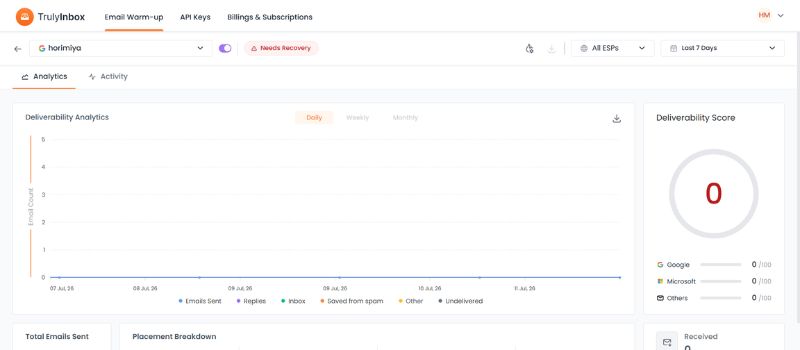
TrulyInbox is the budget option in this list, aimed at agencies and outbound teams warming a lot of mailboxes at once. If your reason for leaving Warmy is per-inbox pricing rather than what the warm-up itself does, that is the case for it.
TrulyInbox lists:
- A network the vendor puts at 40,000+ inboxes.
- Warm-up emails generated by AI rather than fixed templates.
- Control over ramp-up schedule and pace.
- Monitoring of authentication records and per-provider performance.
- Management of multiple mailboxes and domains under one account.
Where TrulyInbox stops. Generated messages are still generated, however well they are varied — the reputation being built belongs to mail your recipients never receive. Monitoring and per-provider reporting are included, but the product is built around warm-up volume rather than diagnosing why placement moved or repairing a domain that has already been damaged. It addresses much the same input Warmy does, at a lower price per mailbox.
Which Warmy alternative is right for you?
Throughout our comparison, one theme has emerged. Not every Warmy alternative is trying to solve deliverability problems in the same way.
Smartlead is an outbound platform with warm-up bundled into it. MailReach is positioned around warm-up plus deliverability diagnostics. TrulyInbox is built around warm-up volume across many mailboxes.
InboxAlly covers the same warm-up ground as any of them, then treats sender reputation as something that keeps moving while you send, rather than something you set once and forget. Use it for as long as it is earning its place, and no longer. Mailbox providers weigh recent engagement more heavily than old history, which is why a reputation built once does not stay built.
Take the next step: Start building a stronger sender reputation with InboxAlly based on actual engagement signals.
FAQs: Warmy Alternative
Darren Blumenfeld is the CEO and Founder of InboxAlly, an email deliverability platform trusted by growth-focused marketers. He’s previously founded HonestMail, worked at NASA, and holds degrees from Tufts and Columbia. His passion for tech, education, and creativity continues to inspire innovation in email outreach.