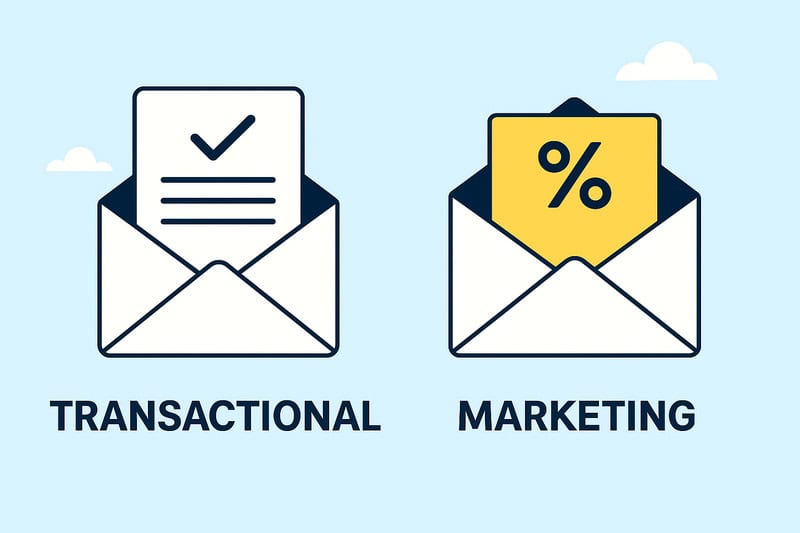
Email deliverability might seem like one big bucket that holds every email you’ve ever sent, but that’s not really how it works. Email service providers (and especially users) don’t treat all messages the same. A password reset and a holiday promo can be sent from the same domain, but they’re in different universes once spam filtering comes into question.
One is expected, the other is tolerated…
The difference between them influences everything from inbox placement to engagement to how fast an ISP forgives your mistakes. Understanding that difference is the first step to understanding why some emails glide through while others get shoved into the part of the inbox nobody checks twice.
In this article, we’ll explain why transactional and marketing emails are so different when it comes to deliverability and give you some practical insight to keep both delivered on time.
Key Takeaways
- Separating transactional and marketing email infrastructure protects deliverability by allowing each channel to build its own reputation without one damaging the other.
- Managing engagement, sending behavior, and compliance requirements across both channels helps stabilize inbox placement and prevents marketing volatility from delaying critical transactional messages.
Why inboxes treat transactional and promotional emails differently
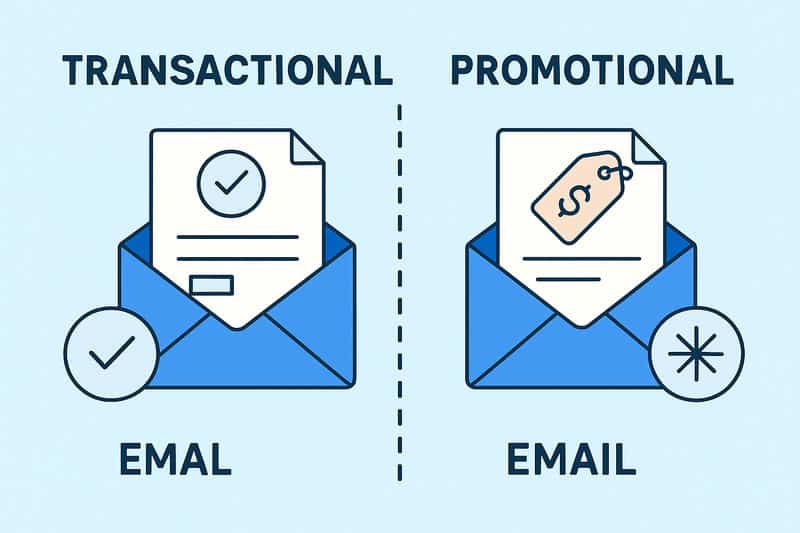
Inboxes essentially sort messages into two mental buckets as soon as they arrive:
- Transactional emails. These could be receipts, password resets, shipping updates, account alerts, etc. They exist because the user did something.
- Marketing email examples include promos, newsletters, announcements, “thought you might like this” content, etc. They exist because the sender wants something.
That in itself is a vast difference.
Unlike marketing emails, transactional emails are pull-based. The user triggers them, for example, when they buy something or change a pricing plan. From this, the inbox understands that the user took an action, so they’re expecting a response. Deliverability engines treat that anticipation differently and usually more positively.
Marketing emails are push-based. The user gets them whether they asked for them today or not. That doesn’t make them inherently bad, but it does make them less desirable. Spam filters look harder at intent, timing, and whether this sender has a history of respecting user boundaries.
What’s being watched?
Spam filters study the content but also patterns like:
- How quickly users open transactional messages
- How often do they not open marketing emails
- Whether similar messages are sent in a predictable way
- How often recipients delete them without reading
- Increases in volume (not so good for promos, but normal for transactional bursts)
Transactional emails naturally score higher in all of these areas because users tend to open them immediately. Marketing emails, meanwhile, live or die by engagement.
What does this have to do with deliverability?
From day one, transactional emails come pre-qualified as trustworthy. They’re expected and usually short, and ISPs love that.
Unlike transactional emails, Marketing emails start from zero. They must earn their reputation, which requires:
- Clean lists
- Predictable behavior and sending
- Low complaint rates
These requirements are why combining both types is one of the easiest ways to ruin deliverability, because one type of email follows rules and the other tests them.
Engagement: the metric that determines your sender reputation
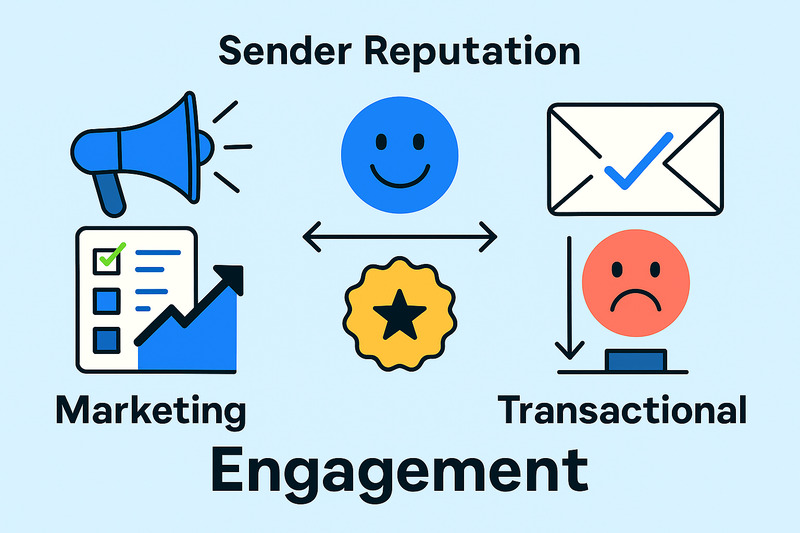
If deliverability had a single kingmaker, it would be engagement. Opens, clicks, deletions, spam complaints, “this is not spam” rescues… everything a user does (or doesn’t do) will make or break how inboxes rank you, and this equation is usually very different for marketing vs. transactional traffic.
Marketing emails can be chaotic. One week, everyone loves your offer, the next, half your list never opens the email. Promotions spike engagement, then drop it. Unsubscribes come in waves. Complaints happen, even if you’re doing everything right, and every one of those signals gets logged against your domain or IP.
So if the total engagement drops below a threshold, it usually impacts your sender reputation. That doesn’t mean you’re “spammy,” but it just shows the inconsistent nature of email marketing. The more your audience behaves as if it doesn’t want your emails, the more suspicious inboxes become.
Transactional engagement = stability
Transactional emails work a bit differently because users open them immediately: reset password = open order confirmation = open shipping update = open
Since they’re functional, rather than promotional, they predictably get opened, and that predictability gives ESPs confidence that you are a legitimate sender.
Virtually no complaints, very high open rates, and minute-tight timing give transactional traffic a “high value ”effect, which is something marketing emails will never fully get.
Why you should separate your email channels
In the early days, you could get away with blasting everything from the same domain, but not anymore. Today, all major email service providers expect them to be separated because the intent of each channel is fundamentally different.
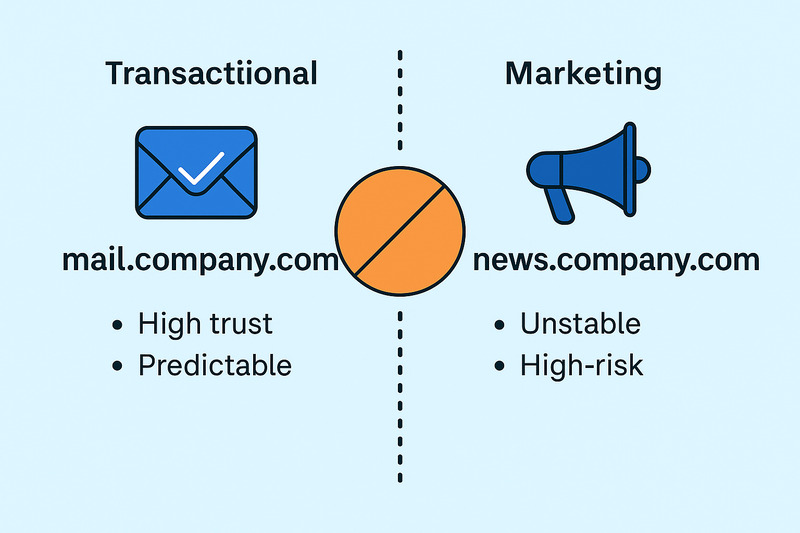
Transactional traffic > high trust, predictable
Marketing traffic > unstable, high-risk
If you don’t keep them on separate IP addresses and let inboxes score them together, one dip in marketing engagement can take down the whole domain. The best way to do it is to break it apart:
- mail.company.com for receipts, resets, updates
- news.company.com for promos
This way, you get two distinct reputations, so marketing volatility can’t poison important messages.
If you want to validate your setup as you go, you can use InboxAlly to see a real-time view of where your emails are landing, something most dashboards don’t provide.
How promotional bursts ruin transactional performance
Marketing email campaigns create sudden spikes where thousands of emails are sent at once, get uneven engagement, and almost certainly higher complaint rates. Inboxes respond by throttling traffic, delaying delivery, and sometimes greylisting the entire IP to “re-evaluate” behavior.
And what happens when your verification link arrives after the session has already expired? It frustrates the user and makes your brand less trustworthy. It’s a disaster, but it’s also a natural outcome of spam filters treating all traffic on that IP as a single reputation.
What a good deliverability architecture looks like
A good setup looks simple from the outside:
- Dedicated IP (or a pool of IPs) for transactional traffic
- Separate subdomain for marketing
- Authentication (SPF, DKIM, DMARC)
- Defined throttling rules for promotional emails
Good deliverability comes with discipline, so keep these apart, and both will run as you expect them to.
Compliance, trust, and the laws marketers forget
Engagement and infrastructure are one thing, but the legal side of things dictates deliverability just as much. Filters don’t wait for regulators to intervene, which is why they enforce their own interpretation of compliance in real time. So what are the legal requirements you need to know about?
The compliance rules marketing emails can’t escape
Marketing emails tend to have stricter rules because they’re push-based. They require a clear sender identity, accurate subject lines, proper consent, and a functional unsubscribe link at the bottom.
Inboxes monitor unsubscribe handling as a trust metric. If users struggle to opt out, or if your email service provider sees a pattern of spam complaints tied to poor list management, your marketing traffic will get flagged long before a regulator ever looks your way.
The wiggle room in transactional emails (and how not to misuse it)
Transactional emails get more breathing room legally. They don’t need an unsubscribe link, and they aren’t held to the same standards as promotional messages… as long as they stay purely transactional.
But this is a common place where brands slip up
A discount code tucked into a receipt, a cross-sell inside a shipping update, a “while you’re here…” section added to a password reset, these tiny additions strip the message of its transactional nature. It doesn’t matter that you see it as harmless; they pass as hybrid emails, trying to go against the rules.
Once reclassified, the message is treated like a marketing email and its deliverability is “adjusted” accordingly.
Regulators act on all of this slowly (if ever), but Inboxes don’t. They punish violations instantly, and staying compliant keeps you on the right side of both.
Transactional email vs promotional email: what “good” looks like for both channels

If infrastructure is the skeleton and content is the muscle, performance is the blood. These are the metrics that tell you whether your email program is set up the right way. Transactional and marketing traffic have completely different priorities when it comes to metrics, and treating them the same could have you misdiagnose everything.
Transactional benchmarks
A good transactional message flow is boring on purpose. These emails should land instantly and look identical every time. You’re aiming for:
- Near-instant delivery (usually in seconds)
- Consistent formatting with zero design surprises
- Stable email marketing platform performance even during peak load
- Minimal visuals: no banners, no cross-sells, nothing that could reclassify the message
- Predictable user actions (password resets get opened because the user needs them, not because they’re “compelling”)
If users ever have to “hunt” for their order confirmation or wait for a password reset link, that’s already a failure. Transactional emails are utilities that keep customers informed and should work seamlessly.
Marketing benchmarks
Marketing performance is more of a curve than a baseline. A good one includes:
- Warm senders who don’t hammer cold lists
- Suppressed inactive subscribers before major promotional campaigns
- Campaign pacing that respects fatigue and isn’t pushy.
- Behavioral segmentation instead of demographical
- Cross-channel consistency (email + site + ads all tell the same story)
The idea is that marketing streams don’t spike, crash, and spike again. They should be at least somewhat consistent and predictable when it comes to engagement.
So don’t rely on luck. Instead, build a system where both of these channels build good customer relationships without competing with each other.
Two channels, one reputation
Summing up, here are the key elements of a good email deliverability setup:
- Keep them on separate infrastructure so one can’t damage the other
- Let transactional mail stay functional and untouched
- Keep marketing messages targeted and engagement-friendly
- Implement proper authentication and consistent sending patterns
If you follow those basics, deliverability becomes easier to manage and turns into something you can rely on.
And if you want a better view of how inboxes interpret your email marketing strategy, let InboxAlly give you the insight. Book a free demo here and get the right lens on the system you’re already running.