
What happens to an email after you send it out? Most Go-to-market leaders couldn’t answer that with any confidence. It either arrives or it doesn’t, and when it doesn’t, the assumption is usually that the copy missed, not that the domain was never trusted to begin with.
Deliverability is the part of outbound nobody wants to own. It’s technical, and it goes wrong in ways that are genuinely hard to diagnose without experience. So most companies either ignore it or hand it to whoever set up the ESP and hope for the best. What could go wrong, right?
Quite a lot, as it turns out. Mailbox providers are running classification systems that evaluate your sender reputation, and when the system decides it doesn’t trust you, no amount of good copy will save the campaign.
Managed deliverability services exist to remedy this. The six below are broken down by what they do, who they’re built for, and what they won’t do, so you can match the service to the problem rather than the one that sounds most familiar. Let’s begin!
Key Takeaways
- There are two types of managed deliverability services: pure infrastructure providers that own and manage the technical sending part, and full-service outbound agencies that handle deliverability as part of a broader GTM operation.
- Managed services make the most sense when deliverability becomes too complex to handle in-house, which, for most early-to-mid-stage B2B companies running outbound, it does fairly quickly.
Two types of service, one category name
Before the list, let’s make this clear.
Pure infrastructure services own sending (domains, IPs, authentication, warm-up, monitoring) and hand it back to you to run campaigns on top of. They don’t control your copy or your audience. They are a sort of foundation contractors who pour the concrete so you can build on it safely.
Full-service outbound agencies go further. They handle deliverability as part of running your entire outbound motion: ICP research, list building, copywriting, sending, and reply management. Deliverability isn’t a standalone service for them but a prerequisite built into everything they do.
Both solve deliverability problems, but it’s on you to decide whether you need a sending foundation or a complete outbound operation.
Now, if you’re not ready to hand deliverability to an agency, you don’t need to. InboxAlly strengthens how inbox providers treat your domains while you keep full control of targeting and copy. Start a free trial and see how much you can improve deliverability without resorting to radical measures.
But with all that in mind, here’s which GTM deliverability services you should have on your radar:
1. Senders
Best for: B2B SaaS companies that want their sending infrastructure professionally managed without handing over their campaigns
Senders works purely at the infrastructure level: domains, subdomains, IPs, authentication, warm-up, monitoring, system health, etc.. They own and run all of it. What they don’t work with is your copy, your audiences, or your go-to-market strategy, and that’s an intentional design choice. They describe it plainly: sending runs in the background, and your team chooses what to send and to whom.
Everything they build is transparent and portable, which is what makes this model distinctive. When a client is ready to take the infrastructure in-house, they can do it easily since there’s no lock-in architecture. That’s more important than it sounds for companies scaling outbound since rebuilding a burned domain in the middle of a campaign is far more expensive than never burning it in the first place.
They also offer a consulting tier for companies that want to retain ownership of their own infrastructure but need expert judgment to diagnose issues or navigate transitions. It’s quite a useful option for in-house ops people who know what they’re doing but want a second opinion on something specific.
Watch out for: Warm-up alone takes seven weeks or more. This is not a service you engage in two weeks before a product launch.
Pricing: Starts at $1,200/month; varies by scope.
2. Belkins
Best for: Mid-market and enterprise companies running multi-channel outbound who need deliverability handled by dedicated specialists
Belkins is a full-service B2B lead generation agency with a dedicated deliverability function, which includes a full team of Email Deliverability Specialists who manage the technical infrastructure as a distinct discipline inside client campaigns. Those specialists own DNS setup, mailbox signatures, spam trigger audits on every template, sending limits, blacklist monitoring, and ongoing domain health. The claim is 97%+ inbox placement across client campaigns, and their scale of over 800 clients means the methodology has undergone inbox placement testing in a way smaller agencies simply haven’t.
What’s different here compared to pure infrastructure services is that Belkin’s deliverability function doesn’t work on its own but in coordination with researchers, copywriters, and SDRs running the actual campaigns. The result is that deliverability decisions get made with full awareness of what the campaigns are doing and not just what the DNS records say.
The consulting tier is also available as a standalone service, which is useful for companies that already have outbound running but need a domain audit and an actionable plan without hiring a full agency.
Watch out for: At $5,000–$15,000/month, Belkins is priced for companies where outbound is already a huge revenue channel. Early-stage startups with limited runway should look further down this list first.
Pricing: Custom monthly retainers. Deliverability consulting is available as a standalone engagement.
3. ColdIQ

Best for: B2B companies that want a fully managed outbound where deliverability is built in from the start.
ColdIQ positions itself as a GTM agency, and the framing is kind of accurate. They build the technical infrastructure that prevents deliverability problems before they start, then run outbound campaigns on top of it. The emphasis is on building a system instead of just running campaigns, which is a meaningful difference. A campaign built on shaky infrastructure fails eventually, regardless of how good the copy is. ColdIQ’s argument is that you fix the foundation first and everything else becomes more predictable.
They’ve scaled to over 300 B2B clients and $6.5M ARR as a bootstrapped agency, which suggests the model works in practice as well. The AI-powered research handles audience targeting and personalization at scale, while human strategists manage campaign architecture and deliverability.
Watch out for: ColdIQ is a GTM agency that does deliverability well, not a deliverability agency that also does GTM. If deliverability is your only problem and your campaigns are otherwise running fine, a pure infrastructure service is probably a better fit.
Pricing: Custom (consultation required)
4. Beanstalk Consulting
Best for: B2B companies that need a full outbound operation but aren’t ready to hire a dedicated sales team.
Beanstalk is somewhere between a traditional outbound agency and a fractional revenue team. They build and run the complete outbound infrastructure with list building, domain setup, ScaledMail (their proprietary email infrastructure), copywriting, sending, and meeting booking, then hand everything over when the client is ready to run it internally. Domains, customer data, workflows, it all stays with you.
Deliverability runs on ScaledMail, their proprietary email infrastructure that combines multiple domains with warm-up protocols to maintain 95%+ deliverability at up to 11,000 emails per month. Not enterprise scale, but more reliable than a self-configured Instantly account.
The pay-as-you-go default is worth noting. Most agencies in this space require six-to-twelve-month commitments. Beanstalk’s model means they have to earn the next month rather than lock it in contractually.
Watch out for: ScaledMail’s ceiling of 11,000 emails per month works well for focused outbound but won’t support high-volume operations. If your send targets are aggressive, you’ll reach the ceiling quickly.
Pricing: Flat monthly retainer; email performance-linked options available.
5. Interceptly
Best for: Early-stage B2B companies that need a good technical setup before launching outbound
Interceptly is on the leaner end of this category. They handle the technical groundwork that determines where outbound campaigns land: domain setup, DNS configuration, Google mailbox setup, and warm-up. It’s a straightforward managed infrastructure service for companies that want to launch outbound without spending weeks figuring out why their transactional and marketing emails are going to spam folders on day one.
The value proposition is simple: they handle the technical risk, you focus on the message. Warm-up typically takes around 14 days before full sending begins.
Watch out for: Interceptly is a setup and warm-up service, not an ongoing monitoring operation at the scale of Senders or Belkins. IF you need continuous infrastructure management as volume grows, be aware that this is a starting point, not a long-term solution.
Pricing: Not publicly listed; scoped per engagement.
6. Belkins Deliverability Consulting (standalone)
Best for: Companies with existing outbound that need a domain audit and a specific fix, but not a full agency
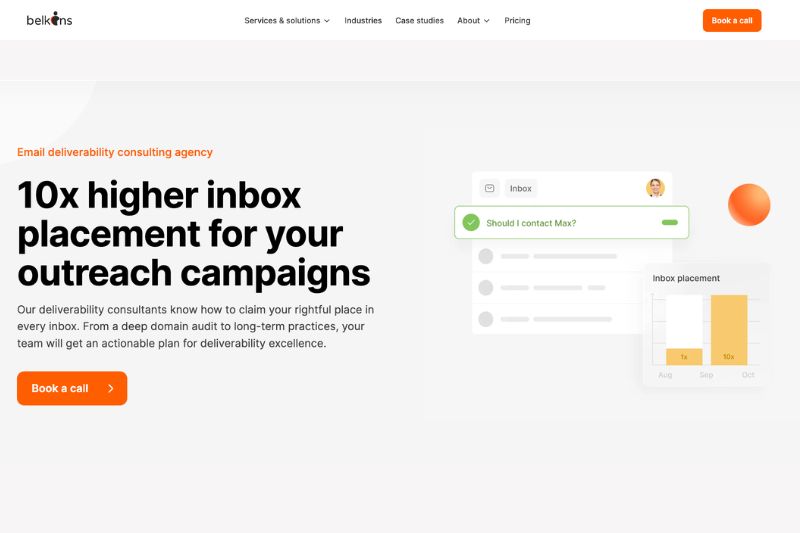
Worth mentioning separately: Belkins offers deliverability consulting as a standalone service, separate from their full agency model. This covers domain audits, spam placement diagnosis, DNS records, IP and domain reputation, blacklist delisting, and outreach tool configuration. This is a more proportionate option than hiring a full agency, which is a somewhat common need for in-house RevOps people who know what they’re doing but have run into a problem they can’t diagnose alone.
Watch out for: This is an advisory and audit engagement. Once the recommendations are implemented, continued monitoring is your responsibility.
Pricing: Custom; based on audit scope.
Can it be easier to improve inbox placement?
Most go-to-market problems that look like messaging problems are actually infrastructure problems. That’s solvable, but only if someone properly owns it.
Software tells you what’s wrong. The services above fix it, keep it fixed, and free up the people running email campaigns to focus on what they’re actually good at.
You can hire a managed service, or you can start fixing the underlying signals today. InboxAlly is the fastest way to strengthen inbox trust across domains while your team keeps running campaigns. Try it free and measure the difference yourself.