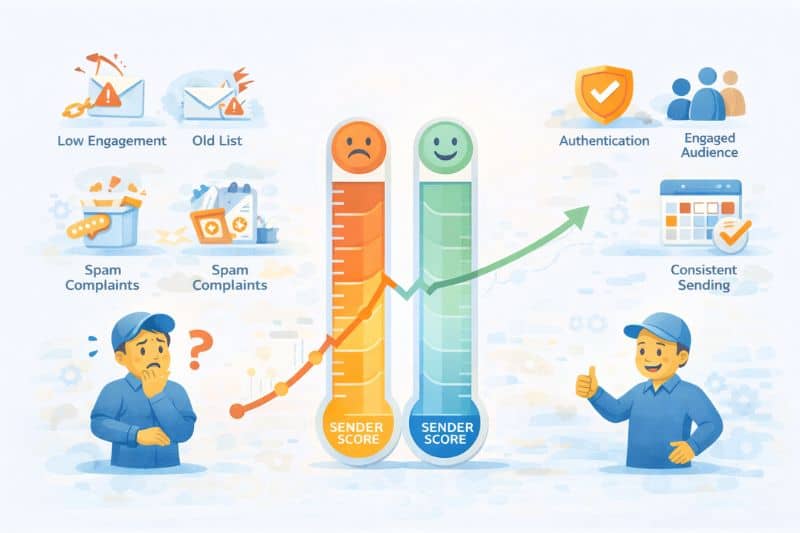
Sender score advice hasn’t aged well, and most marketers feel it as stalled inbox placement, fixes that don’t work for too long, and campaign performance that just isn’t what it used to be. Things like proper email authentication and a decent list no longer explain the outcomes you see today.
That’s because sender score is more of a consequence than a tactic, and just like a good habit, keeping it in shape takes daily discipline.
Unlike most email deliverability guides that focus on tools and settings, this article looks at sender score the way mailbox providers and internet service providers do: as a long-term read on behavior, patterns, and audience response.
By the end of it, you will learn:
- What sender score reflects
- Why “doing everything right” can still lead to worse placement
- How engagement, list age, and sending rhythm influence reputation
- Which fixes help over time, and which ones just waste your time
If you’ve fallen victim to the spam folder and see no way out, keep reading.
Key takeaways
- Sender score changes only when mailbox providers see consistent sending patterns and good engagement. Configuration changes alone do not affect it.
- Most attempted fixes fail because they rely on infrastructure or tools instead of audience quality, sending frequency, and actual subscriber response.
What does the sender score represent?
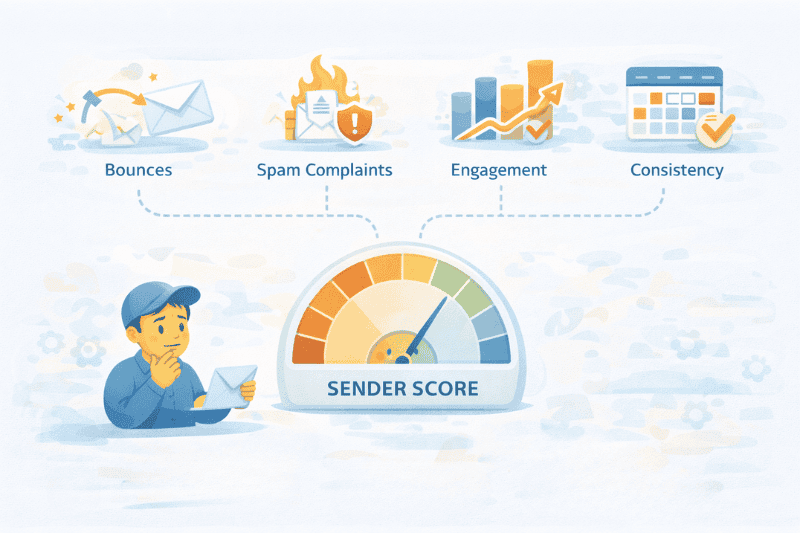
The email sender score is built from recipient reaction data. What happens after messages arrive? Not what the sender intended. Not what the template looks like. Just outcomes.
That reaction data is very specific:
- Bounces (did this address even exist?)
- Spam complaint frequency (how often someone reports spam?)
- Engagement (opens, click-through rate, replies)
- Consistency (is sending predictable over time?)
Once enough of that data goes through, inbox providers form an expectation of what mail from this sender usually looks like in the real world. Sender score is a summary of that expectation.
This is why “doing everything right” doesn’t always translate into better placement. The setup can be correct while the audience has aged out. A list can be technically valid while half of it hasn’t opened a single email in months. The mail keeps going out, the response rate gets worse with each email, and future email marketing campaigns get treated more cautiously.
Infrastructure changes don’t rewrite that history. They mostly change how quickly new outcomes become apparent in the record. The same audience, same rhythm, and same response patterns always bring the same outcome.
Why “doing everything right” still isn’t enough

What do you do when seemingly everything you can control is in place, and your email marketing metrics are still disappointing?
If authentication is in place, templates render correctly, and nothing is obviously wrong, there’s little else you can do. That loss of control is something that drives most email marketers crazy (and for a good reason)
While you should be on top of these things, technical fixes alone can often feel delayed or ineffective. Mailbox providers don’t judge whether today’s email meets all the technical requirements. They judge runs of behavior over weeks and months (or at least long enough to see a pattern). A carefully thought-out campaign today doesn’t overwrite a long stretch of mixed outcomes yesterday. It just joins the record.
There’s another, more subtle contributor that a lot of people underestimate, and that is list age.
Over time, audiences change. People switch jobs, interests dwindle, and much of the contact information previously provided becomes outdated. Mail keeps going out, but fewer people react. From the outside, that looks like mail people no longer want or care about.
None of this is malicious; it’s just how email works. But this entropy in a mailing list accumulates, and it does so slowly enough that it’s easy to miss.
Later, we will talk more in-depth about why list age matters more than how big the list looks on paper, but for now, the important part is this: poor placement usually means the sending history being evaluated no longer matches the assumptions behind the sending strategy.
IP reputation vs domain reputation: same sender, different histories
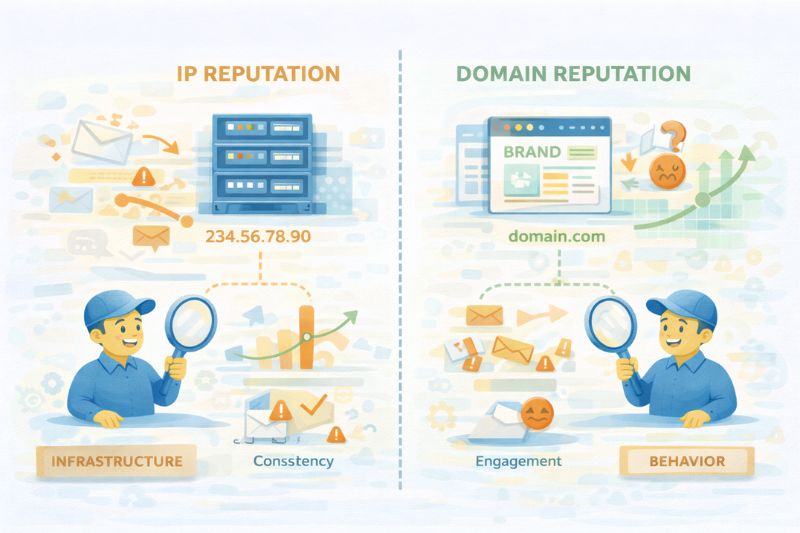
IP reputation and sending domain reputation get lumped together, which is where a lot of confusion starts. They’re related, but they’re not interchangeable since they answer different questions.
IP reputation is about how mail is sent. That includes sending volume patterns, bounce behavior, consistency (or inconsistency) over time, etc. It reflects what inbox providers have observed from a specific piece of sending infrastructure. When an IP has a long, stable history, they know what to expect when mail arrives from it.
Domain reputation is about who the mail is from. It forms more slowly and tends to last longer, which also makes it harder to repair. It reflects how recipients react to messages tied to a brand or organization. Opens, complaints, and long-term engagement (or the lack of it) all contribute to that assessment.
Because these histories are tracked separately, they don’t always reflect the same state. An IP can look fine while the domain attached to it has a weaker standing. That usually means the infrastructure is behaving predictably, but recipients aren’t responding well to the brand’s messages anymore. The opposite happens, too: a trusted domain sending through infrastructure with a short or inconsistent history can still run into deliverability issues.
This difference explains why reputation tools sometimes seem contradictory, where one score points up while another points down. Most of the time, neither is “wrong.” They’re just reporting on different slices of history.
It also explains why infrastructure changes don’t behave the way people expect. Moving to new sending resources doesn’t erase domain history, and improving domain perception won’t immediately compensate for unstable infrastructure.
Once you understand this difference, the shared versus dedicated IP decision makes a lot more sense, and it becomes much harder to mistake it for a quick fix.
Shared vs dedicated IPs: improvement speed, not improvement magic
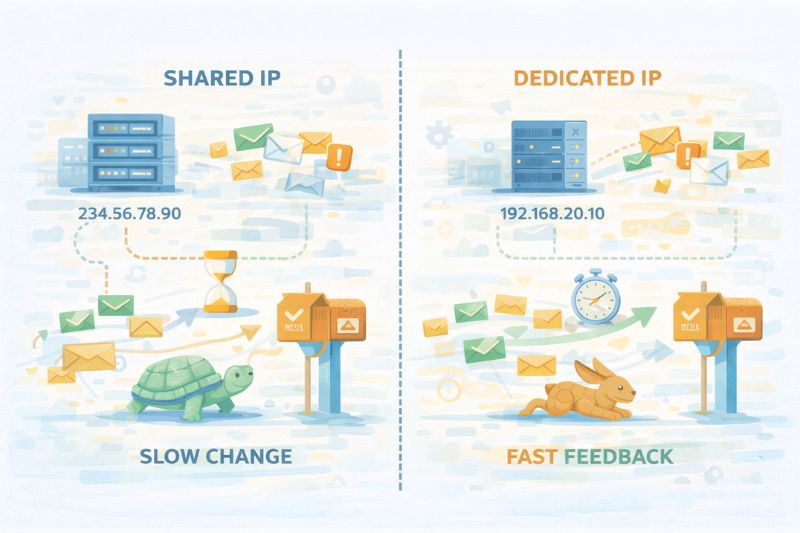
First thing worth mentioning is that dedicated IPs are not the ultimate solution, even though they’re often treated that way. There’s a trade-off with both shared and dedicated IPs.
On a shared IP address, email sending reputation changes slowly. Good behavior takes time to affect inbox placement, but so do mistakes. Risk is spread across many senders, which softens both gains and losses. That’s why shared infrastructure often feels stable, even when email performance isn’t great.
A dedicated IP address removes that cushion. Every send comes from one source, tied to one sender. That concentration makes feedback arrive faster. Improvements show up sooner, but so do problems. Sender score changes quickly because there’s no shared history to absorb the impact.
This is where expectations usually break. Marketers sometimes move to a dedicated IP, keep sending the same way, and expect better placement. What they actually get is a more direct view of existing problems. If engagement is poor or the list is filled with disinterested leads, those issues are no longer masked.
A dedicated IP doesn’t repair email reputation or the sender score. It accelerates feedback. Used with good sending practices, it can be helpful. Used as a shortcut, it usually makes things worse faster.
If faster feedback is exposing problems you didn’t expect, InboxAlly can help. By sending to real seed inboxes, simulating authentic engagement, and letting you control timing, volume, and sender profiles, InboxAlly stabilizes engagement patterns before reputation becomes a constraint on your email campaigns. Book a free demo and see how it works.
Engagement is the multiplier most teams underestimate
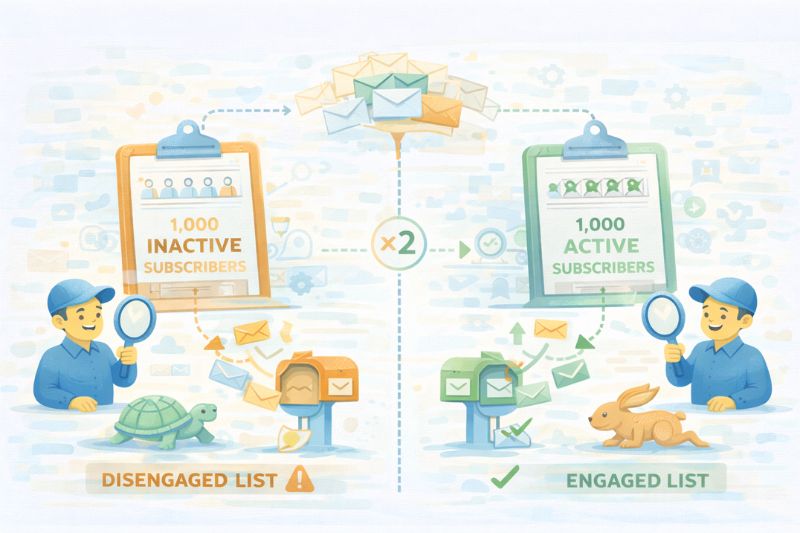
As mentioned earlier, providers observe what recipients do with your mail once it arrives. Do they open the message? Click through? Delete it without reading? Let it sit unread? All of these engagement outcomes are directly correlated with list age, which is counterintuitively more important than list size.
A large list can look good on paper while behaving very differently in the inbox. The biggest risk is inactive subscribers, because they don’t trigger obvious failures. There are no hard bounces or complaints to flag a problem. Instead, repeated non-response slowly changes how future emails are treated, even for the portion of the audience that remains engaged.
That’s also why re-engagement campaigns work best as corrective measures rather than routine sends. When used sparingly, they help separate active readers from everyone else, but at a higher frequency, they can reinforce the same pattern of low response and hurt your sender score even more.
Engagement changes slowly, and so does sender reputation. When audience quality improves, the number follows. When it doesn’t, no technical fixes will make a dent in improving your sender score.
Monitoring sender score without chasing noise
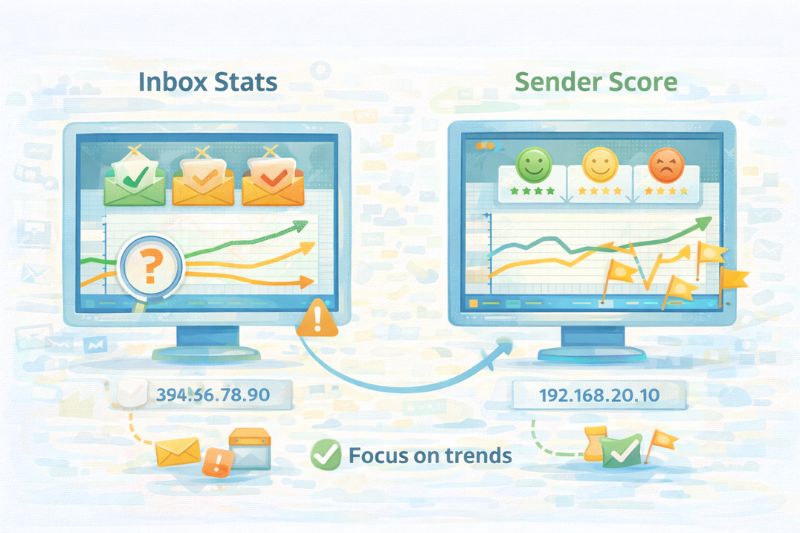
Monitoring sender score works best when it’s treated like a trend line.
Mailbox providers don’t publish their internal judgments, so anything you see externally is partial by design. Postmaster tools are useful because they show how a specific provider is treating you as a sender over time. They’re not there to give certainty, but they can show direction. Is trust improving, not moving, or weakening? That’s what you want to know.
Third-party sender score tools are one level further out. They aggregate signals, apply their own interpretation, and turn it into a number. That number can be helpful for spotting movement, especially sudden drops, but it isn’t a clear-cut verdict you should bet your life on. It’s an approximation of how risk might be perceived, not whether every inbox will accept your mail.
These scores don’t always match because inbox providers don’t judge senders the same way. One provider can become more cautious while another stays neutral. Seeing mixed feedback doesn’t mean that there’s something wrong with the data. Sometimes multiple interpretations are happening in parallel, and that’s where the ambiguity comes from.
The changes you should react to are directional, and they usually appear as a sustained decline or abrupt changes after a campaign. Small daily swings are rarely actionable.
Improving the sender score works
Sender score is important for inbox placement, but it shouldn’t be intimidating.
Once you understand what influences it, improving it becomes a matter of focus and daily care. With the framework and examples covered in this article, you have what you need to assess your current approach, make targeted adjustments, and move your sender score in the right direction over time.
When audience, cadence, and expectations match, inboxes respond accordingly. The number follows on its own.
If deliverability has become unpredictable and it’s hard to tell what’s helping versus what’s making things worse, InboxAlly can help. Book a free demo to see how InboxAlly supports consistent inbox placement by reinforcing engagement patterns that mailbox providers respond to.