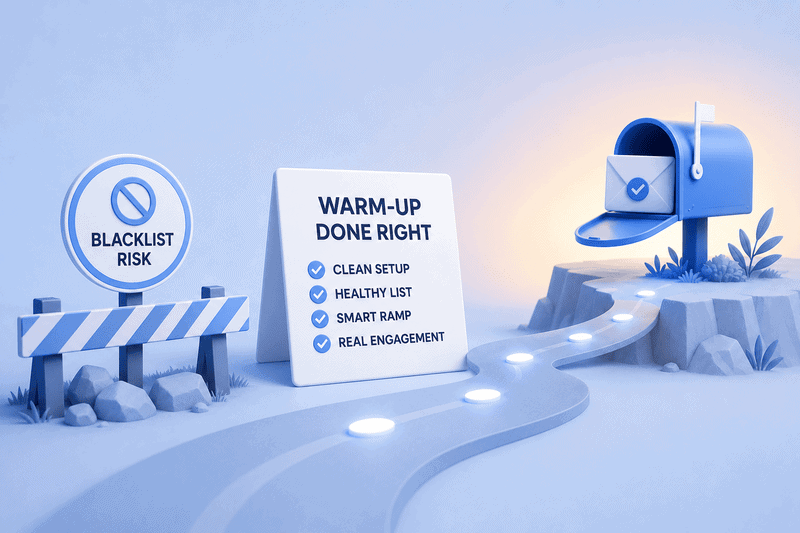
Whenever you ask for advice on email warm-up, you’re usually told to ramp up slowly, authenticate properly, clean your lists, and keep an eye on the bounce rate. Solid advice, all of it. But it leaves out the strange, often overlooked fact, which is that a lot of senders get blacklisted during warm-up, not before they started warming, and not after they finished. They follow the rules and still end up on a blacklist like Spamhaus within days.
How does that happen?
It happens because warm-up is the most reputation-fragile period your domain will ever go through, and small choices you made before the first send (or small patterns you misread along the way) create the conditions for a blacklist hit to detonate later.
In this article, we’ll go over why warmed-up domains still get blacklisted, the inherited reputation problems that follow you from the first day, and why “perfect” engagement during warm-up can actually backfire. By the end of it, you’ll know how to avoid email blacklisting during warm-up and how to read the whole process like a doctor reads early symptoms. Let’s begin!
Key takeaways
- Blacklisting during warm-up is usually caused by inherited reputation problems, list and link issues often unnoticeable at low volume, and a misreading of when warm-up is actually finished.
- The riskiest moment is in the first production send after the warmup, when a sudden volume jump makes a warm domain look brand new to every reputation system watching.
What does a “warm-up” do?
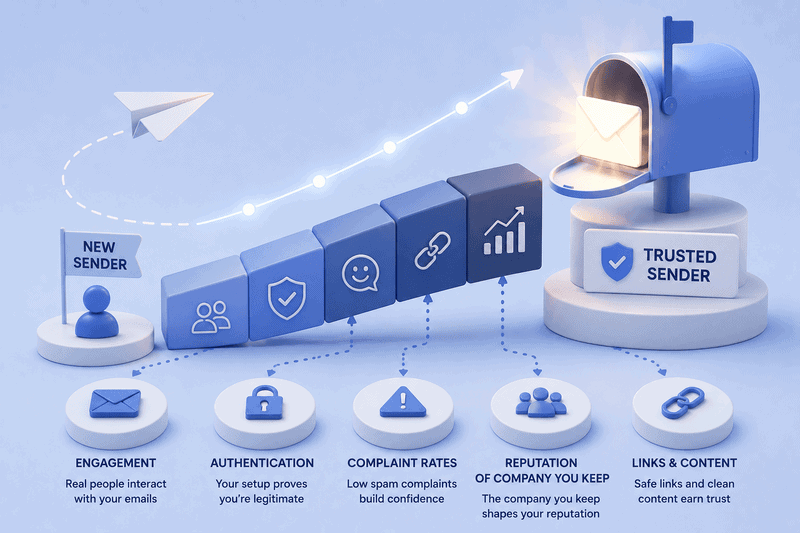
Warm-up essentially teaches mailbox providers that your domain belongs to a real human or business that sends real mail that real people want, and volume is just one of the levers affecting this. Underneath, internet service providers are evaluating engagement, authentication consistency, complaint rates, and the company your domain keeps (its IP neighborhood, its hosting, the links inside its emails).
It’s very important not to see an email warmup as a workout plan, where you add ten reps a day and call it progress. In reality, it’s closer to a credit score. This means you don’t build one by spending more money each week, but instead by spending predictably, paying on time, and not setting off any of the dozens of background checks lenders run.
This is an important distinction because the things that get you blacklisted during warm-up are usually background checks you didn’t know were running.
The reputation you inherited before your first send
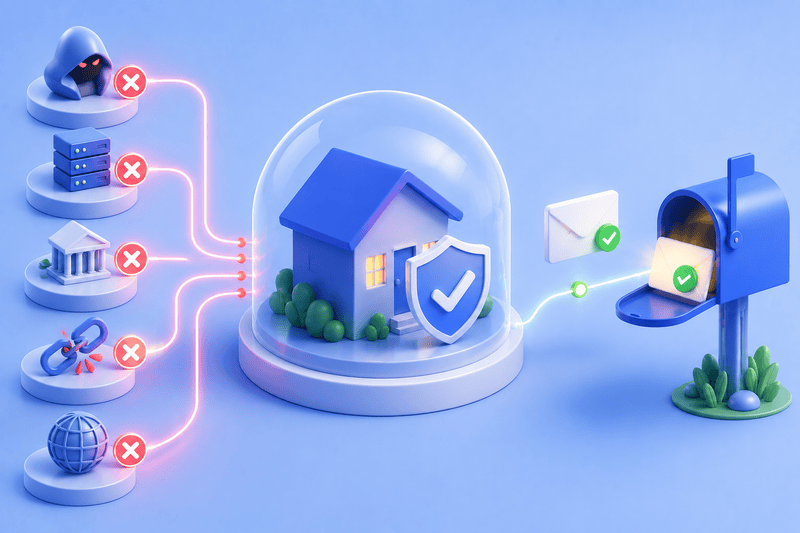
You might think a warm-up starts with the first email, but in reality, it begins as soon as you register the domain, pick a host, and set up DNS.
A surprising number of warm-up blacklist listings come from things that were already true before a single message went out:
- The domain was previously owned and used by a spammer, and the old reputation never fully decayed.
- The hosting provider comes from an IP range that some blacklists (UCEPROTECT is infamous for this) treat as guilty by association.
- The domain was registered through a registrar that’s been flagged for hosting abusive infrastructure at scale.
- The links you plan to use in your warm-up emails resolve to URLs already on URI blacklists.
You can run a perfect ramp on top of any of those and still get blacklisted. The blacklist isn’t reacting to your behavior but to the address you moved into.
Before starting warm-up, run the domain through MXToolbox and check for prior listings, query the domain’s history through a tool like Wayback Machine, and verify that every link you’ll include in early emails resolves to a clean destination. If you skip this, you’ll most likely pay for it twice: once when you get listed, and again when you have to delist.
Disclaimer: You should never pay real money for delisting. While some blacklists offer paid “expedited removal,” reputable ones (Spamhaus, SpamCop, Barracuda) don’t charge a cent. Any blacklist demanding a fee to delist is either running a soft extortion scheme or has so little impact with mailbox providers that being on it doesn’t meaningfully hurt your deliverability anyway.
The warm-up paradox
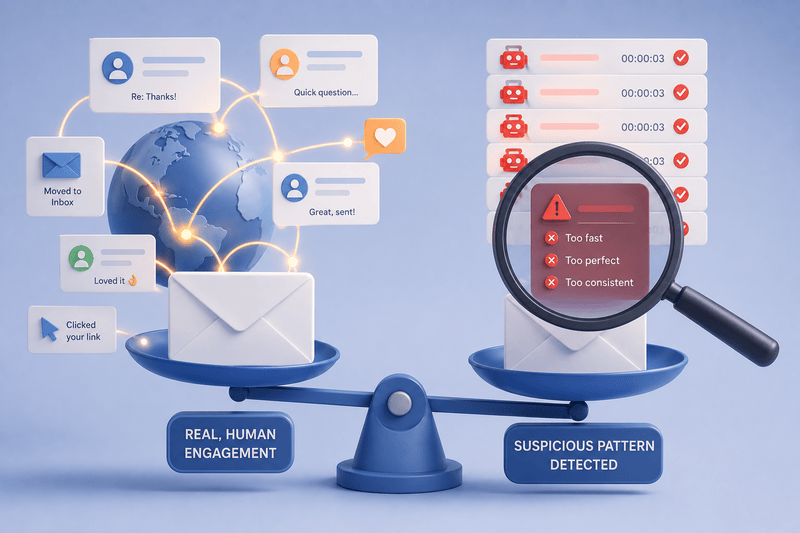
One of the strangest parts of a warm-up you might not have known is that the exact engagement signals you’re trying to build (opens, replies, link clicks, moves out of spam) are also the ones blacklist operators and spam filters use to detect fake engagement.
Why does that matter? Because if your warm-up pattern looks too clean, too symmetrical, or too consistent, it starts skewing into that “too good to be true” category. Providers have gotten very good at spotting reply chains that all happen within three minutes of delivery, or open rates that hover at exactly 100% for two weeks running, or click patterns that fire in perfect intervals.
This is one of the reasons cheap warm-up tools often backfire. They generate engagement, but they generate it in ways that pattern-match to bot behavior, and providers downgrade the reputation they were supposed to build.
What a good warm-up engagement looks like in practice:
- Opens spread across hours and time zones, not bunched in the first 90 seconds after delivery.
- Replies that vary in length, timing, and content, rather than arriving back instantly with the same template structure.
- A mix of actions between messages: some replies, some clicks, some moves out of spam, some marked as important. Not every message needs to get every action.
Realistic engagement is what InboxAlly builds during warm-up, which is part of why it’s used as a reputation-shaping tool on top of whatever sending platform a team is already on. The point is plausibility, and that’s exactly what you’re building when you get started with InboxAlly.
Early list mistakes that show up late

Two list problems do most of the warm-up blacklisting that gets blamed on volume.
The first is spam traps. A pristine trap (an address created solely to catch senders who don’t have permission) can put you on Spamhaus within hours of being hit. Recycled traps (addresses that were once real but went dormant and were reactivated as detection tools) do their damage more slowly. The common factor is that traps rarely end up on properly opted-in, recently verified lists. They end up on purchased lists, scraped lists, or lists that were clean two years ago and haven’t been validated since.
The second is hard bounces. Google and Yahoo expect spam complaint rates to stay below 0.10%, with anything reaching 0.30% triggering active filtering on Gmail, and bounce rates above 2% during warm-up signal the same kind of list-quality problem to most providers. Spam rate is calculated daily, so keep it below 0.1% and prevent it from ever reaching 0.3% or higher.
The trick is that at low warm-up volume, even a small number of bounces or one trap hit produces ugly ratios. Twenty emails a day with two hard bounces is a 10% bounce rate. Same list, same problem, but the math is catastrophic at warm-up scale and inviting at production scale, which is exactly the opposite of how reputation actually accumulates.
Things that can go wrong by the third week
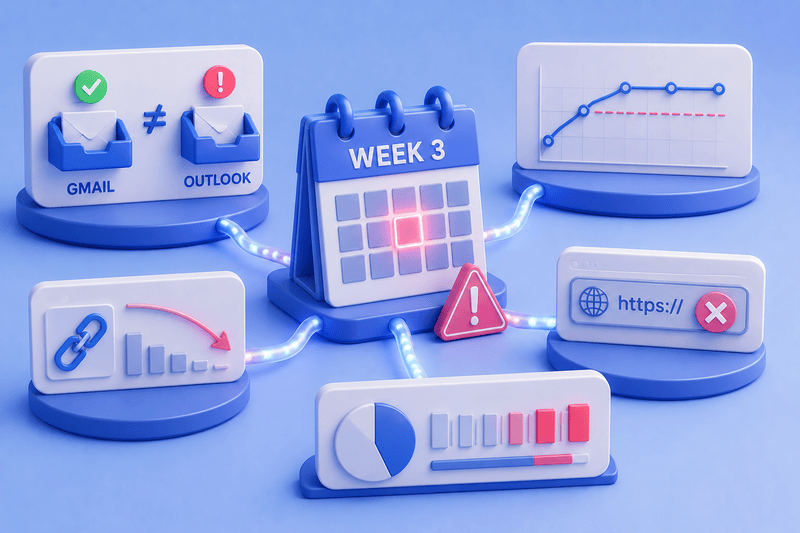
If you’re going to get blacklisted during a warm-up, you’ll usually notice it somewhere around the third week. Usually not because something new went wrong, but because the slow-build problems from within the first week finally have enough data behind them to push things over the line.
A few things to watch for in the back half of warm-up:
- Provider divergence. Gmail placement is fine compared to Outlook placement, or vice versa. This usually means one provider’s reputation system has caught onto something the other hasn’t yet, and the second one is days behind. Always run separate inbox placement checks for each provider.
- Engagement plateau. Open and reply rates aren’t increasing steadily. This is often the first visible sign that a reputation system has started downgrading you, even though placement reports haven’t caught up.
- First link-click drops to zero. If recipients were clicking and then stopped, the issue may not be the email. It may be that a URL in the message is now on a URI blacklist, and clients are suppressing the link.
- Postmaster Tools data finally populates, but it looks worse than expected. Google won’t show reputation data until you’ve sent to hundreds of Gmail users daily, which usually happens late in warm-up. The first real number is often a shock.
Each of these is a “before” signal, so if you read them in time, you can usually fix the underlying issue before you get blacklisted.
The first real send after a warm-up
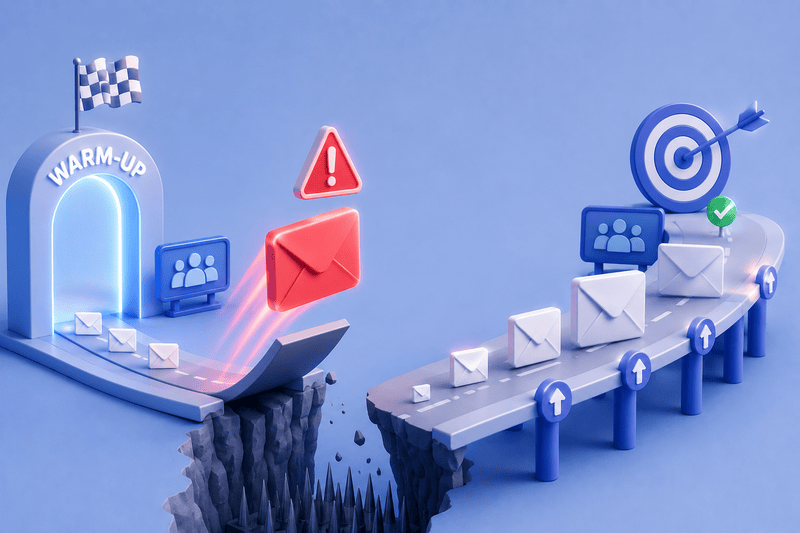
As we mentioned earlier, the most common time senders get blacklisted isn’t during warm-up at all, but in the first “normal” send after warm-up ends.
Why? Because many senders treat the end of warm-up as a graduation, jumping from 50 warm-up emails per day to 5,000 production emails on Monday morning, every reputation system that was happy on Sunday treats the spike as a brand-new sender behaving like a spammer. The warm-up was great, but the exit was rushed.
A realistic post-warm-up ramp keeps daily volume increases under 30% for at least another two weeks and keeps a portion of daily volume directed to engaged contacts so engagement signals don’t dry up overnight.
Is your warm-up safe, or just on schedule?
The rules everyone repeats about warming up a domain don’t explain what actually causes blacklisting: inherited reputation, synthetic-looking engagement, list problems that hide at low volume, and the risks that appear right after warm-up ends. Warm-up is a reputation sensitivity window, where small signals become long-term outcomes. That means most blacklisting events that catch good senders by surprise often leave warning signs first.
If your domain ends up being blacklisted even though you “followed all the rules,” the rules probably weren’t explaining the whole picture. InboxAlly helps improve the engagement signals mailbox providers evaluate alongside authentication, reputation, and sending behaviour. Book a free demo to strengthen the part of warm-up most other tools still ignore.