
Cold emailing remains the cornerstone of marketing strategies that effectively generate leads and expand business reach. However, as technology advances, there is a growing concern and need to maintain online privacy. So it’s only natural for you to wonder, “Is cold emailing illegal?”
You don’t want to compromise your cold outreach campaign and tarnish your reputation as an email marketer.
So we’ll walk you through cold emailing regulations in different countries, how to differentiate cold emailing from spam, and more. Keep reading to ensure your cold emails are legally compliant!
Is Cold Emailing Considered Spam?
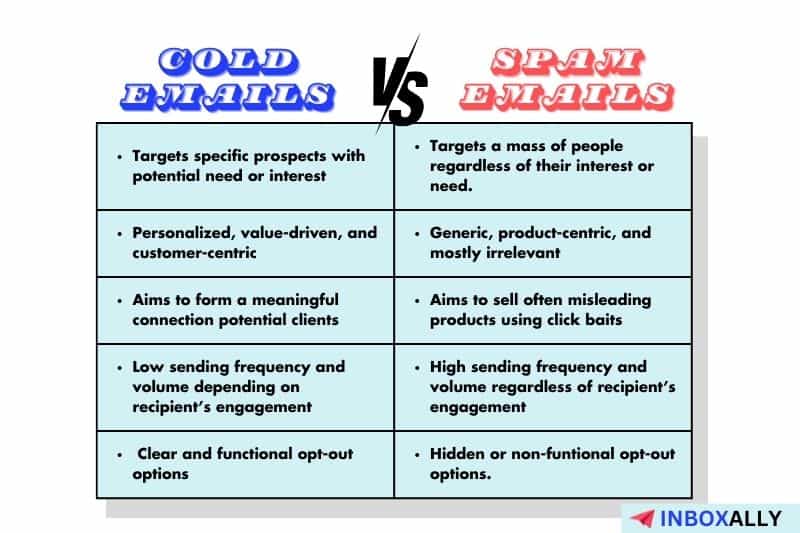
No, cold emails are not spam emails. Technically, cold emailing and spamming both involve sending unsolicited commercial messages or emails that the recipient never requested or agreed to receive. However, the two differ in various ways, especially when it comes to intention, sincerity, personalization, and frequency.
The table below details the major ways you can differentiate a cold email from spam:
When Does a Cold Email Become Spam?
Even though there is a difference between a cold and a spam email, over the years, cold emailing has received a bad reputation based on the strategies some email marketers use. The two most common reasons for your cold emails landing in spam are:
1. Triggering Spam Filters
Email Service Providers (ESP) have spam filters in place to keep unsolicited emails from flooding their users’ inboxes. Spam filters differ depending on the ESP, and various elements of your email can trigger the filters, such as deceptive subject lines.
A good way to avoid spam folders is to test your emails using a spam checker. Using Inboxally’s spam checker, for example, you can check if your DKIM & SPF are properly configured, if your domain has any issues, and if your email headers, HTML, URL, and email template are not spammy among other triggers.
Don’t let your important emails get lost in the spam folder. Use Inboxally’s free Email Spam Checker to ensure your cold email reaches the inbox.
2. Spam Complaints
A spam complaint results from a recipient marking your email as spam. This means that all your future emails may be directed to the spam folder. Spam complaints often happen when the recipient doesn’t see value in your emails or finds them annoying. This could be due to misleading subject lines (click baits), impersonal and irrelevant content, or overly promotional and intrusive messages that show no clear value to the recipient.
Learn more about how you can reduce spam complaints and improve your cold email outreach through our detailed guide on How To Write a Cold Email That Gets Opened and Read.
Is It Okay to Send Cold Emails?
Now that we’ve drawn a line (well, technically a thin line) between cold emails and spam emails, let’s address the big question: is it legal to send such unsolicited emails in this digital era?
Yes, you can legally send cold emails, including sales outreach emails, but you have to follow specific laws and regulations. These regulations involve ethical considerations like avoiding spamming practices and respecting the recipient’s privacy and preferences, among other do’s and don’ts.
But why should you care about cold email laws? First and foremost, you avoid legal repercussions, such as heavy fines and penalties (and sometimes lawsuits), that could lead to significant losses. But there are also other major benefits you can enjoy as an email marketer by staying compliments with cold emailing laws, such as:
Improved email deliverability
You’re able to maintain a positive sender reputation by sending compliant cold emails. This increases the chances of your emails landing in the recipient’s inbox. This, in turn, improves overall email deliverability.
Guaranteed campaign success
Complying with the standards set by cold emailing laws means you’re generating relevant, value-driven, and personalized cold emails. Recipients are more likely to open and engage with such emails and possibly even take action. This not only boosts your engagement and open rates but ultimately increases your cold email campaign’s Return on Investment (ROI).
Increased Brand Loyalty
Following the regulations set when sending a cold email shows recipients that you are committed to respecting their privacy and preferences. This trust helps you build meaningful long-term customer relationships. That in turn will help increase brand loyalty through increased repeat customers in your business.
Curious about the best practices for sending personalized and compliant cold emails? Read our detailed guide on Personalized Cold Email – A List of Best Practices That Work in 2024
Understanding Cold Emailing Regulations Around the World
Cold emailing laws and regulations differ depending on the geographical location. To ensure your cold email remains compliant regardless of where you or your recipients are in the world, you must understand the various regulations set in different countries.
Is it Legal to Send a Cold Email in the US?
Cold emailing is legal in the United States (US) as long as you follow the guidelines laid out in the CAN-SPAM Act that was enacted in 2003. These guidelines were created to regulate the sending of both solicited and unsolicited commercial emails and give recipients the option to opt out.
According to the CAN-SPAM Act, for your cold email to be considered compliant, you must:
Use clear and transparent information
You should provide accurate header information (i.e., “from,” “to,” “reply-to,” and routing information). The information should clearly and accurately identify the email sender. Also, avoid using deceptive subject lines or misleading information within your email.
Identify the email as an advert.
CAN-SPAM Act requires you to inform the recipient that the email is an advertisement. There are no restrictions on how exactly you should do this as long as it’s clear to the recipient that the email intends to advertise your product or service.
Provide a physical location.
Part of the CAN-SPAM Act guidelines is that you should provide a genuine and updated physical address to prove the existence and credibility of your business. It can be a street address, a P.O. Box registered with the U.S. Postal Service, or a private mailbox registered with a commercial mail-receiving agency or service.
Offer easy opt-out options.
Recipients should be able to easily opt out of receiving future emails from you. The opt-out service you use should be able to process opt-out requests for at least 30 days from when the email was sent. CAN-SPAM Act also requires you to process all opt-out requests within 10 business days of receiving them.

NOTE: Violation of any of the CAN-SPAM Act could lead to a fine or penalty of up to an average of $50,000. These penalties will also apply to you even if you’re using a third-party emailing service. So, you are required to ensure that any emailing service you use is CAN-SPAM Act compliant.
Is Cold Emailing Illegal in Canada?
You can legally send a cold email in Canada as long as you have explicit or implied consent from the recipient. This is among the guidelines stated in Canada’s Anti-Spam Legislation (CASL).
But implied consent is only acceptable in certain scenarios. For example, if there is a proven existing relationship between you and the recipient (business or otherwise), it’s implied that the recipient may want to receive marketing emails from you. Implied consent also applies in the case where the recipient’s contact information is publicly available with no suggestion that they’re against receiving marketing emails.
Aside from receiving consent from the recipient, the CASL has two other major requirements which are:
- Provide accurate identification – this involves providing a valid and active email address, along with an updated physical address and contact information.
- A clear and functioning opt-out mechanism – the recipient must be provided an easy-to-use and properly functioning unsubscribe link or something similar. You must also promptly honor their request to opt-out.
The CASL was created in 2014 to regulate all commercial electronic messages sent by native and international businesses within Canada. It is considered the strictest anti-spam regulation worldwide, given its emphasis on the need for consent and violation fines that can go up as high as $10 million.
Is Sending a Cold Email Illegal in Australia?
Like the Canadian regulations, you can legally send a cold email in Australia as long as you have the recipient’s consent. This is stated in the Australian Spam Act (2003), which has similar compliance requirements to the CASL, that is:
- Get the recipient’s consent (explicit or inferred/implied consent, e.g., if the recipient gave you their contact information beforehand)
- Provide the identification information of the sender who authorized the email sending.
- Have a simple and functional unsubscribing mechanism, whose request must be honored within 5 days.
What’s worth noting about the Spam Act (2003) is that it applies to all emails opened within the country, regardless of where you’re sending them from.
Can You Legally Send Cold Emails in Europe?
Yes, you can legally send cold emails in countries within the European Union as long as they comply with the guidelines of two main regulations. These are the General Data Protection Regulation (GDPR) and Privacy and Electronic Communication Directive (PECD).
The PECD came out first in 2002 and focuses mainly on the right to privacy, whereas the GDPR came out later in 2018 and focuses on the protection of personal data. Aside from having an easy opt-out option, to comply with both of these regulations, you must:
- Send emails to recipients with legitimate interest or need of your product or service.
- Openly disclose the source of the recipients’ information.
- Delete all of the recipient’s information from your database as soon as they opt out.
NOTE: Non-compliance with GDPR requirements attracts a penalty of up to €20 million or 4% of the company’s or business’ global turnover (whichever is higher).
Is Sending a Cold Email Legal in the UK?
Yes, it is legal but it is governed by three regulations. These three regulations include the Privacy and Electronic Communications Regulations (PECR) 2003, the Data Protection Act (2018), and the UK GDPR (2018). Compliance involves meeting requirements similar to those of the EU GDPR, with the added requirement of following data protection principles in obtaining and handling personal data.
Ensure Your Cold Email Campaigns Are Compliant!
Cold emailing is legal as long as you comply with the set regulations. As we’ve explained, these regulations may differ from country to country. So, you need to remain informed about all legal requirements and updates to improve your email deliverability and guarantee your campaign’s success. With a tool like Inboxally, you not only improve your deliverability but also ensure your campaign is within legal boundaries.
See InboxAlly in Action – Schedule a Product Demo Today! Discover how InboxAlly can revolutionize your cold email outreach. Schedule a demo with our experts to see the features and benefits of our platform in real time.