About the Author: Kath Pay is a globally recognised email marketing consultant, strategist, and international keynote speaker with over 25 years of experience. As the Founder and CEO of Holistic Email Marketing, she partners with brands to improve performance through strategy, deliverability, and her pioneering Holistic Testing Methodology. Kath is the author of the best-selling book Holistic Email Marketing and is known for integrating behavioural science and psychology into modern email marketing practices.
When emails start landing in spam, most senders want the fastest possible fix. That is understandable. When campaigns miss the inbox, revenue, leads, registrations, and relationships take a hit.
The pressure to act quickly is real. So, teams start changing things.
They rewrite subject lines. They reduce send volume for a few days. They remove words they think might trigger spam filters. They send only to their most engaged subscribers for a short period. Some even switch domains or move sending infrastructure, hoping for getting a fresh start.
Some of these actions might create a temporary lift. But temporary improvement is not the same as deliverability recovery.
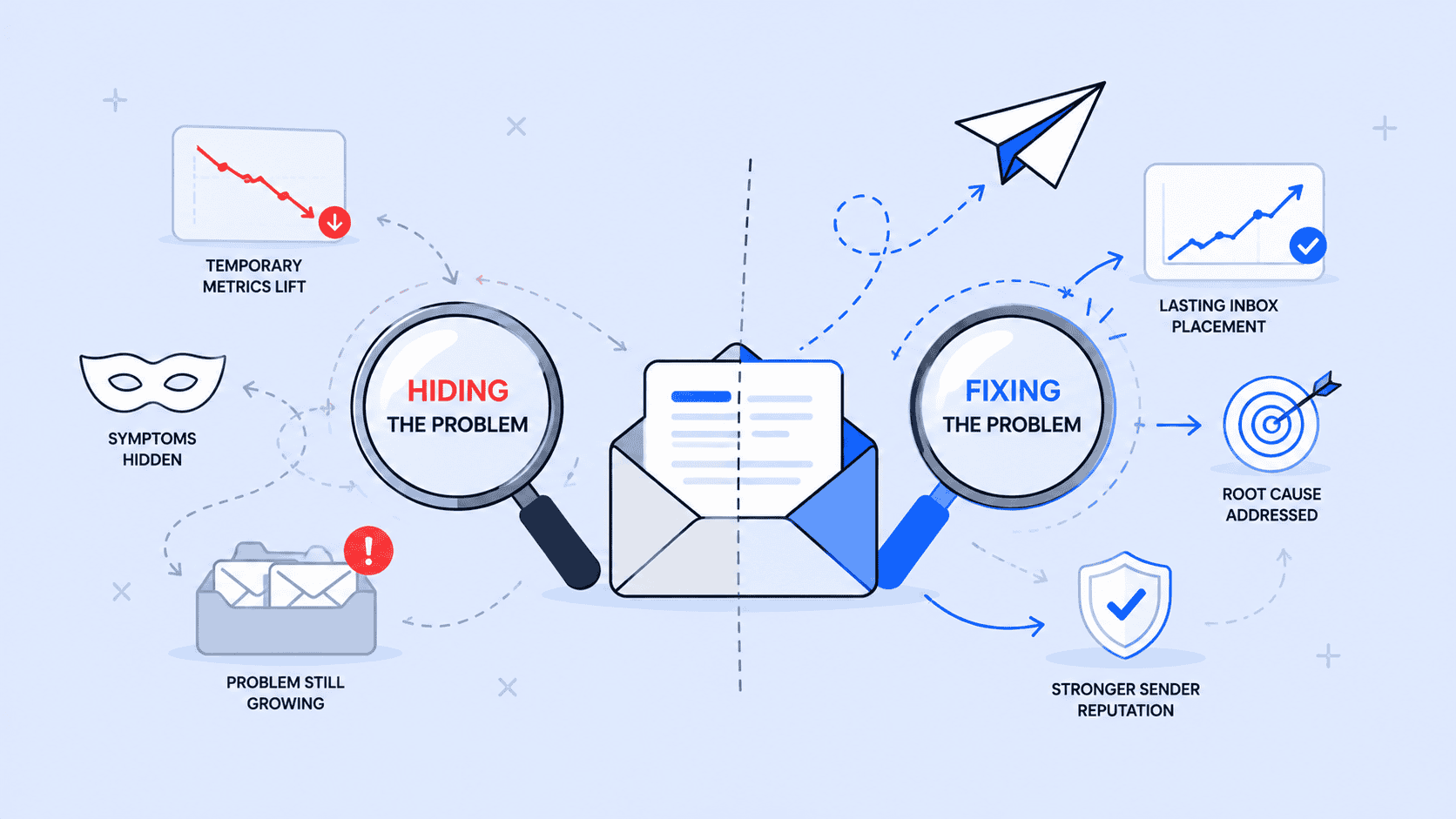
That is where the difference between fixing email deliverability problems and simply masking them becomes important:
- Masking a deliverability problem means making the symptoms look better without resolving the underlying cause.
- Fixing a deliverability problem means identifying what damaged trust and changing the sender behavior that created the issue.
In other words, poor inbox placement is rarely the whole problem. It is usually the warning light on the dashboard.
What does masking a deliverability problem mean?
Masking happens when a sender’s reparative action improves metrics in the short term but leaves the root cause untouched.
For example, a brand might try changing subject lines. That feels logical, especially if the team believes certain words are triggering spam filters. But changing the subject line will not solve the problem if the real issue is poor list quality, complaints, inconsistent sending, or lack of consent.
The same is true for reducing volume for a few days. A smaller, more engaged send might perform better, but that does not mean the sender reputation has fully recovered. It could mean only that brand has temporarily omitted its riskiest subscribers.
Domain switching is another common masking tactic. It can feel like wiping the slate clean, but the new domain could quickly develop the same reputation problems if the brand doesn’t change its list, cadence, content, and acquisition practices.
Masking makes the dashboard look better before the sender behavior gets better. That is why it can be so dangerous. You feel as if you’re making progress, but the underlying issue is still growing.
What does fixing a deliverability problem mean?
Fixing deliverability means looking beyond the immediate symptoms and asking why mailbox providers lost trust.
Mailbox providers do not judge a sender based on just one campaign. They look at patterns. They consider how recipients interact with messages, whether people open, click, ignore, delete, complain, unsubscribe, or mark emails as spam. They look at bounce rates, sending consistency, authentication, infrastructure, historical behavior, and recipient engagement over time.
A real fix starts by identifying where trust has been damaged.
That could begin by reviewing how subscribers were acquired. Did they clearly opt in? Did they understand what they were signing up for? Are old or inactive contacts still being mailed too aggressively? Do complaints come from a particular source, segment, or campaign type? Do some mailbox providers filter messages more heavily than others?
Fixing often means changing the behaviors that caused the problem:
- Tighten list acquisition
- Improve segmentation
- Adjust cadence
- Remove risky addresses
- Strengthen authentication
- Change re-engagement strategy
- Improve content relevance
- Rebuild positive engagement signals with a cleaner, more deliberate sending plan
Fixing can take more time than masking. But it is more sustainable because it addresses the trust issue instead of hiding the symptoms.
Why masking deliverability issues is risky
The biggest risk with masking is false confidence.
A sender could make a quick change and see better open rates, fewer complaints, or improved inbox placement for a short time. The team assumes the problem has been solved. So, it returns to normal sending behavior and watches the same issue come back.
This happens because the temporary tactic did not change the underlying pattern.
If poor list quality was the problem, then suppressing inactive subscribers for one campaign is not enough. If complaint-heavy acquisition was the issue, then rewriting copy will not solve it. If the sender’s cadence is too aggressive, then a short reduction in volume could merely delay the next reputation hit.
Mailbox providers are not asking whether one email looks acceptable. They are asking whether your sending behavior deserves trust.
Masking can also make diagnosis harder. When teams keep changing multiple things at once, they might not know what caused the improvement or the decline. Without a clear diagnosis, recovery becomes guesswork.
In deliverability, guesswork can be expensive. It can lead to unnecessary platform changes, lost revenue, damaged domains, frustrated teams, and repeated cycles of panic whenever inbox placement drops.
Common masking tactics that feel like fixes
Many masking tactics feel helpful because they are easy to see and quick to action. The problem is that they often focus on surface-level changes.
Changing subject lines can help campaign performance, but it rarely fixes a reputation problem on its own. Instead, teams should pair it with a review of relevance, consent, and engagement.
Switching domains can feel like a fresh start, but it does not repair the behavior that damaged the previous reputation. Careless or repeated use can even create more suspicion.
Sending less for a week might improve short-term metrics, but senders need a sustainable segmentation and volume strategy that works when normal activity resumes.
Removing so-called spam trigger words can give teams something tangible to change, but modern filtering is more sophisticated than a simple word list. Message quality, subscriber expectations, engagement, and sender reputation matter more.
Cleaning only hard bounces is another partial fix. Bounce management matters, but list quality also covers inactive subscribers, spam traps, invalid addresses, complaint sources, and people who no longer want the emails.
Warm-up activity can support recovery, but it does not substitute for fixing poor acquisition, weak engagement, irrelevant content, or inconsistent sending behavior.
These tactics are not always wrong. The problem is using them as the entire solution.
How to tell whether you are fixing or masking
A useful way to tell the difference is to ask whether the action would still work when normal sending resumes.
If the answer is no, it could be masking.
A genuine fix should follow a clear diagnosis. It should connect the symptom to a cause and the cause to a behavioral change.
For example, if inbox placement is poor at one mailbox provider, the next step should be to understand what’s triggering that provider. If one segment generates most complaints, that segment needs investigation. If engagement is falling across the list, the team should review relevance, frequency, expectations, and subscriber lifecycle stage.
Also, senders should look at multiple signals together. Open rates alone are not enough, especially with privacy changes affecting measurement. Inbox placement, complaints, bounces, unsubscribes, clicks, inactivity, authentication, and provider-level performance give a clearer picture.
The key question is simple: Are you changing the campaign, or are you changing the sender behavior behind the campaign?

A 5-step framework for deliverability recovery
A stronger recovery process starts with diagnosis.
1. Identify the trust issue.
Look at inbox placement, sender reputation, complaints, bounces, engagement, authentication, and performance by mailbox provider. The aim is to understand what is happening and where the damage appears to be concentrated.
2. Stabilize sending behavior.
Reduce risky sends, avoid sudden volume swings, and prioritize subscribers who are more likely to engage. This can contain the problem while you address the root cause.
3. Repair the underlying cause.
That could mean improving consent, removing poor-quality sources, adjusting cadence, cleaning the list, fixing authentication, reviewing content relevance, or changing how you handle inactive subscribers.
4. Rebuild positive engagement signals.
Mailbox providers need consistent evidence that recipients want the emails. This means sending wanted, relevant messages to people who are more likely to interact positively.
5. Monitor recovery over time.
A single improved campaign does not prove the problem is fixed. Recovery should hold across campaigns, segments, and mailbox providers.
Fix the trust issue, not just the symptom
Masking deliverability problems might buy time, but fixing them rebuilds trust.
That distinction matters because inbox placement is not only about technical setup, content, or one campaign’s performance. It is the result of a sender’s behavior over time.
Short-term tactics can have a role, especially when a sender needs to stabilize quickly. But they should be part of a wider recovery plan, not a substitute for one.
The goal is not to make one email look safer. The goal is to become a sender mailbox providers can trust and recipients consistently welcome.
That is the difference between hiding a deliverability problem and actually fixing it.