Email has been around since the 1970s, and it’s survived every “email is dead” headline, every new channel, and every algorithm change. Now, half a century in, it’s somehow getting smarter.
AI is changing what email marketing can do. It’s not doing it by replacing the people behind it, but by handling the parts that used to eat hours and guessing away decisions that used to be pure intuition. The results are quite interesting: automated, AI-personalized emails drive 30% of email revenue while accounting for just 2% of sends.
But most marketers are starting with the wrong use case. In this article, we’ll explore what the ones getting the results are doing differently.
Key Takeaways
- AI’s highest-leverage use cases in email are send-time optimization, behavioral segmentation, and scaled A/B testing.
- Engagement quality is the prerequisite for everything else. AI amplifies good email programs but doesn’t save bad ones. Inbox placement, sender reputation, and list health have to be solid before AI can do its best work.
You are probably using AI for the wrong thing
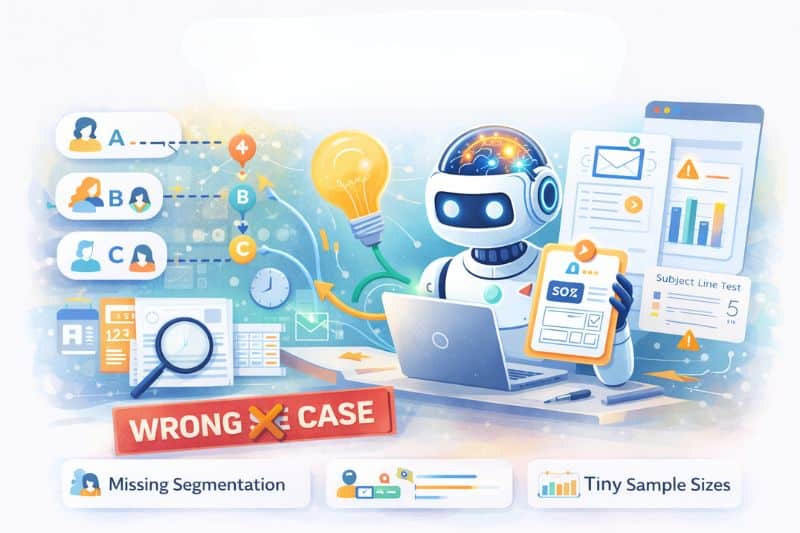
Sixty-three percent of marketers now use AI email marketing software for email, and that number keeps going up. But ask most of them what they’re using it for, and you’ll hear the same answer: writing copy.
That’s not exactly wrong since AI-generated copy is faster, and speed can sometimes be a make-or-break factor for high-volume senders. But a copy comes later in the process. If your segments are too broad, and your subject lines are tested against sample sizes that don’t mean anything, better-worded sentences won’t yield better results.
But getting the most out of AI tools comes down to making decisions that used to require a data analyst with a spreadsheet and a few free hours. That’s the actual benefit of using AI for marketing.
AI’s biggest contribution to email marketing is pattern recognition at a scale humans can’t match. We’ll get to what that looks like in practice, but first, let’s talk a bit about the distinction that might change how you think about all of this.
Two kinds of AI, two different jobs
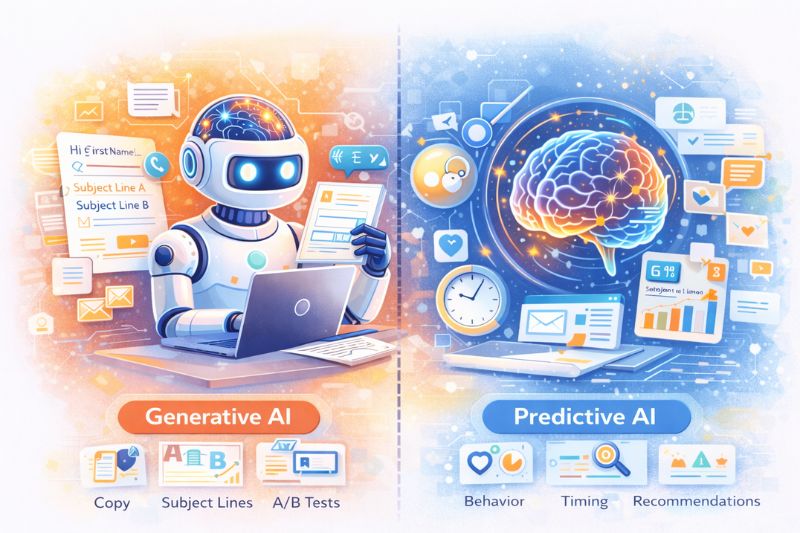
The word “AI” gets used for two things that work very differently.
Generative AI creates: drafts catchy subject lines, writes email copy, produces content variations for A/B tests. You give it a prompt, it gives you words. ChatGPT, Gemini, and the AI writing tools built into platforms like Klaviyo and HubSpot all fall here.
Predictive AI forecasts: it analyzes historical behavior to anticipate future actions. When is this specific subscriber most likely to open? Which segment is about to churn? What product should we recommend next? This is the driving force behind send-time optimization, churn scoring, and dynamic content blocks.
Most marketers start with generative because it’s visible and immediate. The output is a sentence, and you can read it. Predictive AI works in the background, and it’s often where the real gains come from. Speaking of gains, what can you realistically get out of it?
The use cases for tangible results
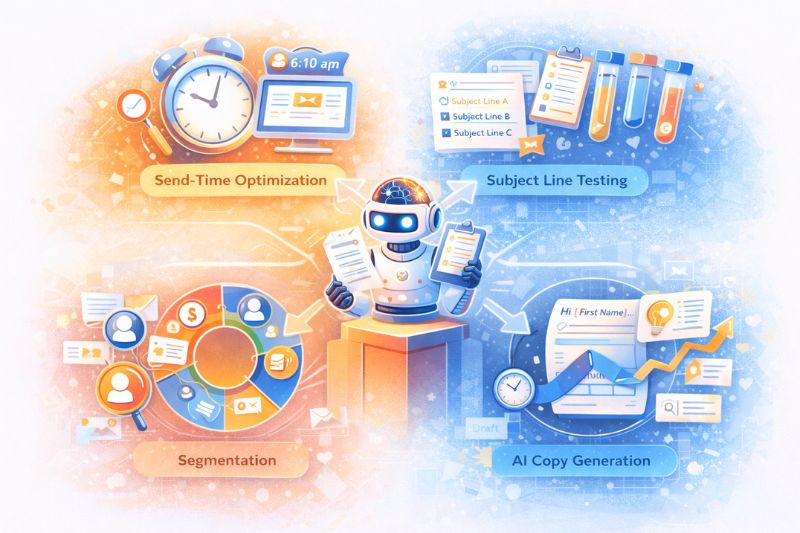
Since the industry moved toward AI, a few use cases of AI in email marketing have been shown to consistently deliver measurable gains:
- Send-time optimization. Instead of “Tuesday at 10 am” for everyone, we can now set per-recipient timing based on when each subscriber historically opens. The lift is modest per send, but it quickly adds up in a large list.
- Subject line testing at scale. AI email marketing tools generate dozens of variants and score them based on your audience’s engagement history. Oracle’s AI models train on around 20,000 email subject lines to build their scoring AI algorithms. That’s not something you replicate manually.
- Segmentation beyond demographics. There’s behavior-based segments built from purchase history, browse activity, and engagement patterns. A first-name token in a subject line isn’t personalization. Sending a win-back email to someone who hasn’t clicked in 60 days but opened three abandoned cart emails is much closer.
- Content generation as a starting point. AI copy is a first draft. It’s fast, structurally sound, and occasionally good. It also doesn’t know your brand voice, your audience’s specific sensitivities, or when a joke lands wrong, which is why human review is still required.
More than 70% of marketers have had AI-related incidents like hallucinations, off-brand output, and factual errors. The advantage with AI isn’t as simple as clicking “generate” and publishing. Editorial guardrails have to exist in every email marketing strategy.
The stats that set expectations
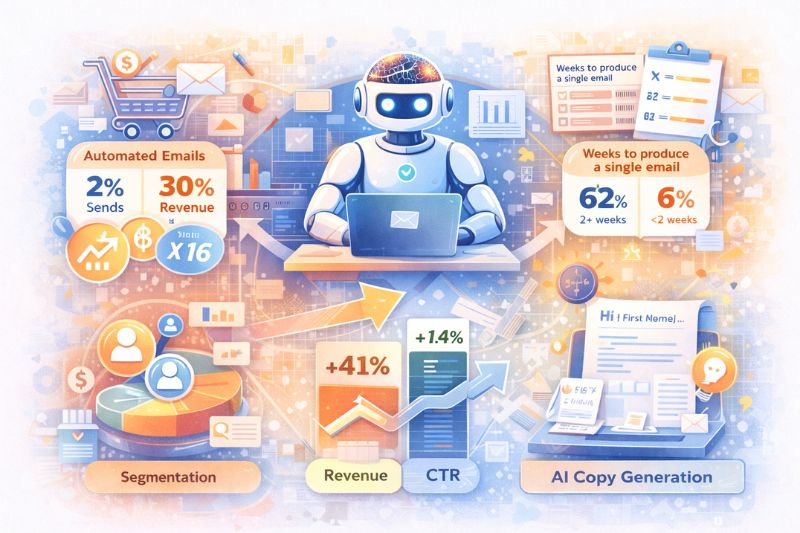
Automated emails account for just 2% of total email sends but drive 30% of revenue. They earn 16 times more per send than standard broadcast campaigns.
That’s not a marginal difference. Triggered, behavior-based emails from abandoned cart, post-purchase, win-back, and welcome sequences perform the way they do because they’re relevant at the moment they arrive. AI is what makes that relevance possible at scale.
The production side has changed dramatically, too. In 2023, 62% of marketing teams needed two or more weeks to produce a single email. By 2025, only 6% do. That compression happened because AI absorbed the repetitive, time-consuming parts of the workflow, like brief creation, copy drafts, variant generation, and performance summarization, and handed time back to the people who needed to make decisions with it.
And the revenue case is hard to argue with: AI-driven personalization increases revenue by an average of 41% and click-through rates by 13.44%. Average order value for AI-assisted senders runs about $7 higher per order. Small per-transaction but meaningful after millions of sends.
If a big slice of your email revenue comes from one-size-fits-all broadcasts, automated and AI-personalized flows can help. If you’re scaling with AI, book a demo with InboxAlly to make sure the engagement signals you’re generating work in your favor before the next big send.
What happens when AI meets a poor sender reputation
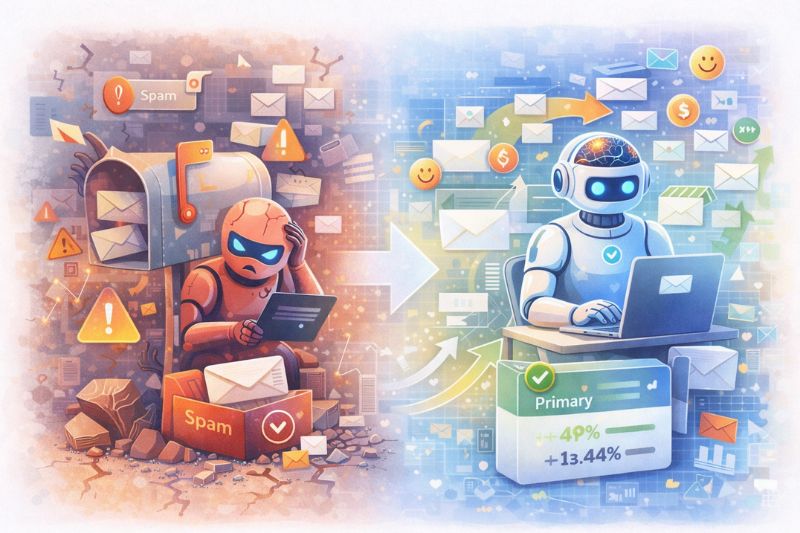
Most AI-for-email articles overlook one important thing: none of this works if your mail isn’t reaching the inbox.
Inbox providers decide where your email lands based on engagement history. This is all from open rates, click rates, replies, scroll depth, and even whether recipients move your mail out of spam. That feedback loop is how they separate wanted mail from tolerated mail.
This is exactly why the pattern-recognition point from earlier matters so much. AI helps you send more relevant emails. More relevant emails yield better engagement signals. Better engagement signals tell inbox providers your mail belongs in the Primary inbox.
But that chain only works if your sender reputation is already in decent shape. If it’s not, and you’ve been burning through disengaged lists, seeing low opens, getting filtered, better AI-generated content won’t undo the damage. The reputation has to come first.
What AI still can’t do (and probably won’t for a while)
It’s worth being honest about this because the hype doesn’t help anyone.
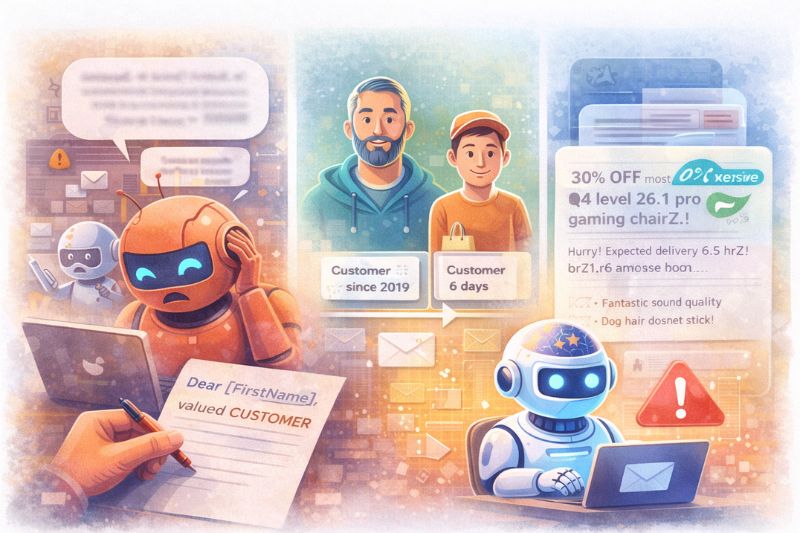
AI doesn’t have a brand voice. It has pattern-matching on language. When you ask it to “write like us,” it produces something plausible, but the specific word choices, tonal quirks, and things your audience actually recognizes as yours require training, iteration, and human refinement that most companies gloss over.
It also doesn’t understand relationships. An email to a customer who’s been with you for four years shouldn’t read the same as one to someone who signed up last week. AI can segment by tenure, but it can’t feel the difference in how those two people should be spoken to.
Hallucination is another major problem that is getting better, but remains unsolved. AI generates confident-sounding output regardless of how accurate it is. For email copy, that means it can invent statistics, return wrong product details, or use tone-deaf phrasing in sensitive contexts.
The limit on AI email performance isn’t the AI itself, but the human judgment overseeing it.
The right order to add AI to an existing program
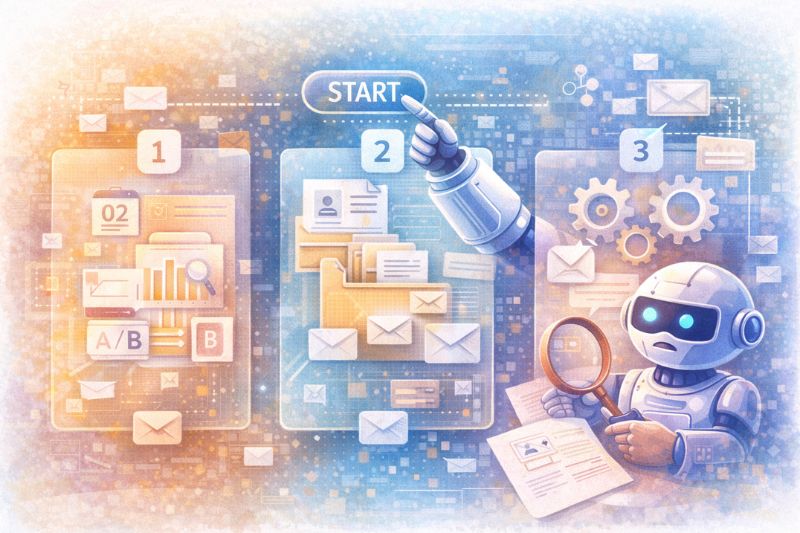
If you’ve been sending email for a while and want to incorporate AI without torching your existing program, it’s important in what order you do it.
- Start with send-time optimization and subject line testing. Lowest risk, quickest feedback. Both are available on most major platforms at no extra cost. Run them for 60 days and look at the data before moving to anything else.
- Audit your data foundation before attempting personalization. AI personalization is only as good as the data it trains on. Stale lists, inconsistent tagging, and missing behavioral data don’t get better when you add AI.
- Don’t automate what you haven’t manually proven. If a welcome sequence doesn’t convert when you build and send it by hand, automating it won’t fix the underlying problem. Prove the logic first, then let AI scale it.
The instinct is to start with the flashy stuff like AI-generated marketing campaigns and funnel automation. But does any of that matter if the foundation isn’t there?
If you’re about to roll out “full-funnel AI automation,” sanity-check the foundation first. Start a free trial of InboxAlly and protect placement while you scale, so your shiny new flows don’t learn on a list that’s already half-dead.
What’s coming next
The near-term trajectory is 1:1 personalization at scale. Every subscriber getting an email built around their specific behavior, history, and context makes a huge difference. Generative AI plus behavioral data plus real-time triggers makes that possible, and the infrastructure is mostly there already.
Further out, agentic email workflows, including systems that plan, draft, test, and optimize campaigns in just a few clicks, are becoming fully usable, and most industry leaders are already running them.
If you want to get the most from all of this, make sure you understand what AI is doing under the hood. Not to become data scientists. Just to know which knobs to turn, and when to override the machine.
That’s always been the job.