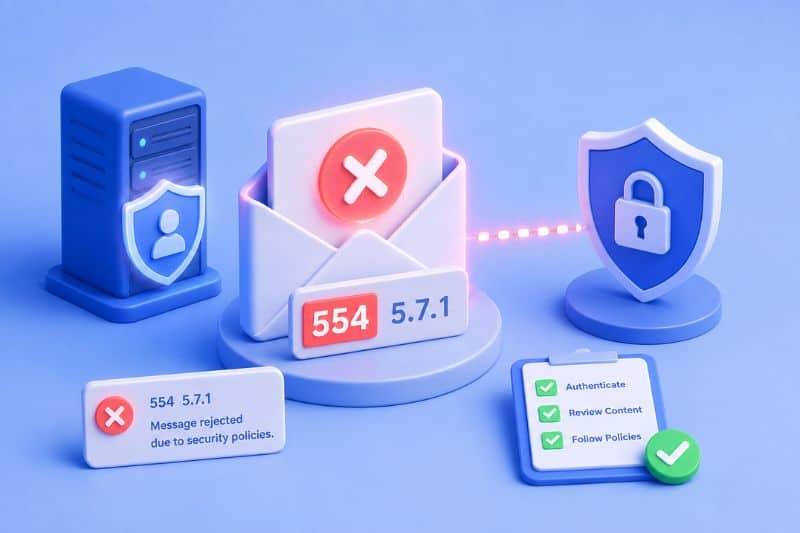
Receiving a “554 Email Rejected Due to Security Policies” error means the recipient’s mail server refused to accept your message. The rejection could stem from authentication failures, blocked IP addresses, invalid recipient addresses, or sender reputation issues.
The good news is that the accompanying bounce message usually provides clues about what went wrong, making most SMTP 554 errors relatively straightforward to diagnose and resolve.
Key Takeaway
SMTP Error 554 isn’t a single problem; it’s a rejection code used for several different delivery issues.
If you receive a 554 error:
- Verify the recipient’s email address.
- Check your SPF, DKIM, and DMARC records.
- Review whether your sending IP is blocklisted.
- Examine the bounce message for clues about the specific rejection reason.
- Retry later if the recipient’s server is experiencing temporary issues.
In most cases, identifying the exact bounce message will point you toward the appropriate fix.
What is SMTP Error 554?
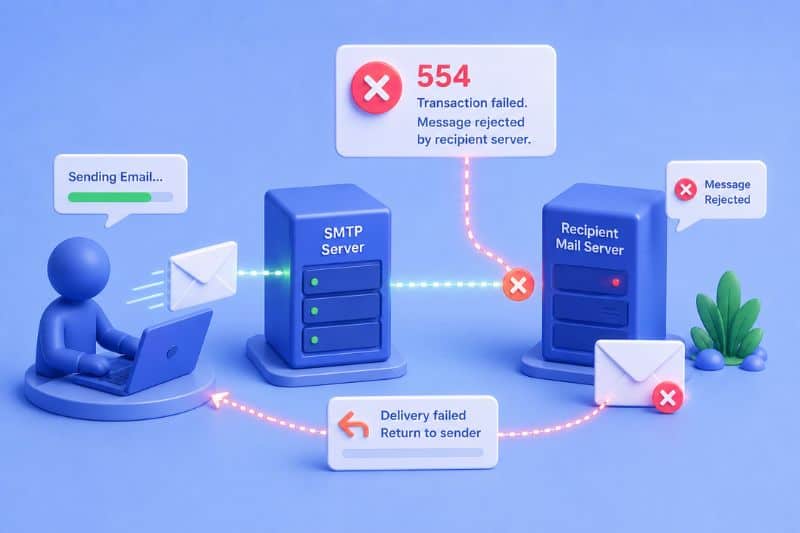
SMTP Error 554 occurs when you attempt to send an email, but the transaction fails mid-way because the recipient’s mail server rejects the message.
Unlike temporary delivery errors, a 554 rejection is typically considered permanent, meaning the sending server won’t automatically retry delivery until the underlying issue has been resolved.
SMTP 554 is often used as a catch-all rejection code. In many cases, the bounce message tells you that the receiving server rejected your email, but not exactly why. That’s why reviewing the accompanying error text is essential to identifying the root cause.
Common SMTP 554 Bounce Messages and How to Fix Them
| Bounce Message Example | What It Usually Means | Recommended Fix |
|---|---|---|
| 554 Message not allowed – [PH01] Message rejected for policy reasons | The receiving server blocked the email due to its security policies or the sender’s reputation. | Verify that your SPF record authorizes your current email provider, confirm that DKIM signing is enabled, and use a blocklist lookup tool to check whether your sending IP or domain has been flagged. |
| 554 rejected due to spam content 554 Transaction Failed Spam Message not queued 554 Spam violation, the content of your e-mail contains illegal characters | The message triggered spam filters because of its content, sending patterns, or poor reputation. | Remove excessive promotional language, review any links or attachments, and compare the rejected message against previous campaigns that delivered successfully. If complaint rates have recently increased, investigate whether sender reputation has declined. |
| 554 Virus found, message permanently rejected (#5.3.0)554 rejected due to virus | The message or an attachment was flagged as malicious. | Scan all attachments using reputable antivirus software, remove unnecessary attachments where possible, and resend the message using clean files from a trusted source. |
| 554 Relay access denied554: Relay access denied | The sending server is not authorised to relay mail through the recipient’s server. | Double-check your SMTP username, password, server address, and port settings. If you’ve recently migrated providers, confirm that you’re authenticating through the correct mail server. |
| 554 delivery error: dd This user doesn’t have a ymail.com account554 Sorry, no mailbox here by that name | The recipient address is invalid, inactive, or no longer exists. | Confirm that the address hasn’t been misspelled, check whether the mailbox is still active, and suppress invalid recipients from future campaigns to prevent repeated hard bounces. |
| 554 Message permanently rejected | A generic permanent rejection that often requires reviewing the full bounce message for additional clues. | Review the full bounce message for provider-specific clues. Look for references to authentication failures, reputation issues, or policy violations, then troubleshoot the issue most closely aligned with the rejection text. |
Even when a bounce message provides a reason, the wording is often technical and difficult to interpret. If the reason remains unclear after reviewing the bounce details, contact your email service provider for assistance interpreting the rejection.
To better understand an email bounce, check out Why Do Emails Bounce Back and How to Lower Your Bounce Rate
Understanding the Most Common Causes of SMTP Error 554
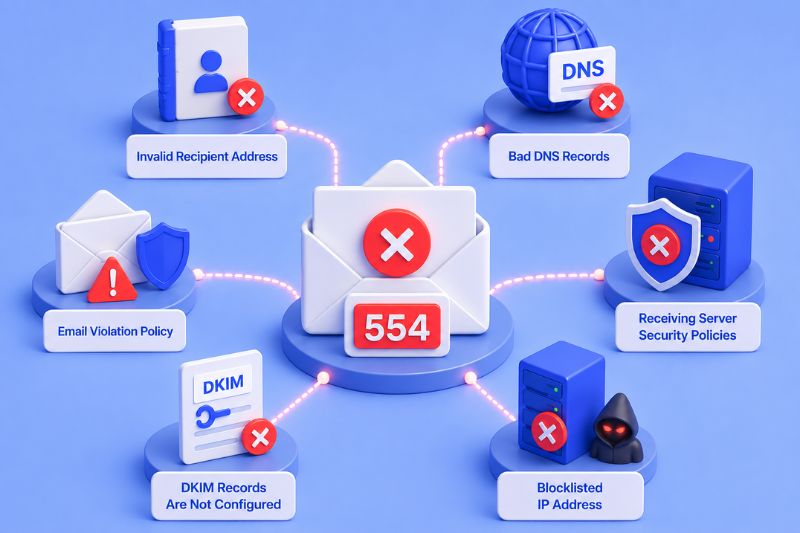
SMTP Error 554 can happen for several reasons, but most rejections fall into a few common categories. Once you identify which category your bounce message belongs to, you can take the right next step.
Invalid Recipient Address
If the recipient address is inactive, misspelled, suspended, or no longer exists, the receiving server may reject the message with a 554 error.
Check the address for typos, confirm that the mailbox is still active, and remove invalid contacts from your list. If you are sending to a larger audience, use email verification before your next campaign to reduce repeated hard bounces.
Free tool: Inboxally’s Email Validator
Email Authentication Problems
Misconfigured SPF, DKIM, or DMARC records can cause the receiving server to reject your message because it cannot verify that you are authorized to send from that domain.
Check that your SPF record includes your current email service provider, confirm that DKIM signing is active, and review your DMARC policy for alignment issues. This is especially important if you recently changed ESPs, moved domains, or added a new sending platform.
Free tool: SPF/DKIM/DMARC Checker
For an in-depth understanding of how SPF, DKIM, and DMARC are used in email authentication, check out this post: SPF, DKIM, DMARC explained Infographic
Sender Reputation or Blocklist Issues
A 554 error can also happen when your sending IP or domain has a poor reputation. This may be caused by spam complaints, sudden sending spikes, poor list hygiene, or previous suspicious activity from the same IP.
Check whether your IP or domain appears on public blocklists, review recent bounce and complaint rates, and avoid sending large campaigns until the issue has been investigated.
Free tool: Inboxally’s Email Blacklist Checker
Spam-Like Content or Sending Behaviour
Some messages are rejected because the content or sending pattern triggers spam filters. This can include suspicious links, misleading subject lines, too many promotional phrases, unusual formatting, or sending the same message repeatedly to large lists.
Review the email content, test a simplified version, remove unnecessary links or attachments, and make sure your message matches what recipients expect to receive.
Free tool: Free Spam Word Checker
Recipient Server Security Policies
Some receiving servers apply strict internal security rules. Even if your setup looks correct, the recipient’s server may reject mail from certain senders, domains, attachments, or message types.
If the rejection only happens with one company or mailbox provider, contact your email provider or the recipient’s IT team for more details.
Final Words
SMTP Error 554 can be frustrating because it doesn’t point to a single cause. The same rejection code can indicate anything from invalid recipient addresses and authentication failures to IP reputation problems and recipient security policies.
The good news is that the accompanying bounce message usually provides clues about what’s going wrong. By identifying the underlying cause and applying the appropriate fix, you can restore deliverability and reduce the likelihood of future rejections.
Want to improve inbox placement and strengthen your sender reputation? Check out InboxAlly.
InboxAlly helps mailbox providers recognize that emails from your domain are wanted and valued, helping legitimate senders reach the inbox more consistently. Try our free 10-day trial to see how it works.
About the author:
Darren Blumenfeld is the CEO and Founder of InboxAlly, an email deliverability platform trusted by growth-focused marketers. He’s previously founded HonestMail, worked at NASA, and holds degrees from Tufts and Columbia. His passion for tech, education, and creativity continues to inspire innovation in email outreach.