

If you send emails with Klaviyo long enough, you eventually notice a pattern: deliverability doesn’t just fall off a cliff. It weakens in small, easy-to-miss ways as volume grows and automation piles up.
Why does that happen so consistently? It’s not one of the settings or that one campaign you had a suspicion about all along. It’s a series of decisions made over time: who you add, how often you send, what you pay attention to, and what you let slide.
While you won’t be able to predict every inbox outcome perfectly (no one can), you can learn how to recognize the small but important changes that predict a dwindling sender reputation.
In this article, you will learn how deliverability behaves in Klaviyo at scale, what puts inbox placement at risk, and how to read the signs before you need to ask for help. Let’s get started!
Key takeaways
- For best deliverability in Klaviyo, keep an eye on how engagement changes over time and avoid using day-to-day results as a deliverability benchmark.
- The quickest way to hurt inbox placement is to treat “good-looking” metrics as permission to scale, instead of asking what changed and why.
Why Klaviyo’s deliverability issues aren’t always obvious

Klaviyo is designed to scale by default: more flows, more segments, more volume added to what already exists. It seems that more is, in fact, better! But with scale, some things change, and the first one is the list of people who actually read your emails. With a bigger pool of subscribers, a smaller share of the list engages, and certain providers respond differently to that.
On the other hand, Klaviyo’s reporting presents email performance in a way that favors continuity. As long as results don’t swing sharply, it makes it easy to assume that things are stable, while fewer people are actually seeing the emails. Reach narrows while volume compensates, and the two cancel each other out just enough to look fine.
This is why waiting for a clear failure is a losing email marketing strategy. By the time results visibly drop, the underlying problems have already settled, and you’re left with little to no room to react.
Infrastructure: sending domains, IPs, and DNS settings
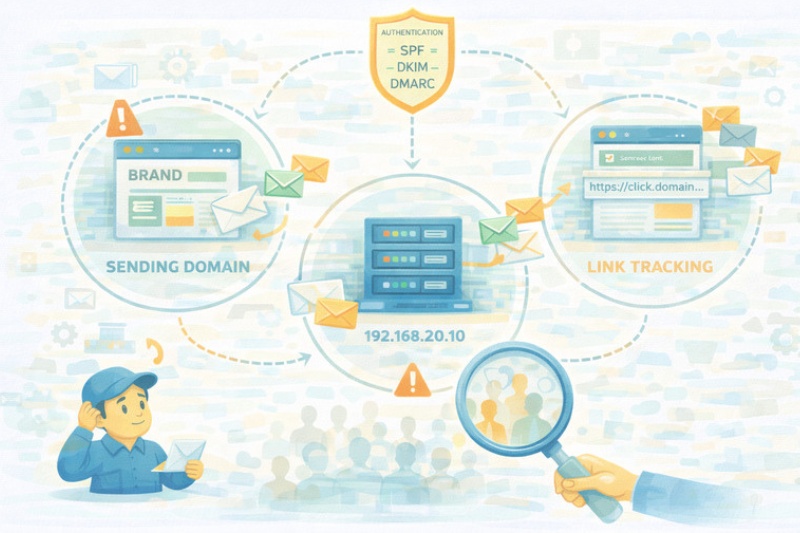
Infrastructure is what everyone wants to get “done” so they can move on, but that mindset causes more trouble than outright misconfiguration.
A branded sending domain is a good example. Connecting it is easy, but are you making sure it’s aligned with the rules? The domain people see, the domain doing the signing, and the domain used for tracking all need to point in the same direction. When they don’t, mailbox providers may still accept the mail, but with much more caution.
Dedicated IPs are both an upgrade and a responsibility. Unless your sending volume is both high and predictable, a dedicated IP removes the buffering effect you get with shared infrastructure. Unpredictable sending patterns on a dedicated IP make sender reputation harder to maintain.
Click tracking domains with SSL tend to get dismissed as less relevant, but inbox providers and internet service providers evaluate every domain involved in a message, not just the one in the From address. When tracking links come from unrelated or generic domains, you introduce a weak point that has nothing to do with content quality.
To wrap up all of what we’ve listed here is authentication: SPF, DKIM, and DMARC. You won’t get a medal for having them in place, but not having them will cost you. Most Klaviyo accounts are technically correct here, which is exactly why people assume that infrastructure can’t be the issue.
List acquisition mistakes and best practices
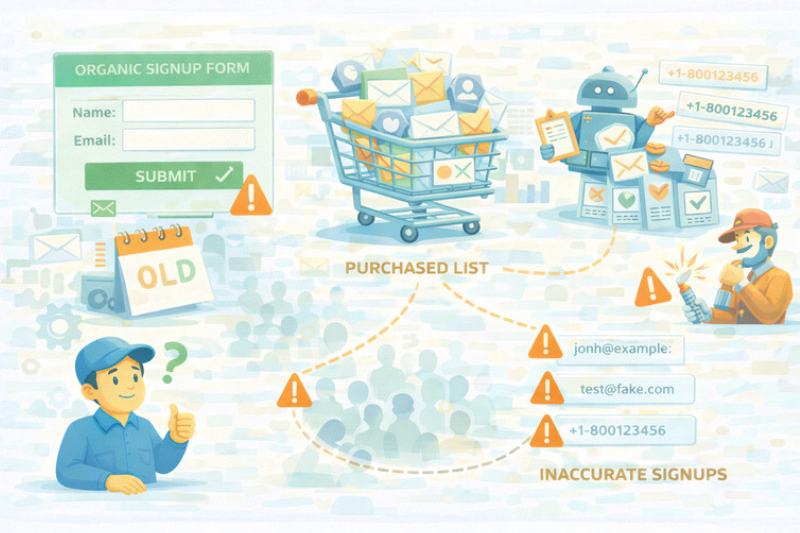
Getting people onto an email list is easy. Getting the right people onto it is harder, and Klaviyo doesn’t protect you from that difference. An organic signup only means someone filled out a form. It says nothing about intent, accuracy, or the quality of engagement that the address will have over time.
This is why purchased and rented lists are never a good deal. They limp along for a while because the addresses look valid enough to send to, but engagement never materializes in a meaningful way. Over time, that dead weight changes how inbox providers read your sending patterns, even if nothing looks obviously wrong inside Klaviyo.
Having a double opt-in tends to get framed as a moral stance, but for any good list, it works more as a spam filter. It catches typos, fake submissions, and automated signups before they harden into long-term problems. Without it, those mistakes resurface later as delivery issues that feel disconnected from acquisition.
The same goes for stale data. Old event lists, abandoned promos, or forms that haven’t been reviewed in years are pretty much guaranteed to result in higher bounce rates and spam complaints. And just like purchased or rented lists, these will have huge segments that never quite engage.
Warming: the part everyone rushes and pays for later
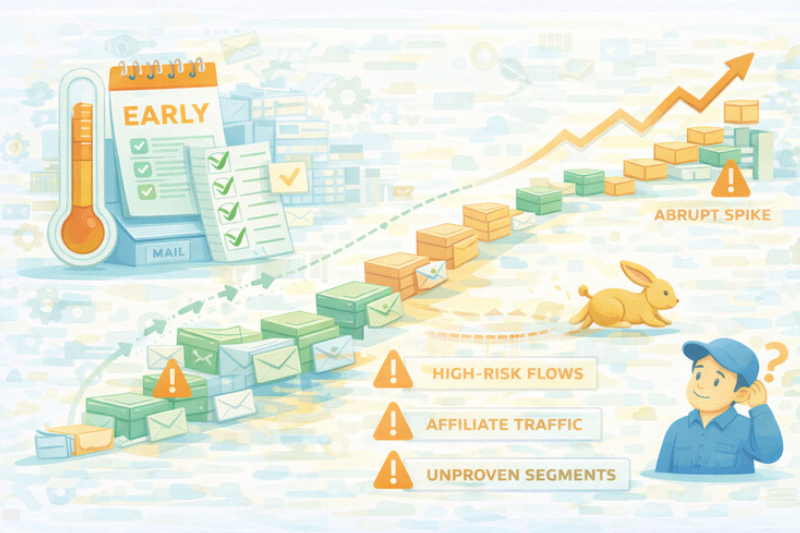
Email warmup is one of the hottest topics for every email marketer sending at a half-decent scale. And although there’s a lot of information on how to do it right, most never seem to nail it.
The first messages a mailbox provider sees set expectations, and those expectations quickly harden. Sending slowly only helps if early email campaigns go to people who are likely to engage. Low volume sent to weak audiences teaches the wrong lesson just as effectively as a sudden spike.
This applies both to new email domains and brand changes. From an inbox provider’s perspective, a new sending domain starts with no history. Similarly, a rebrand doesn’t carry its old reputation. If you ease back into smart sending with low-quality segments, you’re essentially trying to build trust on nothing credible.
Instead, use a predictable daily sending schedule, as it will give inbox providers something stable to evaluate. Stops, starts, and frequent adjustments muddy early behavior and slow recovery if something goes wrong.
During warmup, some traffic is better left alone:
- High-risk re-engagement and winback flows
- Affiliate or third-party traffic
- Large, unproven segments
Sending emails to these adds unnecessary load without useful feedback. Warming works well when you focus on strong engagement signals, not when you spread them too thin.
To make sure your warmup teaches the right lesson to inbox providers, book a free InboxAlly demo and see how early engagement lands you better inbox placement with all providers.
Key metrics, and how they’re misused
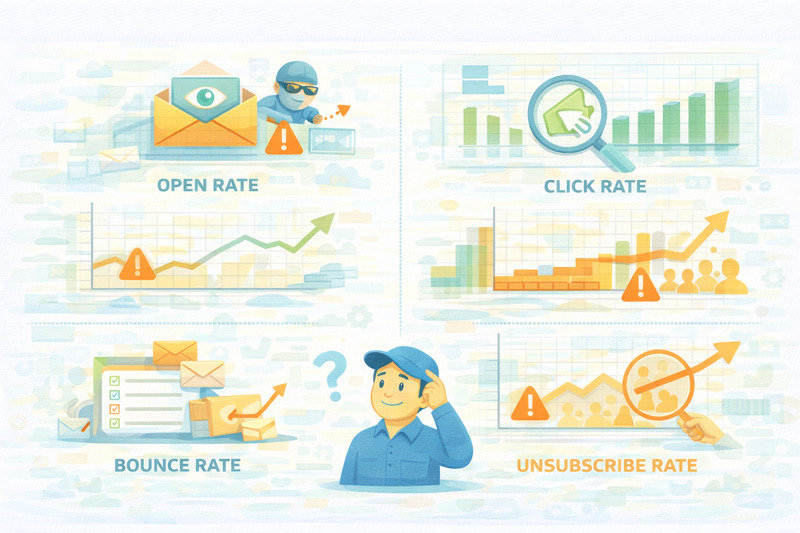
Metrics don’t tell you how deliverability is, but they do tell you how it’s changing. Let’s go over the big four you should watch for in Klaviyo:
- Open rate is the best example. Since Apple introduced Mail Privacy Protection, a “good” open rate is no longer a reliable read on human behavior. It still changes over time, and those changes can help when combined with other metrics. Looked at alone, open rates are just as likely to mislead you as to help you.
- Click-through rate is closer to real intent, but intent alone doesn’t describe overall health. CTR tells you how many people clicked, not how evenly that engagement is spread, how stable it is over time, or how the rest of the audience reacted. Clicks show who is engaged. They don’t, by themselves, tell you whether the program is healthy.
- Bounce rate is more than just housekeeping. Increasing bounce rates usually predicts bigger placement issues because they hint at problems with list quality and sending habits. They’re one of the few metrics that react early, which makes them easy to ignore until it’s too late.
- Unsubscribes aren’t a problem in themselves. If someone doesn’t want your emails, let them go. But when the unsubscribe rate starts going up, it’s a sign you’re missing the mark either with targeting, timing, the content, or all three at once. Let people leave, just pay attention to how many are choosing to do it.
Klaviyo can show trends, but it can’t show inbox placement. If you want to see how Gmail, Yahoo, and Outlook are treating your mail, you can connect Klaviyo to InboxAlly and monitor placement directly. Check this guide to learn how.
Engagement decay, re-engagement, and when to stop sending
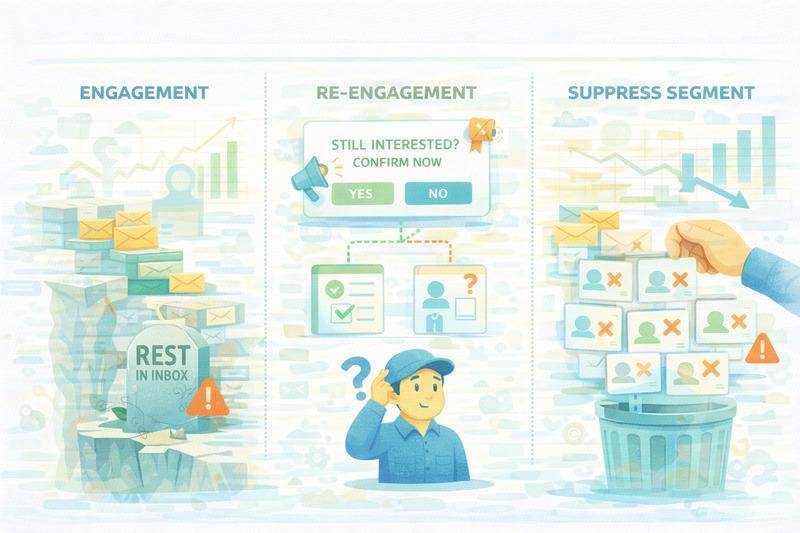
Re-engagement campaigns are damage control protocols, not a way to recover lost revenue. The goal is two-fold: get some movement or remove the segment from your list. Most re-engagement campaigns fail because they’re designed like normal campaigns with clever subject lines, discounts, and all the bells and whistles that go into a regular marketing campaign.
But proper re-engagement follows a few simple rules:
- Send once, maybe twice
- Be explicit about what counts as continued interest
- Track who responds, suppress everyone else
Sunset policies should be triggered by behavior, not by arbitrary time windows. Ninety days of inactivity mean different things depending on the sending frequency. If you mail daily, a ninety-day non-responding address is as dead as it gets. If you mail monthly, it’s only three skipped emails and possibly just bad timing. The threshold depends on how many opportunities someone had to engage, not how much time passed.
When engagement falls below 10% for a segment, stop trying to fix it with personalized content. The problem is the list, not the message. Suppression isn’t failure, it’s just proper list hygiene. Keeping dead profiles active because you’re afraid of losing list size is exactly how you make a program collapse under its own weight.
Wrap-up
Email deliverability in Kleivyo is a constraint you learn to manage as you send more and more.
Scaling email always introduces uncertainty. You lose some control, averages become less reliable, and, as a result, old instincts stop working. That discomfort is exactly where the opportunity lies.
If you read engagement properly, maintain good list hygiene, and respond promptly, you will avoid poor deliverability and keep it stable. Nothing here is new, but done consistently, it compounds, and those small, repeated decisions are what maintain inbox access as everything else changes.To make those small decisions easier to spot and act on, book a free InboxAlly demo and get clear visibility into inbox placement without changing how you approach sending.