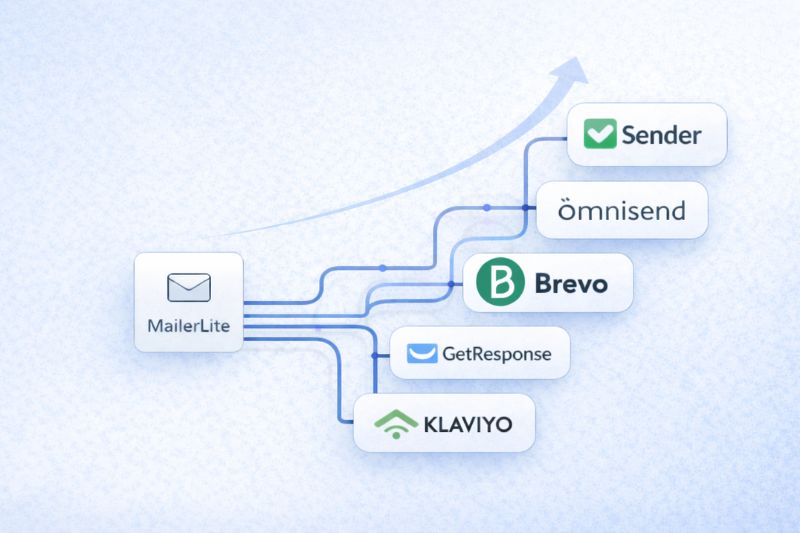
MailerLite works great for simple newsletters and comes with affordable pricing, but it can become limiting as automations add up.
Most businesses switch platforms specifically because existing automation capabilities can’t keep up with increasingly more complex marketing flows. That doesn’t mean a tool is “bad,” just that you sometimes need more than it offers.
This guide covers five Mailerlite alternatives you should consider if you’re at that stage. Some specialize in ecommerce automation, others in visual workflow builders and complex logic and a few simply deliver emails more reliably.
You’ll find email marketing software in the following categories:
- Budget-friendly platforms with a generous free plan
- E-commerce-specific automation and workflows
- Cohesive multi-channel marketing with volume-based pricing
- Webinar and funnel integration
- Analytics-driven platforms for online stores
Key Takeaway
- MailerLite handles basic email marketing well, but is quite limiting when it comes to deeper automation, ecommerce workflows, and advanced segmentation.
- The right alternative depends on whether you’re running an online store, need behavior-triggered sequences, or simply want better inbox placement.
1. Sender – Generous free tier with serious automation

Key features:
- Unlimited automation workflows, even on the free plan
- SMS marketing is included in paid tiers (not a separate add-on)
- Drag and drop landing page builder with conversion-focused templates
- 24/7 support via email and chat across all plans, including free
Sender approaches the free plan differently than competitors, playing games with limits. Most platforms give you just enough to taste the product before forcing an upgrade. Sender provides 2,500 subscribers and 15,000 monthly emails with full automation access.
The automation builder uses a visual flow interface that makes sense the first time you see it. Workflows that would take 20 minutes to configure in MailerLite take five in Sender because the logic is clearer and the interface more intuitive.
Behavioral triggers can get surprisingly complex. Someone clicks a specific link? Send them down one path. They ignore three emails? Move them to re-engagement. Opens on mobile versus desktop? Adjust content accordingly. MailerLite technically supports some of this, but Sender makes it accessible without workarounds.
Pros:
- Free tier is genuinely usable for growing businesses
- Behavioral segmentation that updates in real-time as subscribers act
- Transactional email support without needing separate email marketing services
- Shopify and WooCommerce integration for basic ecommerce workflows
Cons:
- The template library is smaller than other design-focused platforms
- Advanced ecommerce features lag behind Omnisend and Klaviyo
- Form builder could use more customization flexibility
- Reporting is not as detailed as enterprise tools
Pricing snapshot: Free tier up to 2,500 subscribers or 15,000 monthly emails. Standard starts at $7/month (cheaper than MailerLite) and comes with SMS, premium email templates, and no sending restrictions. Professional ($23/month at 5,000 contacts) includes priority support and advanced segmentation. The pricing is subscriber-based like MailerLite, but you’re getting more advanced capabilities per dollar spent.
2. Omnisend – Built specifically for ecommerce workflows

Key features:
- Email, SMS, and web push notifications all in one
- Pre-built automation for cart abandonment, browse abandonment, welcome series, and post-purchase follow-ups
- Product picker for dynamic recommendations based on customer behavior
- Customer review collection is automated after delivery confirmation
Most email platforms added ecommerce features because stores needed them. Omnisend started with ecommerce and built everything around how online retail works. That difference is more obvious in the details.
Product recommendation blocks sync with your store’s catalog in real time, so when inventory changes, the content follows. In the background, the system tracks what people browse, what they buy, and what they abandon in carts and builds suggestions from that activity.
Cart abandonment workflows trigger immediately when someone leaves without purchasing. The emails include the exact products they left behind, current pricing, and a direct link back to checkout, so there’s no need to go back to the site. While MailerLite can do this, too, it does require you to build the sequence yourself. Omnisend, on the other hand, manages the timing and tailors the messaging to the specific products automatically.
Pros:
- Shopify, WooCommerce, and BigCommerce integration requires minimal setup
- Revenue attribution tracking shows exactly which messages drive sales
- Generous free tier for new stores (500 emails monthly, full feature access)
- Multi-channel campaigns coordinated across email, SMS, push, without separate tools
Cons:
- Steep learning curve if you’re coming from newsletter-only tools
- Free plan email limit hits fast once you start sending regularly
- Some sophisticated features, like reviews, are Shopify-exclusive
- Pricing jumps significantly as the contact list grows
Pricing snapshot: The free plan allows 500 emails monthly to 250 contacts. Standard starts at $16/month for 6,000 emails, includes SMS credits, and web push. Pro begins at $59/month with unlimited emails and advanced reporting. Compared to MailerLite’s $9 entry point, you’re paying double. The premium makes sense if ecommerce features directly impact revenue, which they do for most stores. For side projects or early-stage shops, MailerLite’s free plan might still win until transaction volume justifies the upgrade.
But automation means nothing if your emails never reach the inbox. If deliverability is the real bottleneck, book a demo with InboxAlly and see how it rebuilds sender trust through measurable engagement.
3. Brevo – Multi-channel marketing with volume-based pricing
Key features:
- Unlimited contact storage (pay only for emails sent)
- Native SMS and WhatsApp messaging without third-party integrations
- Transactional email built-in with SMTP relay
- Advanced marketing automation with behavior-based triggers and conditional workflows
Brevo (formerly Sendinblue) structures pricing around emails sent rather than contacts stored. That idea benefits businesses with big lists that don’t email constantly. If you have 10,000 subscribers but only send twice monthly, you’re paying for 20,000 emails instead of 10,000 contacts. Much cheaper.
The platform bundles email, SMS, and WhatsApp into one dashboard. Landing pages and signup forms are here too, plus a lightweight CRM that’s useful for tracking deals without the bloat of full sales software.
Pros:
- Free plan includes 300 daily emails (9,000 monthly) to unlimited contacts
- Pricing scales with usage instead of list size
- CRM functionality is included for managing sales
- Advanced tools for deliverability like send-time optimization and A/B testing on all tiers
Cons:
- Automation depth is solid, but pales in comparison to platforms built specifically for complex workflows
- Email builder occasionally feels less polished than design-focused competitors
- Removing Brevo branding costs extra, even on paid plans
Pricing snapshot: Free tier for unlimited contacts with a 300 daily email limit. Starter at $9/month (5,000 emails) removes sending restrictions and adds A/B testing. Business ($18/month for 5,000 emails) unlocks marketing automation, landing pages, and predictive sending. Enterprise custom pricing includes advanced integrations and dedicated support.
4. GetResponse – Webinars and funnels integrated with email

Key features:
- Built-in webinar hosting for up to 1,000 live attendees
- Sales funnel builder with payment integration for selling digital products
- Course creator for structuring and delivering educational content
- AI-powered email and landing page generation
GetResponse has a specific target audience: businesses that use webinars, courses, or lead magnets to sell their products. Besides being able to send emails about your webinar, GetResponse can also host it, manage registrations, and sequence follow-up emails based on attendance.
Conversion funnel templates provide the entire structure from landing page to thank-you message. In this regard, MailerLite requires you to put together separate tools for landing pages, webinar hosting, and email sequences. GetResponse handles all three natively.
There’s also an AI email generator that creates complete drafts based on prompts. Quality varies (it’s still AI), but it can save you a lot of time you’d otherwise spend staring at blank templates. We found it more useful than gimmicky, which is not something we can say for every platform’s AI implementation.
Pros:
- Webinar functionality eliminates the need for Zoom or similar tools
- Funnel templates speed up campaign creation for common use cases
- Advanced automation includes lead scoring and tagging based on engagement
Cons:
- Cluttered interface compared to simpler email marketing tools
- Steep learning curve for advanced features
- SMS costs extra (not included in base plans)
- Pricing increases with subscriber count
Pricing snapshot: Email Marketing plan starts at $19/month (1,000 contacts) with unlimited emails, autoresponders, and landing pages. Marketing Automation ($59/month) adds workflows, segmentation, and funnel templates. Ecommerce Marketing ($119/month) includes abandoned cart recovery and promo codes. GetResponse costs more than MailerLite at every tier, but you’re paying for webinar hosting and funnel tooling that would otherwise require separate subscriptions.
5. Klaviyo – Ecommerce analytics and predictive recommendations

Key features:
- Predictive models for lifetime value, churn risk, and next purchase timing
- Dynamic product recommendations personalized per subscriber
- Customer profiles unifying behavior across email, site visits, and purchases
- Revenue reports attributing sales to specific email marketing campaigns and automation
Klaviyo charges more than every platform on this list. It earns that premium by turning customer data into sales with precision that generic email tools simply can’t match.
Predictive analytics forecasts customer lifetime value, churn probability, and next purchase date based on behavioral patterns. With all that, you don’t have to guess which customers are worth targeting since the platform calculates it using live purchase data.
This kind of personalization requires deep integration with your store’s data, which is why Klaviyo focuses on Shopify, WooCommerce, and BigCommerce rather than trying to support every platform generically.
Pros:
- Most sophisticated ecommerce segmentation available
- Deep Shopify integration syncs inventory, orders, and customer data
- Good deliverability infrastructure designed for high transaction volume
- Pre-built flows for every major ecommerce scenario
Cons:
- Expensive—costs scale quickly with active profiles
- SMS is charged separately by credits (not included in plans)
- Overkill for small stores or non-ecommerce businesses
- Learning curve is steeper than simpler platforms
Pricing snapshot: Free plan covers 250 contacts and 500 monthly emails, which is barely functional for real businesses. Email starts at $45/month (1,500 contacts, 15,000 sends). Email + SMS begins at $60/month with SMS credits included. At 10,000 contacts, you’re paying $200+/month easily. MailerLite costs $18/month at that scale.
The question is ROI. If Klaviyo’s targeting and automation increase customer lifetime value by 20%, it essentially pays for itself. However, it can be too costly if you’re still figuring out product-market fit or doing under $10,000 monthly revenue, in which case Omnisend gives you most of what Klaviyo offers at half the cost.
Choosing the right email marketing platform
The alternatives we’ve shown you in this list exist because “fine” is not enough when automation limits your growth and deliverability costs you sales.
Choose the platform that solves the problem you’re dealing with today, not the hypothetical one three years out. When your needs change, switching platforms is easy. Recovering lost revenue, not so much.
If automation is only half the battle, fix deliverability too. InboxAlly strengthens sender reputation with real engagement signals so your email campaigns reach their destination regardless of what platform you’re using. Book a free demo and see it in action.