About the Author: Jeanne Jennings is a veteran email marketing consultant and strategist with over 20 years of experience. Through her boutique firm Email Optimization Shop, she partners with medium‑to‑enterprise teams in fractional and project roles to audit program performance, design optimization roadmaps, and embed best practices.
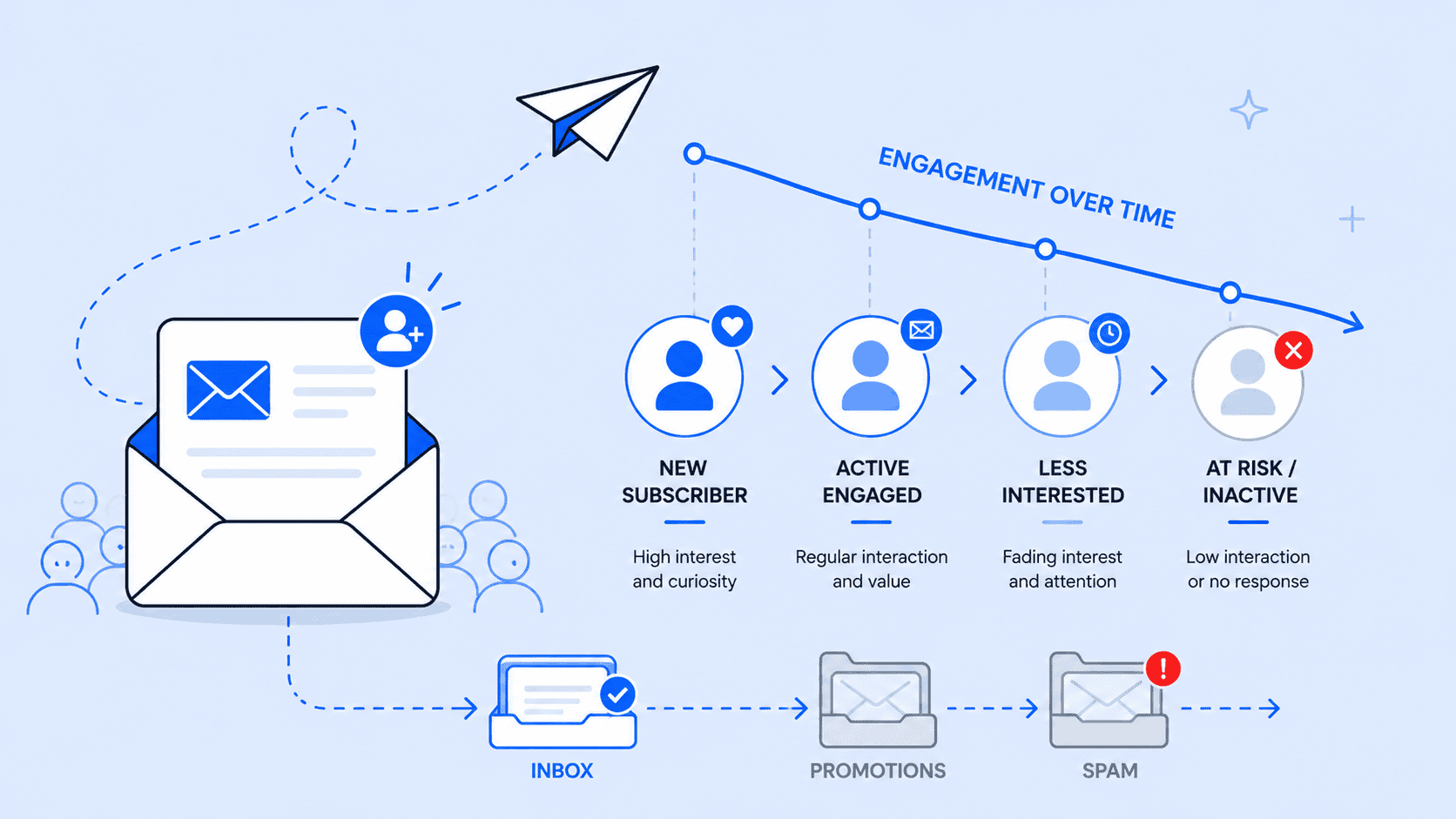
Email lists lose engagement because subscribers move through predictable lifecycle stages. Interest evolves, attention shifts, and interaction patterns change over time. Mailbox providers monitor these behavioral signals continuously, adjusting sender reputation and inbox placement accordingly.
Email lists may appear healthy while structural decline develops underneath the surface.
Subscriber counts grow. Acquisition dashboards trend upward. Growth reports suggest stability.
Yet subscriber behavior evolves. Curiosity fades. Preferences narrow. Engagement declines gradually.
Mailbox providers detect these changes early. Filtering systems analyze engagement patterns continuously, not just campaign-level metrics. When interaction declines across segments, sender reputation shifts.
Most deliverability issues do not begin with technical failures.
They begin with lifecycle failures.
What Is the Email Subscriber Lifecycle?
The email subscriber lifecycle describes the progression of engagement from initial signup to eventual inactivity. Subscribers move through predictable stages: new, warming, steady, cooling, and disengaged. Mailbox providers evaluate engagement across all stages when determining sender reputation and inbox placement.
Lifecycle progression occurs whether marketing teams manage it intentionally or not.
Ignoring lifecycle dynamics produces unstable engagement patterns. Engagement instability weakens sender reputation. Sender reputation influences inbox placement.
Lifecycle strategy determines deliverability stability.
The Five Subscriber Lifecycle Stages
| Stage | Engagement Pattern | Deliverability Role |
|---|---|---|
| New | High curiosity and strong opens | Establishes sender reputation baseline |
| Warming | Selective interaction | Reveals preference signals |
| Steady | Consistent engagement | Stabilizes engagement averages |
| Cooling | Declining activity | Signals emerging misalignment |
| Disengaged | No interaction | Creates reputation risk |
Stage 1: New Subscribers (The Honeymoon Phase)
New subscribers demonstrate high curiosity and strong engagement signals. Early open and click activity establishes the behavioral baseline that mailbox providers use to evaluate future campaigns. The onboarding period therefore shapes sender reputation quickly.
Early engagement establishes sender credibility.
Mailbox providers evaluate engagement ratios during initial campaigns. High opens, clicks, and low complaints indicate positive recipient intent. Weak onboarding signals limited value early in the relationship.
Onboarding is reputation architecture.
InboxAlly is a deliverability platform that helps reinforce early engagement signals by generating authentic positive interaction patterns. Reinforced engagement strengthens sender credibility and supports primary inbox placement during onboarding.
| Email Warmup Guide: Everything You Need to Know Shubhneet Goel, InboxAlly |
|---|
Stage 2: Warming Subscribers (Testing the Relationship)
Warming subscribers shift from curiosity to selective engagement. Interaction becomes preference-driven rather than exploratory. Opens occur less frequently, and clicks concentrate around specific interests.
Subscribers in this stage ignore misaligned content.
Sending strategies designed for new subscribers often produce declining engagement in this phase. Behavioral segmentation stabilizes engagement patterns and builds algorithmic trust.
Consistent engagement within segments protects inbox placement.
Stage 3: Steady Subscribers (The Core Audience)
Steady subscribers engage predictably but less intensely than new subscribers. Interaction patterns normalize while revenue contribution frequently concentrates within this group. This segment anchors engagement averages across the entire file.
Stability protects sender reputation.
Consistent interaction from steady subscribers maintains healthy engagement ratios. When messaging remains relevant and balanced, sender metrics remain stable.
Over-optimization for short-term revenue can erode this stability.
Increasing frequency or promotional pressure reduces engagement tolerance.
Stage 4: Cooling Subscribers (Drifting Quietly)
Cooling subscribers show gradual engagement decline. Opens occur less frequently and click activity narrows further. Many programs ignore this stage until disengagement becomes obvious.
Cooling signals misalignment, not abandonment.
Declining engagement often reflects content fatigue, preference shifts, or cadence mismatches. Continued high-volume sending to cooling segments depresses overall engagement ratios.
Strategic responses may include:
- Reduced frequency
- Content format adjustments
- Preference center reminders
- Re-segmentation by interest
Proactive lifecycle adjustments slow engagement decay.
Stage 5: Disengaged Subscribers (The Reputation Risk Zone)
Disengaged subscribers demonstrate no opens, no clicks, and elevated complaint risk. Prolonged inactivity increases the likelihood of spam complaints and spam-trap exposure.
Inactive records weaken sender reputation.
Persistent sending to disengaged contacts lowers engagement ratios. Lower engagement ratios increase filtering sensitivity. Higher filtering sensitivity reduces inbox placement stability.
If no interaction occurs within twelve months, continued promotional sending rarely improves results.
InboxAlly supports sender reputation repair and engagement reinforcement when lifecycle erosion has already occurred. Lifecycle discipline, however, reduces the need for recovery.
| Email Reputation Repair and Email Warm-Up: What’s the Difference? Eric Jenkins, InboxAlly |
|---|
Why Does Lifecycle Management Affect Deliverability?
Subscriber lifecycle distribution influences sender reputation more than total list size. Mailbox providers evaluate engagement ratios across the entire subscriber base rather than focusing on the most active segment.
A large inactive population reduces perceived sender value.
Engagement distribution protects reputation.
List size alone does not.
Mailbox providers assess engagement across the full file. If a small group interacts while most subscribers remain inactive, sender credibility declines.
Lifecycle balance stabilizes deliverability.
What Lifecycle Mistakes Quietly Damage Deliverability?
Deliverability problems usually develop through repeated lifecycle misalignment. Most programs do not fail because of technical configuration errors. Instead, engagement signals deteriorate gradually across subscriber segments.
Filtering systems evaluate behavioral trends over time.
When lifecycle progression is ignored, inbox placement declines slowly but consistently.
Common Lifecycle Blind Spots
| Blind Spot | Immediate Impact | Long-Term Effect | Deliverability Signal |
|---|---|---|---|
| Over-mailing cooling subscribers | Open rate decline | Engagement concentration narrows | Lower engagement ratios |
| Weak onboarding | Low early engagement | Lower reputation baseline | Weak trust signals |
| No sunsetting policy | Growing inactive population | Complaint sensitivity increases | Sending to unresponsive users |
| Ignoring acquisition source | Uneven engagement patterns | Faster lifecycle decay | Behavioral inconsistency |
Why List Size Can Hide Lifecycle Decay
List growth can conceal engagement erosion. When inactive subscribers accumulate faster than new engagement stabilizes, ratios decline beneath the surface.
Aggregate averages hide structural imbalance.
Mailbox providers evaluate total file behavior.
Lifecycle discipline stabilizes sender reputation.
How Can Marketers Audit Subscriber Lifecycle Health?
Lifecycle health can be evaluated through simple segmentation and cohort analysis. Complex deliverability tools are not required to identify early lifecycle imbalance.
A lifecycle audit focuses on engagement distribution rather than vanity metrics.
The Five-Step Lifecycle Audit
| Step | Measurement | Risk Signal |
|---|---|---|
| Lifecycle distribution | Percentage by stage | >60% Cooling + Disengaged |
| Engagement by stage | Open/click slopes | Steady resembles Cooling |
| Revenue by stage | Revenue concentration | Dependence on aging segments |
| Subscriber age | Median age trend | Aging without acquisition balance |
| Cohort decay | Engagement velocity | Sharp drop within 90 days |
The Key Insight
If 60% or more of a list resides in Cooling or Disengaged stages, the list is not growing.
It is aging.
What Do High-Performing Lifecycle Strategies Look Like?
High-performing email programs manage subscriber progression rather than focusing solely on campaign execution. Lifecycle-aware strategies produce more stable engagement patterns and more predictable inbox placement.
Lifecycle maturity correlates with deliverability consistency.
Lifecycle Strategy Maturity Model
| Level | Focus | Visibility | Sending Behavior | Stability |
|---|---|---|---|---|
| 1: Acquisition-Driven | List growth | None | Same cadence | Volatile |
| 2: Performance-Driven | Campaign metrics | Basic filters | Reactive adjustments | Inconsistent |
| 3: Segmented | Behavioral grouping | Stage tracking | Adjusted cadence | Improving |
| 4: Lifecycle-Strategic | Engagement distribution | Full lifecycle visibility | Stage-specific strategy | Predictable |
| 5: Reputation-Optimized | Engagement velocity | Cohort modeling | Proactive calibration | Highly stable |
Lifecycle discipline prevents engagement erosion.
Reputation optimization sustains inbox placement.
| How to Interpret Your InboxAlly Metrics: Analyzing Engagement with InboxAlly Komal Nirvan, InboxAlly |
|---|
How Does Subscriber Lifecycle Affect Inbox Placement?
Inbox placement reflects behavioral consistency across the entire subscriber base. Mailbox providers reward senders who demonstrate stable engagement ratios, predictable sending patterns, and sustained recipient value.
Lifecycle management strengthens each of these signals.
Filtering systems evaluate three primary engagement indicators:
- Engagement consistency across cohorts
- Predictable sending volume patterns
- Sustained recipient interaction
Volatility reduces placement predictability.
Stable engagement builds algorithmic trust.
InboxAlly is a deliverability platform designed to reinforce positive engagement signals and improve sender reputation. Stronger reputation signals increase inbox placement stability and reduce the likelihood of spam filtering.
Lifecycle discipline prevents reputation damage.
Engagement reinforcement accelerates recovery when damage occurs.
Why Email Lists Decline Quietly Over Time
Email list decline rarely appears dramatic at first. Engagement narrows gradually, and reputation shifts follow behavioral trends.
Lists erode quietly.
Mailbox providers detect engagement erosion before marketing dashboards reflect a crisis. Engagement velocity declines first. Cooling segments expand next. Filtering tightens later.
Programs that treat lifecycle distribution as an early warning system experience fewer severe deliverability disruptions.
They monitor decay curves.
They protect steady segments.
They suppress disengaged records without hesitation.
Every email list ages.
The strategic decision is whether that aging is managed intentionally or allowed to compound.
AI Disclosure
Artificial intelligence tools assisted in outlining, structuring, and drafting portions of this article. Strategic insights, lifecycle frameworks, and editorial judgment were reviewed and refined by Jeanne Jennings based on professional experience in email marketing and deliverability strategy.
AI was used as a drafting and acceleration tool, not as a substitute for subject matter expertise.
Transparent disclosure builds trust. That principle applies to AI as much as it applies to email.
About Jeanne Jennings
Jeanne Jennings is a veteran email marketing consultant and strategist with over 20 years of experience. Through her boutique firm Email Optimization Shop, she partners with medium-to-enterprise teams to audit program performance, design optimization roadmaps, and embed email marketing best practices.
She also leads hands-on training workshops, both public and private, helping internal teams improve email strategy, campaign execution, and AI usage in marketing.
About InboxAlly
InboxAlly is a deliverability software platform designed to help emails reach the inbox instead of the spam folder. The platform provides real-time warm-up, engagement signal reinforcement, seed testing, deliverability diagnostics, and domain or IP reputation repair.
InboxAlly allows senders to improve inbox placement and sender credibility without granting direct access to their sending infrastructure.