
Gmail spent years telling senders how their mail was doing in charts. This month, it started telling them in sentences, and one of those sentences is the bluntest verdict in email: users don’t want your messages.
That was not the only thing that happened in July. A privacy tool millions of people rely on turned out to hand back the exact address it promises to hide, a flaw its maker has sat on for a year. And one of the companies whose job is to show you where your email lands got swallowed up by a bigger one. Three stories in this month’s deliverability news, all pointing in the same direction.
Key takeaways
- Google Postmaster now reports whether people want your email, and the bar for «too many spam complaints» went from 0.3% to just 0.1%
- Gmail flags senders whose emails are ignored, not just ones that get complaints.
- A bug in Apple’s Hide My Email can expose the real address behind a hidden one. Apple has known for over a year and still hasn’t fixed it.
- Infobip bought SocketLabs, another company in the shrinking pool of tools that tell you where your email is landing.
Gmail is stating conclusions based on human behaviour

Postmaster Tools used to give you graphs and leave the interpretation to you. This month, Google began rolling out a «Deliverability analysis» section that replaces the charts with a sentence, written under Google’s own logo. Probably the most direct one is this one:
Users signal they don’t want to get your email messages.
There’s no debating a sentence like that.
However, Google didn’t announce it. The rollout came through practitioners comparing notes: Florent Destors of Selligent spotted the section, Natalia Zacholska-Majer of EmailLabs cataloged the statuses appearing, and Brian Sisolak of Message Digital traced them to Google’s Postmaster Tools API reference, where they remain since mid-May as a Developer Preview.
The system defines seven verdicts:
- One positive: users show they want your mail.
- Two neutral: low engagement, or too little volume to judge.
- Four negative: delivery errors, compliance failure, high spam rate, and the flat statement that people don’t want your mail.
Two of these are especially important. Remember the number that made peace with senders? That comfort is over. Google’s guidance since the 2024 sender requirements has been to stay below 0.3% and aim for 0.1%, and an industry of advice grew up treating 0.3% as the best practice. The new limit since July is 0.1%. If you’ve been running at 0.29% with a clear conscience, rebuild suppression around 0.1% as the maximum you never reach.
The second one is subtler. Gmail added a verdict for recipients who neither complain nor engage. Not people who hate your mail, people who feel nothing about it. Indifference used to be dismissed as nothing to worry about. Now Google tracks it as its own category, one step above «users don’t want you.»
All this is Gmail’s opinion of your mail at Gmail, nothing else. Because it uses the API, you can expect these verdicts in third-party tools before long, which raises the question of who now owns those tools.
Apple’s privacy feature has been leaking the thing it hides

Let’s shift our focus from how Gmail reads your mail to how your subscribers hide from you, because that part has apparently been broken for a while, at least in the Apple ecosystem. Hide My Email is the iCloud+ feature that provides a random forwarding address so someone can sign up without sharing their real email address. They read and reply normally, but you never see the address underneath, so the masking is the entire point.
On July 1, 404 Media reported that the masking can be reversed. This flaw lets an attacker take an alias and work backward to the real address it protects. The outlet verified it using one of its own hidden addresses and confirmed it still worked at publication. Tyler Murphy of the data-removal service EasyOptOuts, who found it, said every alias he probed in testing revealed the address behind it.
Murphy reported it to Apple in June 2025 with reproduction steps. Apple said it was fixed in March 2026 and asked him to hold off on publishing it in May, then promised a patch within weeks. Those weeks passed, and he went public.
Masked and relay addresses are a routine share of consumer lists now, used by people who don’t fully trust the brands they sign up with. Three things follow:
- Don’t treat this as an opportunity. Any vendor offering to resolve aliases to real addresses is exploiting an unpatched flaw against user intent, which is a compliance problem that only looks like a growth hack.
- Don’t block masked addresses at signup. The temptation grows once Apple moves these aliases to a single recognizable domain, but an alias user still opted in, so blocking it loses the subscriber, not the mask.
- Watch the relay. Mail routes through Apple’s infrastructure before reaching a real inbox, so any change Apple makes could transfer over to deliverability.
Deliverability companies keep getting bought by bigger ones
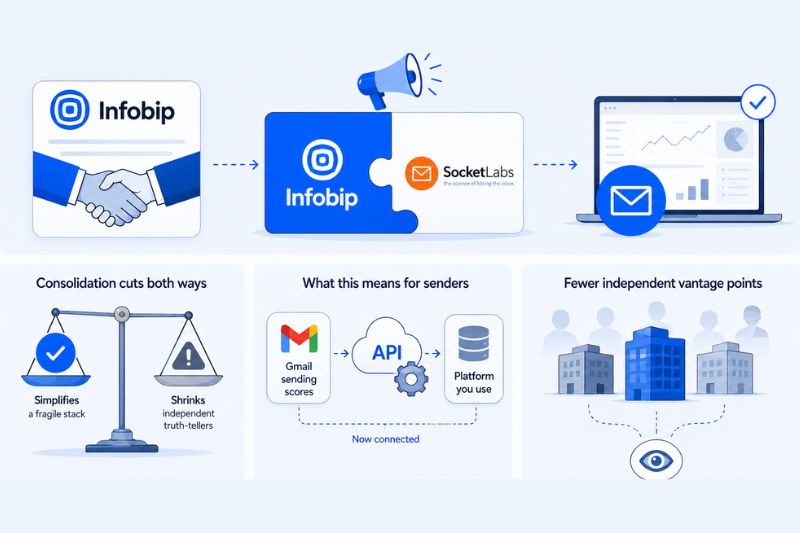
On July 9, Infobip announced it acquired SocketLabs, a US email-infrastructure company built around showing deliverability to senders and letting them switch providers without needing to migrate their whole setup. Terms weren’t disclosed. Al Iverson, who’s written about deliverability since the early days of spam, called it the latest round of email industry consolidation, and that framing is the point.
Consolidation cuts both ways: it simplifies a stack held together with hope, and it shrinks the independent vantage points whose only job was the truth about placement. This connects directly to Postmaster, since Gmail’s plain-language sending scores are heading into the API, which means «what does Gmail say about us» soon becomes a field inside whichever platform bought whichever tool you used.
What it comes down to
A verdict, a leak, an acquisition. Different corners of the industry, same underlying change. The people watching your email, whether it’s Gmail, a subscriber, or the company that owns your monitoring tool, have gotten harder to fool and easier to lose.
With all that, the inbox is still the last mile of every email dollar. InboxAlly makes sure your mail finishes that mile, generating the opens and replies that providers are now scoring you on. Book a free demo and let it tackle every new rule Gmail rolls out next, so you don’t have to.