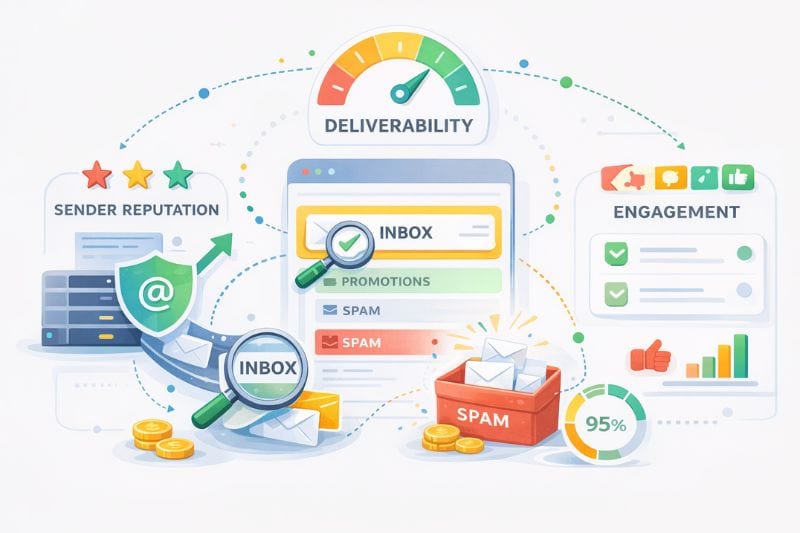
Most email senders are optimizing the wrong things, like split-testing subject lines and obsessing over send times, all while a portion of their mail is routing straight to spam.
Deliverability is the less obvious part of email marketing that still needs attention. Even when your delivery rate is at 99%, inbox placement can kill engagement for reasons that have nothing to do with your content.
If you already know that deliverability is important and want to understand why it deserves more attention than most people give it then this article is for you.
Key Takeaways
- Deliverability and delivery rate are not the same metric. A high delivery rate means your mail was accepted by a server. It says nothing about whether it reached the primary inbox. Inbox placement rate, engagement trends, and spam complaint rate actually tell you how deliverability is performing.
- Deliverability is a reputation problem, not just a technical one. Proper authentication and list hygiene set the floor, but consistent engagement builds the sender’s reputation that earns a reliable inbox placement over time.
Delivery and deliverability are not the same thing
They might sound the same, but they are two completely different things.
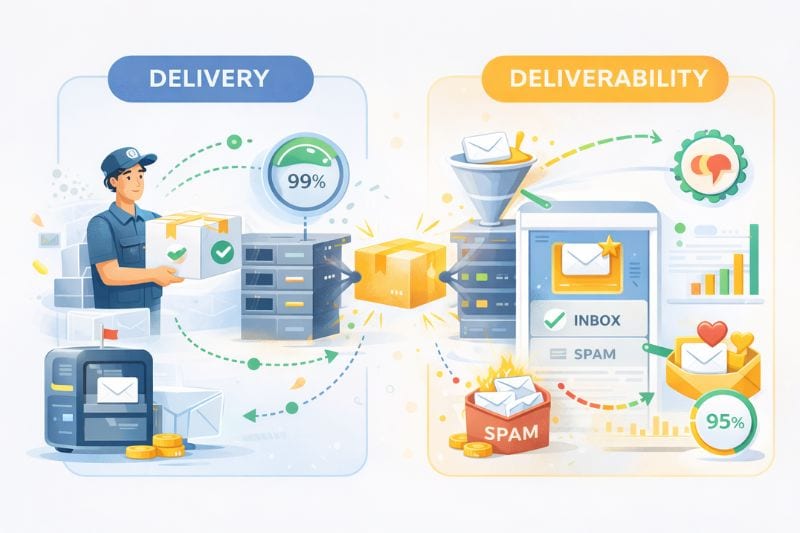
Email delivery measures whether your message reached the recipient’s mail server. If it wasn’t bounced, it counts. Your ESP shows 99%, you move on.
Email deliverability is what happens inside that server once the message arrives. Each of the major web service providers, like Google and Yahoo, runs its own filtering logic and decides where your mail goes. That decision is entirely invisible to your ESP.
Think of it this way: a 99% delivery rate means your mail carrier accepted the package. Whether it ended up at the front door or in the recycling bin is a separate question entirely.
The deliverability metrics that actually reflect its health are inbox placement rate, spam complaint rate, and engagement trends. Further below, we’ll get into how to track them.
What poor deliverability costs you
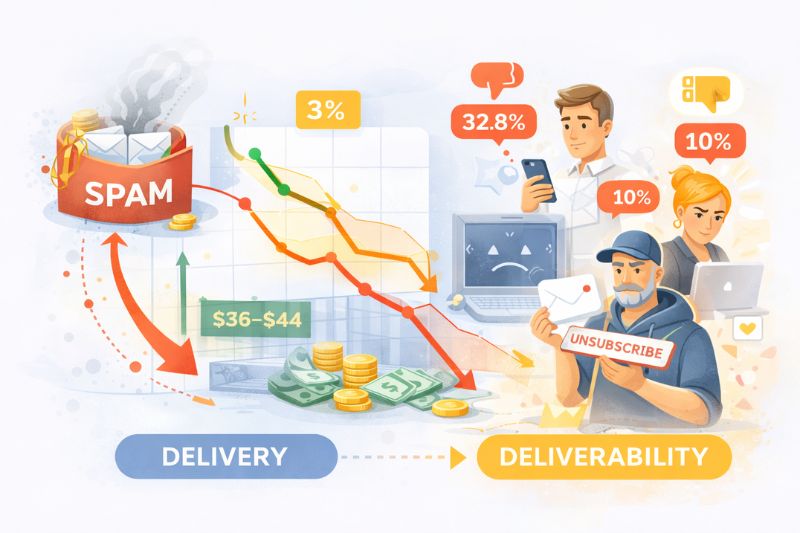
If 20% of your sends end up in spam, you’re not marketing to your full list but to whoever happens to check their junk folder. That’s a fraction of the people you think you’re talking to.
The revenue math follows quickly. A campaign converting at 3% from the inbox converts at near zero from spam. Stretched across a year of sends, that’s not a rounding error.
The Direct Marketing Association estimates email generates $36–$44 for every $1 spent. That figure requires inbox placement.
There’s also what it does to your brand. According to Sinch Mailjet research, when emails consistently land in spam:
- 32.8% of consumers feel annoyed or frustrated
- 10% lose trust in the brand
- 9.9% unsubscribe
The remaining third who say they wouldn’t care aren’t neutral. A subscriber who’s stopped paying attention is one you’ve already lost; they just haven’t made it official yet.
And transactional email makes all of this worse. Password resets, order confirmations, account alerts are messages people are waiting for. When they disappear into spam, customers get frustrated very quickly, and all the negative attention lands on your brand, not your email service provider.
Poor deliverability is rarely one catastrophic failure. It’s usually a slow deterioration that results in complaint rates, engagement softening, and blocklist listings that stay unnoticed for weeks. Most of the factors behind it are controllable, and that’s the part worth understanding.
How inbox placement is measured in email marketing

Inbox placement can’t be measured the way delivery rate can. Your ESP has no visibility into what Gmail does with your mail after accepting it because that decision happens inside Gmail’s systems, which is not open to the public.
So how do you find out? Seed lists.
Deliverability testing tools maintain networks of addresses spread across Gmail, Outlook, Yahoo, Apple Mail, and others. You send your campaign to those addresses alongside your real list, and the tool reports back where it landed at each provider. Primary inbox, promotions tab, spam folder. Provider by provider.
It’s not a perfect science, but they’re the closest thing available to actually seeing inside the black box and checking placement between providers before a major send is a lot cheaper than finding out something went wrong after it.
So before you send a big campaign, run a quick pre-flight check. Start a free InboxAlly trial to track where your emails are landing and reinforce the actions that move placement while you still have time to adjust.
What mailbox providers are evaluating
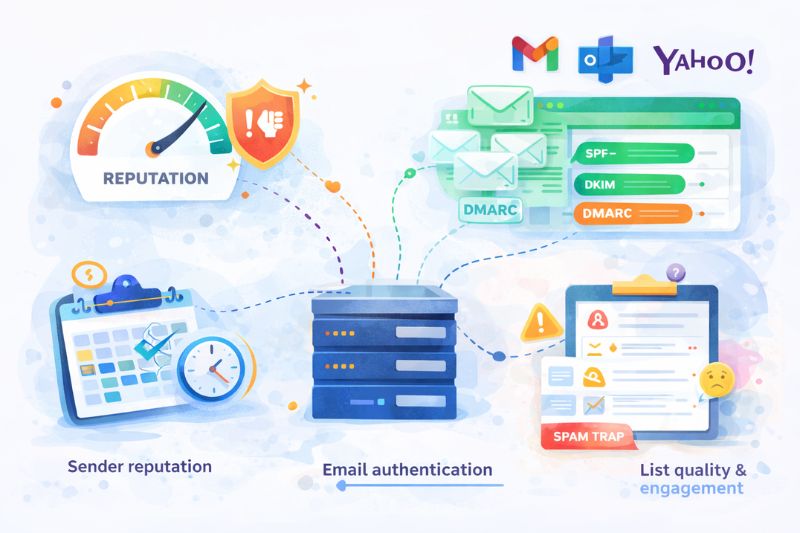
Mailbox providers are running a continuous assessment of your sending behavior, and a few things have a bigger impact than the rest:
Sender reputation is the composite score that everything else relies on. It’s built from how recipients interact with your mail, how consistent your sending patterns are, and what kind of list you’re sending to. Spam complaints are the worst offenders, and a sustained rate above 0.3% is enough to cause huge damage on Gmail. Domain and IP reputation both contribute independently, which is something to keep in mind any time you change sending infrastructure.
Email authentication protocols are the foundation of all email. SPF, DKIM, and DMARC make sure that your mail is coming from who it claims to be. Without all three, any email can trigger spam filters because there’s no reason for internet service providers to extend trust to unauthenticated sends. Gmail and Yahoo now require all three for bulk senders. DMARC at p=reject is the best sign your sending domain is protected against spoofing.
Send cadence is mostly overlooked because it sounds insignificant. But a predictable sending schedule tells providers you’re a legitimate sender. Spammers usually blast in irregular bursts, which is why a sudden volume spike from a domain without the history to support it looks exactly like that. Content quality does not override it.
List quality and engagement are ongoing work. Invalid addresses, spam traps, and large pools of inactive or invalid addresses drag down reputation. Low engagement tells providers that recipients don’t want your mail. That’s a good enough reason, from their perspective, to start routing it elsewhere.
InboxAlly exists specifically to boost the email engagement metrics providers value the most, which helps senders rebuild placement without waiting months for organic behavior to shift things. If this feels like something you’re struggling with lately, start a free trial and see how better engagement produces better outcomes.
One thing to account for: Gmail, Outlook, and Yahoo don’t evaluate these signals the same way. Gmail relies mostly on individual recipient behavior, meaning your reputation at Gmail depends on how your specific subscribers interact with your mail, not senders broadly. Outlook looks domain age and authentication history more heavily, and Yahoo is particularly sensitive to complaint rates.
Yes, it does get complicated like this.
Why engagement is the lever that moves placement
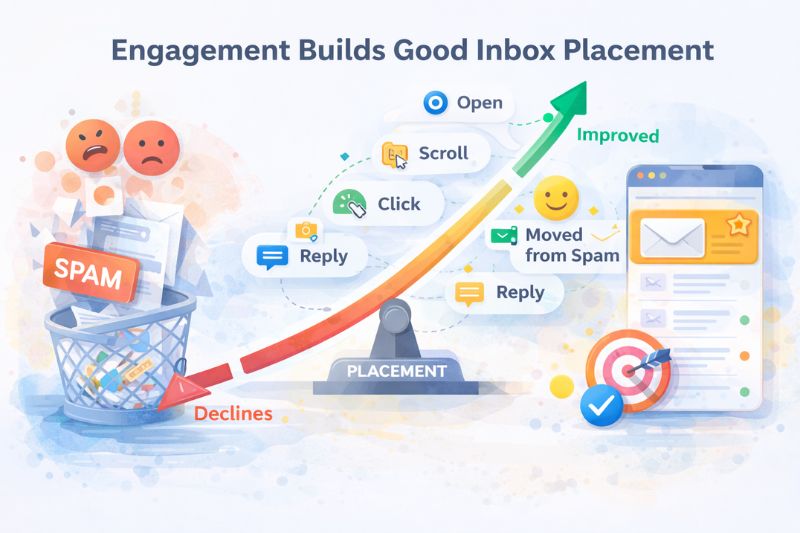
Authentication and list hygiene will keep you out of serious trouble, but engagement is what builds good placement in the first place.
When recipients open mail, scroll through it, click, reply, or move it out of spam, providers register that as evidence your mail is wanted. This behaviour accumulates over time and partially decides how future sends from your domain get routed. Rescue enough mail from spam, get enough replies, and providers will recalibrate their read of your domain accordingly.
Conversely, a large portion of your list never engaging isn’t a neutral condition. Providers read prolonged low engagement as confirmation that recipients don’t want this mail. A technically spotless setup doesn’t cancel that out.
This is why senders who treat engagement as a deliverability input have better inbox placement than those who don’t. Segmenting inactive subscribers, running re-engagement campaigns before cutting people, sending content worth opening, all of it has an impact on how providers classify your domain.
How to tell if something’s wrong
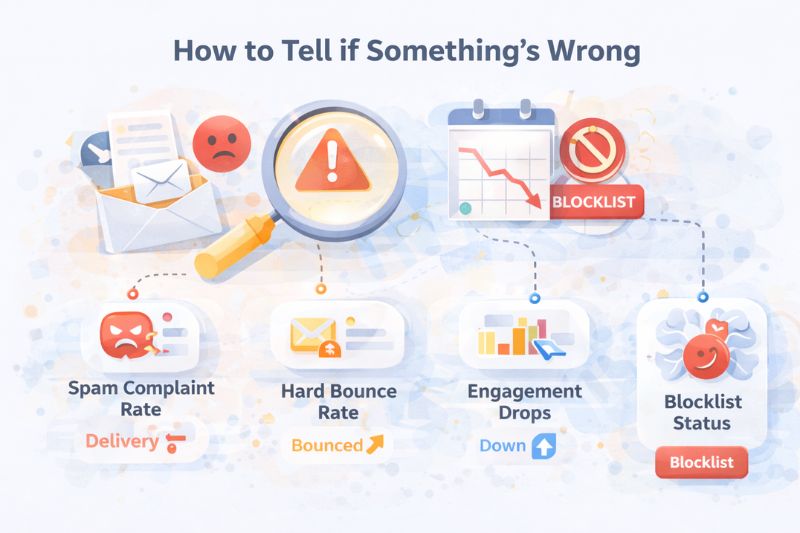
Most senders find out too late, usually when a customer complains, or someone finally notices open rates have been going downhill for a while.
A few things you should keep an eye on before it gets to that point:
- Spam complaint rate – Gmail’s Postmaster Tools gives you domain-level data. Above 0.1% is worth investigating. Above 0.3% means spam filters are already doing their work.
- Hard bounce rate trends – Increasing bounced email addresses almost always have something to do with list decay. Repeatedly sending to dead addresses tells providers your list hygiene is poor.
- Unexplained engagement drops – Declining open or click rate that doesn’t correspond to any content change is often a placement problem.
- Blocklist status – MXToolbox lets you check your domain and IP against major blocklists. Some ESPs show this, but many don’t.
Most deliverability issues follow the same pattern: small > ignored > serious. Don’t be the person to react only when placement drops suddenly.
The bottom line
The best campaign in the world does nothing from the spam folder. And unlike many marketing variables, inbox placement is genuinely improvable with consistent attention to reputation, email authentication, and engagement.
If you treat this as ongoing work, you’re well on your way to staying out of trouble. But if you treat it as a one-time setup, you’ll likely spend a lot of time clawing back ground you didn’t need to lose.
If inbox placement has become a problem and the technical side looks fine, the problem is almost always reputation behavior. Try InboxAlly free and reinforce the engagement inbox providers use to classify your mail so your marketing emails can finally end up where they belong.