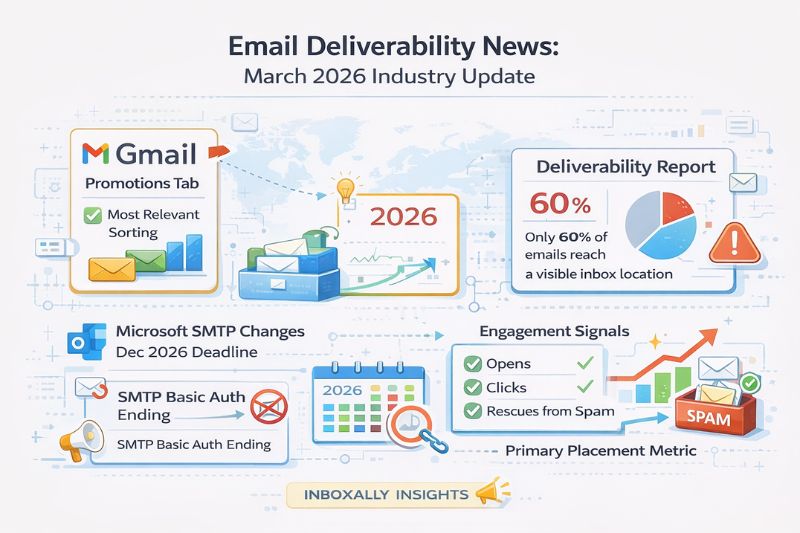
March is a quieter month on the deliverability front, but quieter doesn’t mean nothing happened. A few changes landed that most senders will feel before they understand, and one data point in particular should have you rethink what “good deliverability” means right now.
Here’s what you need to know.
Key takeaways
- Inbox visibility is shrinking: Only ~60% of emails reach a visible inbox location, and Gmail’s Promotions tab now ranks messages by engagement history rather than send time.
- Engagement now drives deliverability: ISPs are prioritizing user engagement signals (opens, replies, spam rescues) over IP/domain reputation, while Microsoft’s SMTP Basic Auth phase-out was delayed to Dec 2026, but bulk-sender enforcement remains active.
The number that should reset your expectations
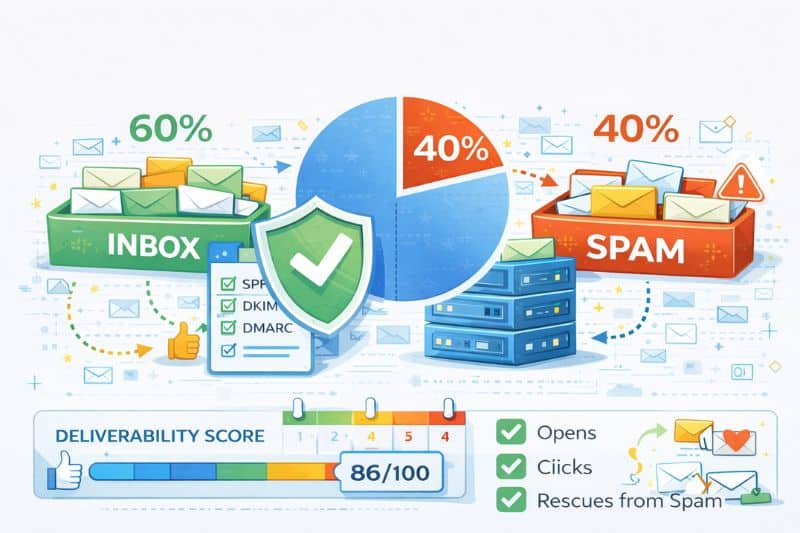
Did you know that only 60% of emails reached a visible mailbox location? They get accepted at the server level, then filtered out of human attention entirely.
The global deliverability health score from 2025 was 86 out of 100. Senders had authentication in place, lists were reasonably clean, and still, four in ten emails went somewhere no one would look.
What makes these figures more unsettling is that even fully authenticated emails still experienced spam placement rates exceeding 30%. We’ll get into why that gap exists, but first, let’s go over a change that is happening inside Gmail’s inbox that most senders haven’t fully processed yet.
Gmail’s Promotions tab isn’t chronological anymore
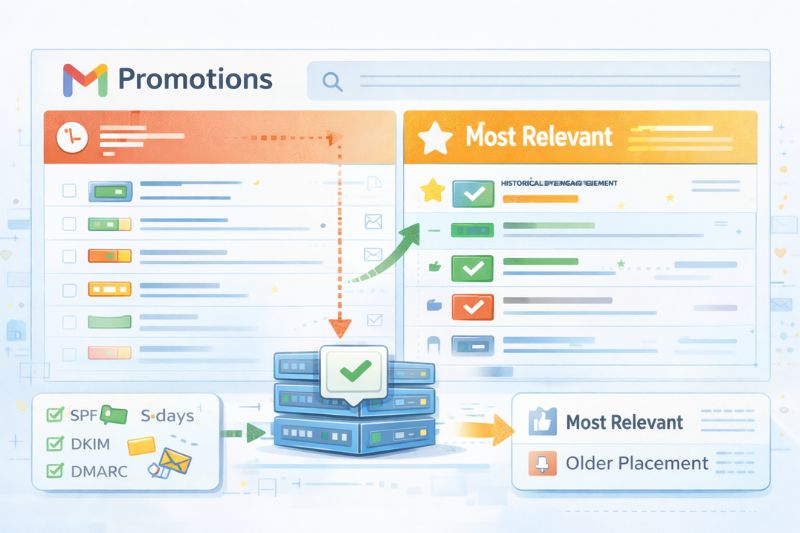
This one flew under the radar for a lot of senders when Google announced it in September 2025, but it’s here.
Google officially changed the Promotions tab from a chronological feed to a “Most Relevant” default sort. In practice, that means that your email no longer gets placement based on when it arrived, but based on how the recipient has historically engaged with you.
Movable Ink’s analysis found that 75–85% of Gmail users have kept relevance-based sorting turned on, and that “above the fold” placement is now delivering measurable gains in opens and retention for senders with good engagement history. The flip side is equally important: if a subscriber has been regularly ignoring your emails, your next one gets pushed down, regardless of how good the subject line is or when it landed.
There’s nothing in your dashboard that hints at a problem. Your delivery rate looks fine, but a growing portion of your audience is seeing your emails after the three or four brands they actually engage with, and by then, most have already moved on.
Microsoft’s SMTP deadline
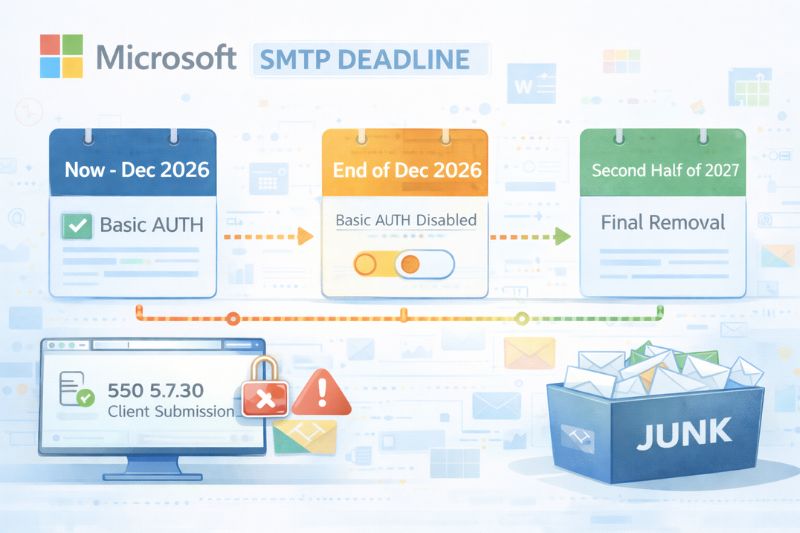
Microsoft updated its plans on January 27, 2026. The original March 1 phase-out / April 30 full cutoff was pushed back (again) due to customer pushback. The revised timeline:
- Now through the end of December 2026: no change, Basic Auth continues working
- End of December 2026: disabled by default for existing tenants (admins can re-enable)
- Second half of 2027: final removal date to be announced
So if you were bracing for March 1 failures, that pressure has eased for now. The direction is unambiguous, though: Basic Authentication is going away, and everyone running legacy systems that send email via stored username/password credentials needs a migration plan before the end of 2026. The error you’ll eventually see if you miss that window is 550 5.7.30 Basic authentication is not supported for Client Submission.
But one thing hasn’t changed, and that’s Microsoft’s bulk sender enforcement. High-volume mailers that fail authentication checks or exceed complaint thresholds go directly to Junk. That deadline was not extended.
Engagement changes: what ISPs are measuring now
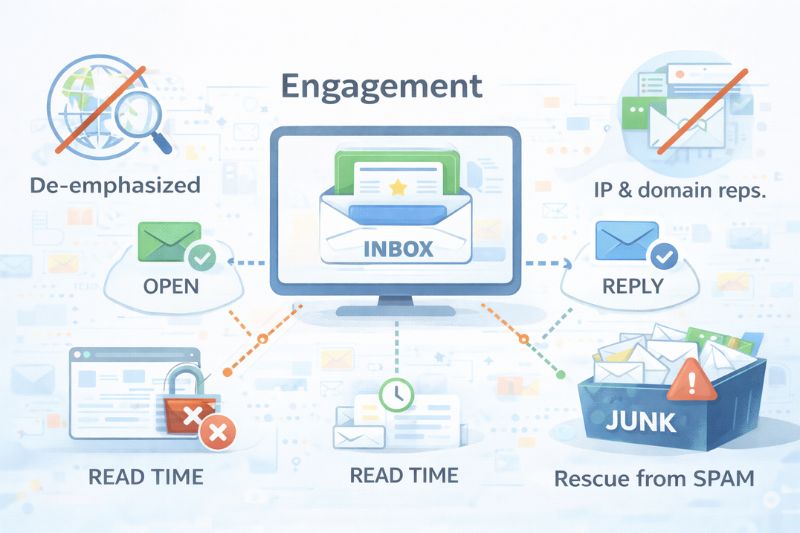
Here’s the thread that runs through everything above.
ExpertSender, which works directly with ISPs in multiple regions, made something explicit in their 2026 analysis that the industry has been dancing around for a while: IP and domain reputation are being de-emphasized as user engagement is taking over as the dominant factor in inbox placement decisions.
That’s a structural change, not a trend to monitor. The old model rewarded good infrastructure. The new one rewards relationships with actual recipients.
What counts as engagement? Opens are still there, though Apple’s Mail Privacy Protection has made them unreliable as a standalone signal since 2021. Mailbox providers are increasingly leaning on replies, click depth, time spent reading, whether a recipient moves your email to a folder, and most powerfully, whether they pull it out of spam manually.
That last one is especially important. When a recipient drags an email from spam back to the inbox, that’s one of the most positive signals that exists. It’s a deliberate, manual action that tells mailbox providers: you made a mistake, I want this. Providers treat it accordingly.
On the other hand, emails that get delivered and immediately deleted without being opened register as a soft negative. Enough of those can kill the same reputation that good authentication built. It happens slowly enough that you don’t notice until it becomes a real problem.
Why your list size might be working against you
Braze’s 2026 deliverability team pointed out a pattern this month that deserves more attention.
A big chunk of email programs are targeting based on proxy signals like last purchase date, signup date, and last website visit, rather than actual email behavior. This results in imprecise targeting, poor engagement, and a slow, compounding reputation problem that shows up as a channel that gradually gets harder to reach.
There’s data to back that up. According to Kickbox research cited by Braze, only 23.6% of businesses verify their email lists before every campaign. And roughly 9% of emails collected through web forms are invalid, meaning nearly one in ten leads could be fake or undeliverable before the first message goes out. A large list with poor engagement is, at this point, a liability.
From “delivered” to “seen”
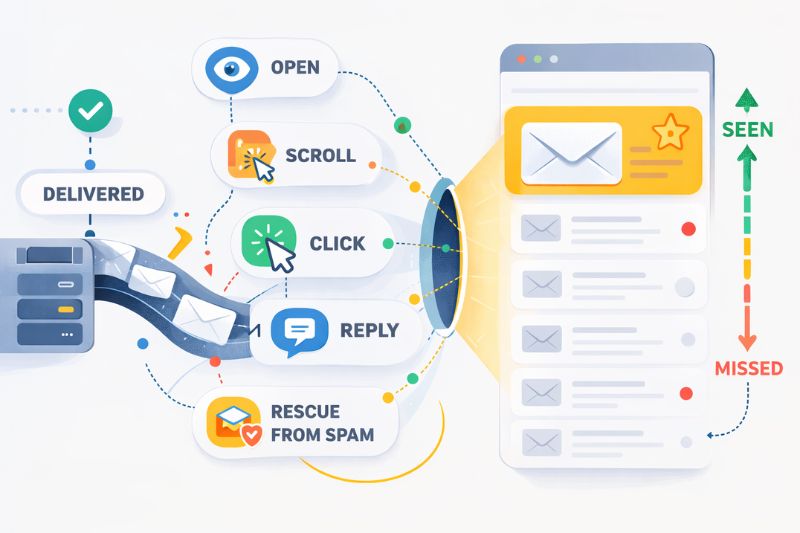
The more pressing question in 2026 is what happens after your email gets delivered because the inbox is now a ranked, behavioral feed, and engagement is what determines your position in it.
This is why InboxAlly is one of the quickest paths to great inbox placement in 2026.
By using seed accounts that open, scroll, click, reply, and rescue emails from spam, InboxAlly maps directly to the engagement signals providers use to make placement decisions. It’s not a substitute for good list hygiene and good content, but it is something that helps sender reputation while the rest of your program catches up.
If replies, scroll depth, and pulling mail out of spam are the strongest signals, you don’t fix this with another subject line brainstorm. Book a free demo and see how InboxAlly generates those exact actions so providers relearn your mail as wanted, not tolerated.