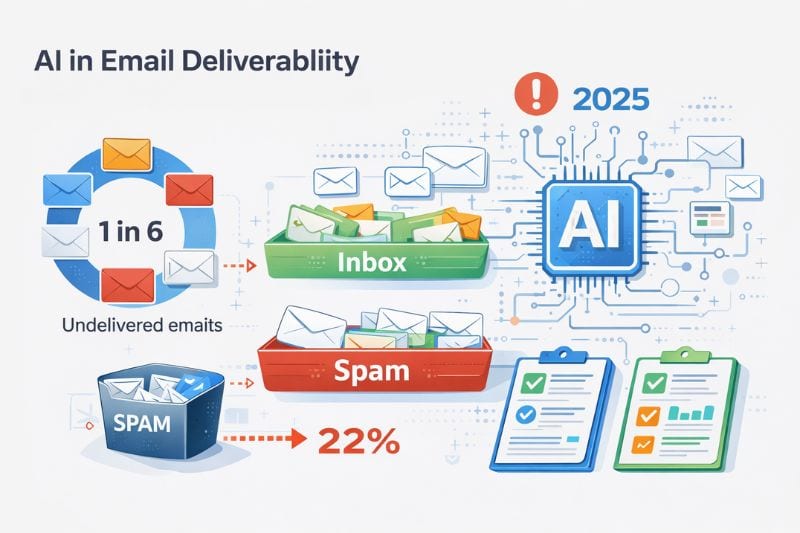
One in six marketing emails never reaches the inbox. That’s the global average in 2025, according to Validity’s Deliverability Benchmark report. And for high-volume senders, it’s even worse. Inbox placement for large-scale senders dropped over 22% in Q1 2025 compared to the year prior.
Email filtering that decides your email’s fate used to be straightforward. Avoid spam trigger words, don’t send from a shady IP, keep bounce rates low, and you’ll be just fine. Those rules still apply, but they’re no longer the whole problem. AI has raised the bar considerably, and on two fronts that most marketers haven’t fully reckoned with yet.
The first is the filtering that inbox providers have built. It’s smarter, faster, and far less forgiving than anything that came before. The second is the set of tools now available to senders. These are the tools that can dramatically improve inbox placement when used correctly.
Both deserve a closer look.
Key Takeaways
- Gmail’s artificial intelligence deprioritizes up to 40% of emails that technically reach the inbox. Delivered and read emails are two different things now.
- Authentication (SPF, DKIM, DMARC), clean lists, and genuine engagement are the foundation. AI tools help optimize campaigns on top of that, but they don’t fix bad fundamentals.
- Content quality is deeply connected to engagement. Vague openings and buried CTAs get deprioritized by Gmail’s semantic filtering and can trigger spam filters before a human ever reads them.
Inbox providers are using AI against you (and that’s actually fine)
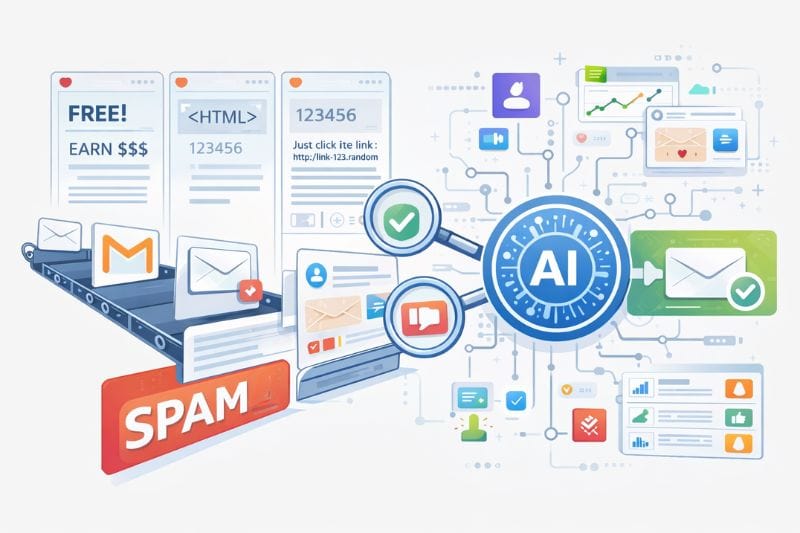
Spam filtering used to work on pattern matching, where they flag words like “free”, all-caps subject lines, suspicious HTML, etc. Spammers figured that out quickly, and the arms race began.
Then machine learning arrived. Filters stopped going in line with patterns and started learning from them, trained on massive datasets of emails, learning to recognize what humans wouldn’t: sender behavior over time, content structure, historical engagement, and user feedback loops. And so, the keyword era was over.
Today’s AI-powered filters go even further by looking at the tone and intent of an email and checking whether links and landing pages look trustworthy. They analyze real-time interactions, which include not just opens, but scroll depth, deletion without reading, replies, and more. And because these systems update constantly, they respond to behaviour changes almost instantly.
Gmail now holds nearly half of all consumer mailboxes globally, and its inbox placement rate dropped almost five percent between early and late 2024, according to Validity. Microsoft’s Outlook hovers around 75.6% inbox placement with spam rates exceeding 14%, which is the highest among major providers. The filters are getting stricter across the board, and AI is the reason.
But at the end of the day, these systems are just trying to show people emails they actually want to read. Senders who earn that trust get better placement, while those who blast unengaged lists with irrelevant email content get penalized because the data says they should be. Fair? Yes, kind of.
The Gmail changes nobody saw coming
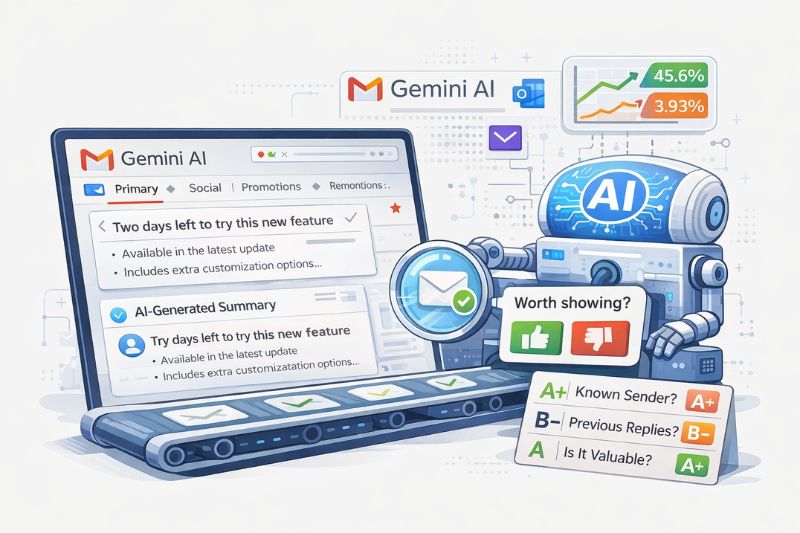
In early 2026, Google launched Gemini AI for Gmail. It now summarizes email threads, prioritizes messages it thinks are important, and evaluates every incoming email for relevance before a human ever sees it.
Many industry-leading platforms that track millions of emails daily call it the biggest change in email deliverability since the introduction of tabs in 2013. Getting past the spam filter is no longer enough. Gmail now asks a second question: Is this email worth showing to this person?
The data-driven insights from what happened are striking. After AI-generated summaries launched, open rates went up to 45.6%, but click-through rates dropped from 4.35% to 3.93%, according to Omeda’s analysis of billions of emails. Users are reading AI-generated snippets and getting enough information without clicking through to the full email.
What Gmail’s AI evaluates now mostly comes down to whether you’ve emailed this person before, whether they’ve replied, whether people like them engage with your emails, and whether your content is valuable in the first few lines.
So, as a practical implication, put your main point in the first sentence and make the value obvious before anything else, because the difference between well-structured and poorly-structured emails has gotten wider.
Gmail can put you “in the primary inbox” and still bury you. InboxAlly fixes that with positive engagement signals (opens, scrolls, replies, moves out of Promotions/Spam) so providers relearn where you belong. Try it for free.
Your landing pages are now part of deliverability
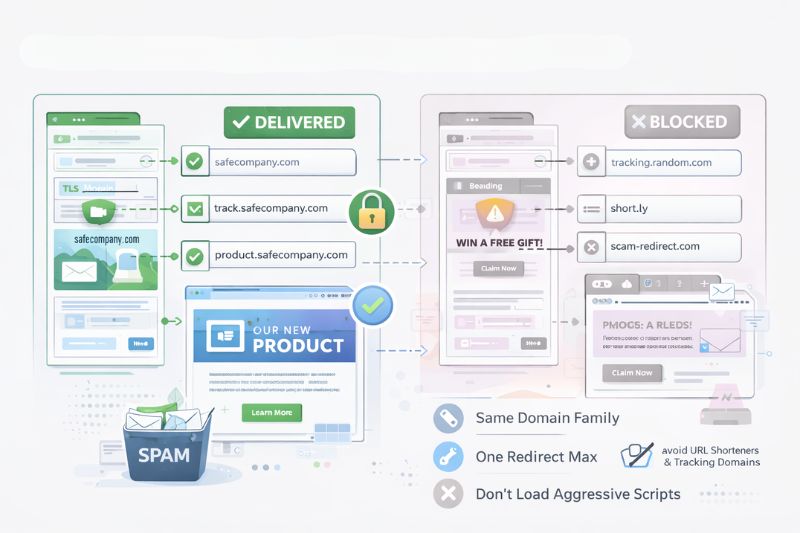
Deliverability filters also evaluate where your links lead. The email gets scored the same way as the click path, regardless of how convincing the copy is.
AI-generated phishing got good enough that providers had to train models on destination risk. The problem for legitimate senders is that modern marketing stacks can look a lot like scam stacks, since they also rely on tracking domains, redirect layers, and third-party scripts when necessary.
Mailbox providers look at whether your from-domain, link domain, and landing domain are consistent, but also at redirect behavior: how many hops, and whether the final destination was hidden. They also evaluate your landing page and look for things like TLS quality, mixed content, scripts, bare pages with no brand context, or CTAs that don’t match what the email promised.
So before your next email campaign, run through this quickly:
- Make sure every link stays within one consistent domain family
- Use one redirect at most
- Avoid URL shorteners and obscure tracking domains
- Don’t load aggressive scripts on email landing pages
- Put above-the-fold context on the page (who you are, what this is, why it’s real)
- Make sure the email headline matches the landing page headline
Most of the time, people debug inbox placement like it’s an email-only problem. But if your destination looks untrustworthy, the inbox treats you pretty much the same as a spammer.
The “other side” of AI-powered email marketing
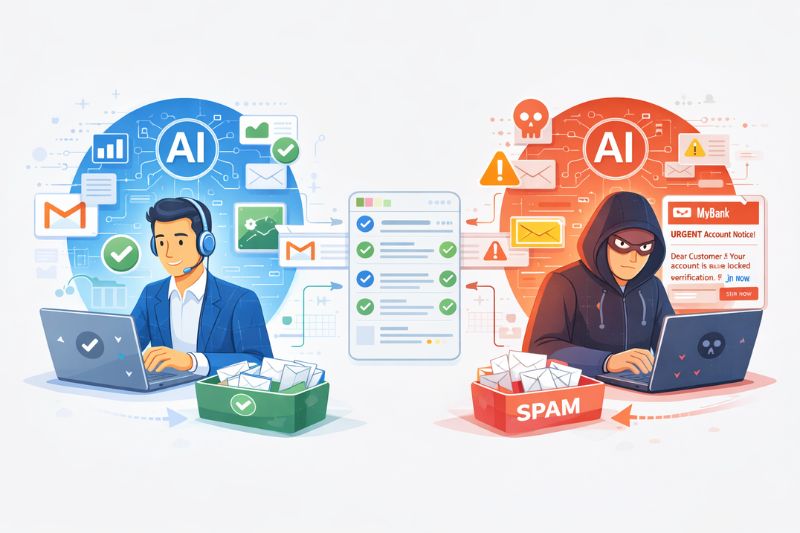
Scammers use AI, too.
You probably remember how phishing emails used to be obvious with broken grammar and generic salutations, so much so that you wondered, “How does anybody fall for this?” But much like AI videos, scammers can pull off imitating credible brands with unnerving accuracy. What AI made this possible at scale is for scammers to use the correct tone, personalized details, and all other traits as regular senders.
Mailbox providers have responded by doubling down on filtering across the board. The scrutiny that catches sophisticated phishing attempts is the same scrutiny legitimate marketers have to live with. That’s why “evergreen” templates that worked great for years are underperforming as senders who haven’t updated their approach are feeling the pressure without understanding why.
This might feel unfair, but it’s an outcome we could have expected of landscape that changed so drastically. The bar for what counts as a trustworthy sender has risen, and it’s not coming back down.
What’s in it for email marketers?
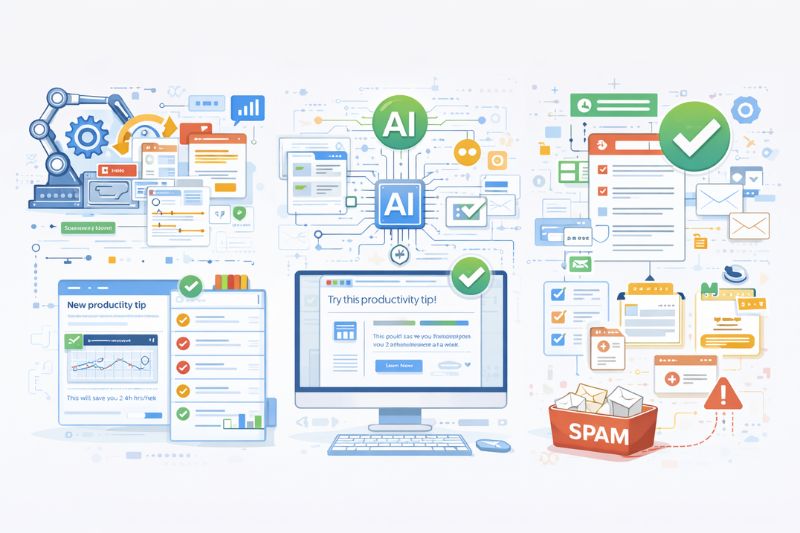
AI isn’t only something inbox providers use to filter you out. On the sender side, it’s most useful as automation for consistency and pattern detection; the two things that cause huge deliverability issues when humans are (wrongly) managing email at scale.
Pattern detection to prevent damage
Humans miss engagement drops all the time and usually notice right when the engagement metrics are bad enough to poke the eye. AI can change that by warning about:
- Slow engagement declines.
- Provider-specific issues like bounce clusters and spam complaint spikes.
- Which segments or templates are starting to negatively impact an otherwise good sender reputation.
Faster iteration on what helps engagement
The variables that control whether someone opens and clicks boil down to compelling subject lines, preview text, the first two lines, and the CTA placement. AI can generate and test variations for all of these faster than any manual process. More usefully, it can pressure-test an email before it goes out:
- What does this email mean in two lines?
- Is the opening vague?
- Are there competing CTAs pulling in different directions?
It’s always cheaper to catch those problems before sending than to diagnose them from open rate data afterward.
List hygiene without a set schedule
Scheduled list cleaning works, but predictive list hygiene works better. AI identifies contacts showing early signs of loss of interest and triggers re-engagement while there’s still something to save.
Beyond that:
- Contacts who don’t respond get auto-sunsetted before they become a liability.
- Suspicious signups (bot-like patterns, typo domains, disposable addresses) can be filtered at entry before they cause damage.
Warmup and sending
Human-managed warmup schedules are clunky and unreliable at best. AI-managed warmup is a different story. Volume adjusts based on what’s actually happening today result in a far better and sustainable domain reputation building and fewer self-inflicted spam trap hits from sudden volume spikes.
Big launch coming up? Don’t gamble it on hope and SPF screenshots. InboxAlly can “prime the pump” before the campaign by building a reputable sending history, so your campaign doesn’t land in Promotions or spam by default. Book a demo and see how it works in your setup.
Where it’s all headed
Email has survived every major change in how people communicate online. It’ll survive this one too. But if you want to thrive on the other side, you need to adapt early. That means better content, better landing pages, and a real understanding of how AI is evaluating every email.
The bar keeps rising, and that’s not a bad thing. It just means the difference between senders who take this seriously and those who don’t will keep widening.