
Here’s a number that should bother every email marketer: when someone clicks “Report Spam” on an email, there’s about a 75% chance the message they’re flagging isn’t spam at all.
Microsoft found that three out of four emails users reported as spam were stuff people had subscribed to but don’t remember doing so. That’s what we now call “greymail.” Your emails aren’t being flagged because they’re malicious, but because they became irrelevant. And that irrelevance, it turns out, creates serious damage whether or not a single person ever opens them.
Key Takeaways
- Graymail isn’t dangerous, but email providers have started treating it almost the same as spam, which means it can still hurt your deliverability.
- Sending better emails to unengaged contacts won’t solve this. The best solution is to stop emailing them altogether and build systems that keep graymail from accumulating
How does graymail work, and why does it sound harmless
Graymail is in the awkward middle ground between email you want and email you never asked for. It’s that newsletter from a product trial you’ve ignored for four months, or the weekly promo from a store where you made a single purchase last December. You technically gave permission, but your interest didn’t stick. That’s graymail.
The distinction between unwanted and unsolicited email is the whole ballgame here. Spam never had consent to begin with. Graymail did once. And that “once” is what makes it so tricky, because technically these emails are legitimate even as they pile up unread. According to research cited on Wikipedia, graymail can account for up to 82% of the average user’s inbox. Abnormal AI pegged it at around 23 graymail messages per employee, per week. That’s an enormous volume of email going out to people who will never read it.
Email providers like Gmail, Outlook, and Yahoo have moved well beyond content-based filtering and are now using advanced filtering based on engagement, which is another thing that stops graymail from being just a harmless nuisance.
The difference between graymail and spam emails
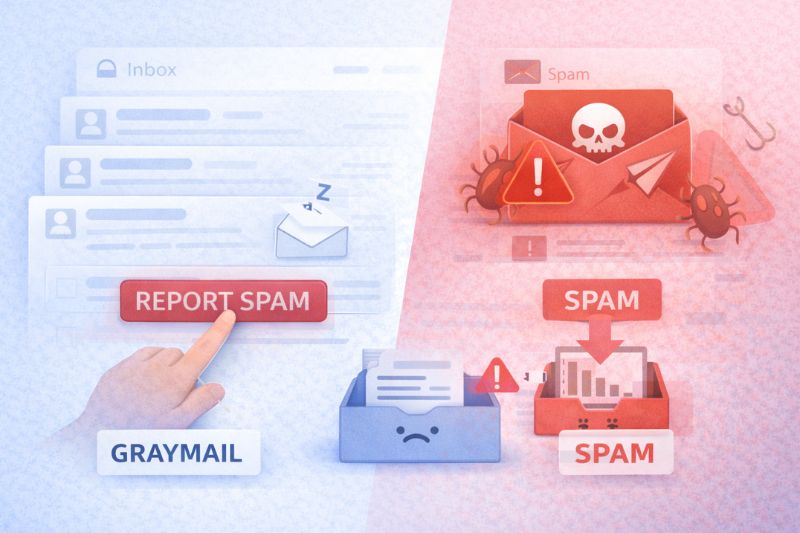
Spam is the easy one to understand. Someone sends a message you never asked for, usually pushing something shady or trying to trick you into clicking a malicious link. Luckily, ISPs have gotten remarkably good at catching it before it ever reaches a primary inbox.
Unlike spam, graymail is harder to deal with because, on paper, everything looks fine, because the content is harmless, and the recipient did subscribe at some point. However, all email providers see is an address that keeps receiving messages and keeps ignoring them, which tells its own story.
Where these two collide is in how people respond. Nobody carefully distinguishes between “I never signed up for this” and “I’m just sick of getting it.” They go for the spam button either way. That chips away at your sender score each time, and the complaint looks identical regardless of whether the person technically opted in.
Weirdly, this makes graymail more dangerous to senders than actual spam. Most spam gets intercepted by spam filters before it can damage your reputation. Graymail flies under the radar for months, hurting deliverability while you’re focused on open rates from the slice of your list that’s still responsive.
How email providers handle graymail using engagement
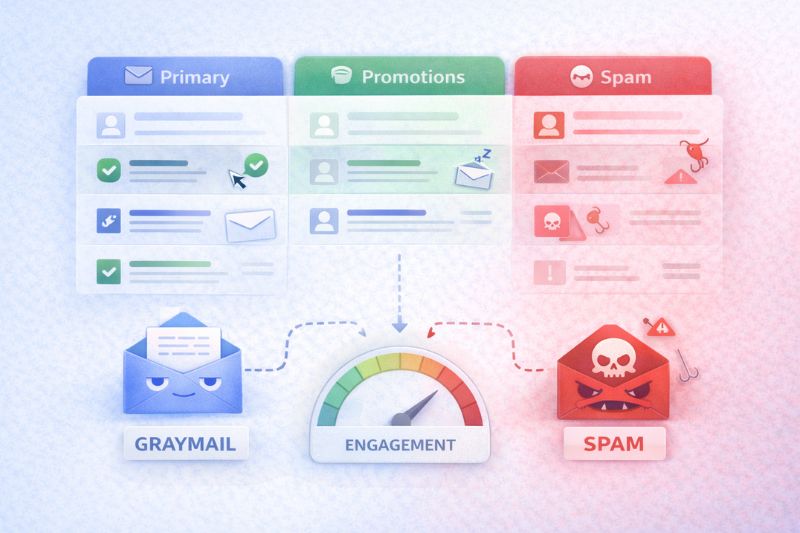
Remember that engagement-based filtering mentioned earlier? This is where most marketers massively underestimate what’s happening.
Gmail tracks how each individual user interacts with your emails. Not your brand in general, but your specific messages to that specific person. Opens and clicks keep you in the Primary tab, but extended silence pushes you to the spam folder regardless of the fact that the person signed up with a real address through a real form. If the recipients stop engaging, Gmail treats you accordingly.
Google overhauled its bulk mail sender rules in 2024 and kept getting more strict through 2025, with proper authentication, one-click unsubscribe, and spam complaint rates under 0.1%. Outlook has been doing engagement-based sorting for years already. Apple launched tabbed inboxes in 2024. The engagement evaluation scales across all major ISPs.
None of this would be a crisis if the impact stayed limited to unengaged contacts. But it doesn’t. When a large enough slice of your list goes cold, your sender reputation takes the damage across the board. That means even the subscribers who open every email, click every link, and buy from you can start seeing your messages filtered into promotions or spam. The unengaged portion of your list is actively dragging down the experience for the engaged portion, and most of the time, you have no idea it’s happening.
If graymail has already dragged your campaign performance down, bring in InboxAlly to restore sender reputation and make sure the subscribers who do care still see what you send.
Possible security threats
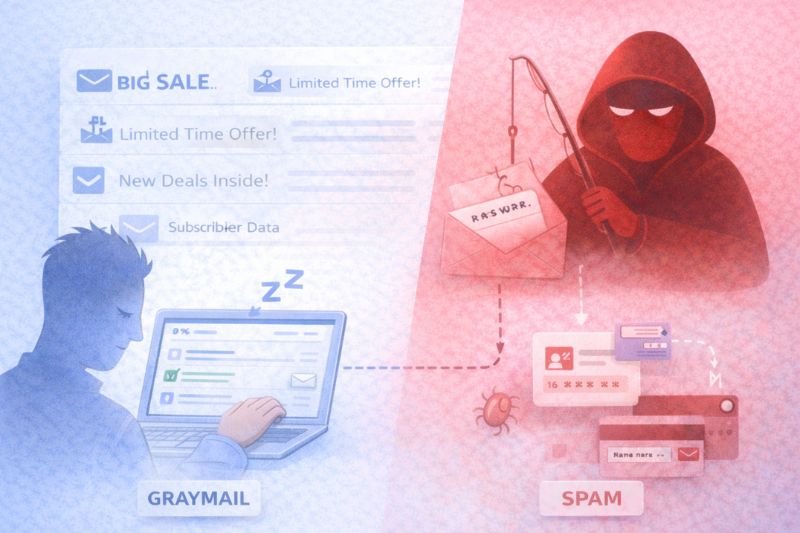
An inbox crammed with unwanted emails that never get read does something subtle over time: it trains the person to stop paying attention. One more subject line, one more brand, one more deal that makes everything look the same.
Phishing attackers know this. A well-crafted phishing email that looks like a routine promotional message has a much easier time getting clicked when the recipient has spent weeks glazing over similar-looking content without a second thought.
From an enterprise standpoint, this is an ever-growing risk. A company that sends large volumes of graymail also stores subscriber data like valid email addresses, engagement history, purchase behavior, and even passwords and credit card info. If those systems get compromised, attackers inherit a trusted sender relationship along with all the context they need to build convincing phishing campaigns.
You might think that marketing emails don’t fall into this category, but contributing to inbox clutter that makes phishing easier to pull off is still contributing. Good (and safe) sending practices keep the entire email channel easier to trust.
How to stop sending graymail
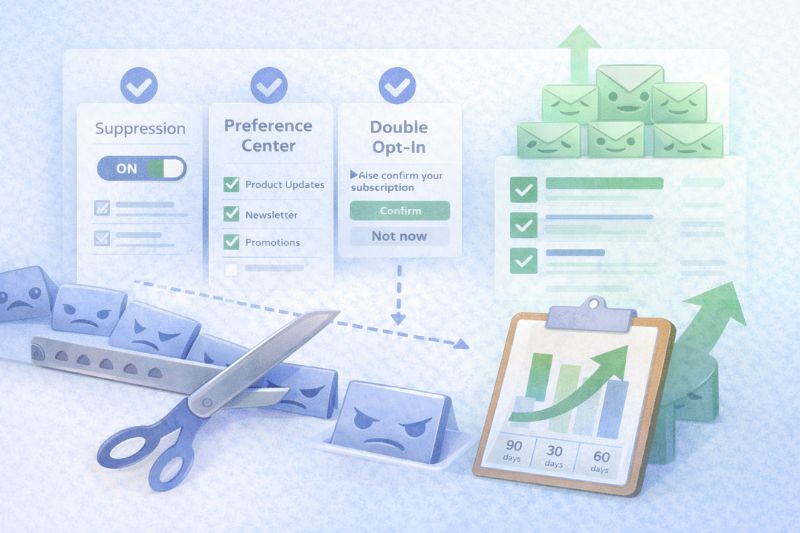
Most graymail advice out there focuses on the recipient: unsubscribe from lists, set up filters, report junk. Fine for managing a personal inbox, but for marketers, the responsibility looks completely different. Here’s what to do if you’re on the sending side:
- Turn on graymail suppression – HubSpot has a built-in version that automatically holds back emails from contacts who haven’t engaged with your last 11 to 16 sends, depending on their history. Klaviyo offers sunset flows and suppression segments for building the same thing manually. The principle is more important than the platform: stop mailing people who stopped caring.
- Build a re-engagement sequence before cutting anyone loose – A short series (two or three emails) gives dormant contacts enough of a reason to come back. If nothing happens after that, move them off the active list.
- Use double opt-in at signup – The contacts who confirm their subscription are contacts who genuinely want to hear from you, at least right now. That’s a much better foundation than a bloated list full of impulse signups who vanish after a week.
- Offer a preference center – Let people choose what they receive and how often. Someone who signed up for product updates shouldn’t automatically get three promotional emails a week. Control over the relationship keeps subscribers engaged longer and complaining less.
- Regularly review engagement decay – Overall open rate can look perfectly healthy while a growing segment of the list quietly disengages underneath. Build segments by recency — 30 days, 60, 90, 180 — and watch how each group trends. That’s where graymail reveals itself before it snowballs into a deliverability crisis.
A big list isn’t the same as a good one
There’s a persistent instinct in email marketing to make the list ever so bigger. After all, more subscribers lead to more reach and more potential revenue, at least on paper. But, as we’ve demonstrated throughout this article, a list stuffed with unengaged contacts more often works against you.
To keep your place in the inbox, you need to be willing to remove dead contacts and treat engagement like the leading indicator it really is. If your inbox placement is already declining or spam complaints tick upward, sign up for InboxAlly and rebuild the engagement signals that providers measure when deciding where emails end up.
Graymail isn’t some obscure technical category. It’s what happens, slowly, every time emails keep going out to people who moved on a long time ago. The cost is your sender reputation, your deliverability, and eventually your bottom line, whether you’re ready for it or not.